Req 2b — Reducing Pack Weight
Every ounce in your pack adds up over the miles. Experienced backpackers have a saying: “Ounces equal pounds, and pounds equal pain.” The good news is that you can dramatically reduce your pack weight through smart choices — without leaving behind anything you truly need.
Understanding Pack Weight
Before we talk about cutting weight, let’s define some terms:
- Base weight — the weight of your pack with all gear but without food, water, or fuel. This is the number most backpackers focus on because it stays constant regardless of trip length.
- Total pack weight (skin-out weight) — everything, including food, water, fuel, and the clothes you are wearing.
A typical beginner’s base weight might be 25–35 pounds. An experienced backpacker aims for 15–20 pounds. Ultralight hikers push below 10 pounds. You do not need to go ultralight, but trimming even a few pounds makes a real difference on a long trek.
Ten Ways to Go Lighter
Here are ten proven strategies for reducing pack weight and bulk. The key rule: never cut weight in a way that puts your health or safety at risk.
1. Repackage food and toiletries. Ditch the original packaging. Transfer trail mix into lightweight zip-lock bags. Squeeze sunscreen into a small travel bottle. Remove cereal from the box and bag it. You will be amazed how much weight and bulk comes from packaging alone.
2. Choose multi-use items. A bandana can be a pot holder, a headband, a washcloth, a water pre-filter, and a sling. A rain jacket can double as a wind layer. Trekking poles can serve as tent poles for certain ultralight shelters. Every item that does two jobs means one less item in your pack.
3. Carry only the clothing you need. Lay out everything you plan to wear, then put half of it back. You do not need a fresh outfit for every day. One set of hiking clothes, one set of camp/sleep clothes, rain gear, and an insulating layer is usually enough for any trek.
4. Share crew gear. A crew of four does not need four stoves, four water filters, or four first-aid kits. Divide shared items — stove, fuel, cook pot, trowel, water filter, repair kit — among the crew so nobody carries everything alone.
5. Leave luxury items behind. That thick paperback novel, the camp pillow, the heavy binoculars — ask yourself honestly whether you will use each item enough to justify its weight. If not, leave it in the car. Your inflatable pillow can be replaced by stuffing a soft jacket into a stuff sack.
6. Upgrade your heaviest items first. The “Big Three” — your pack, shelter, and sleeping bag — make up the majority of your base weight. Replacing a 6-pound tent with a 3-pound tent saves more weight than swapping out every small item in your kit combined.
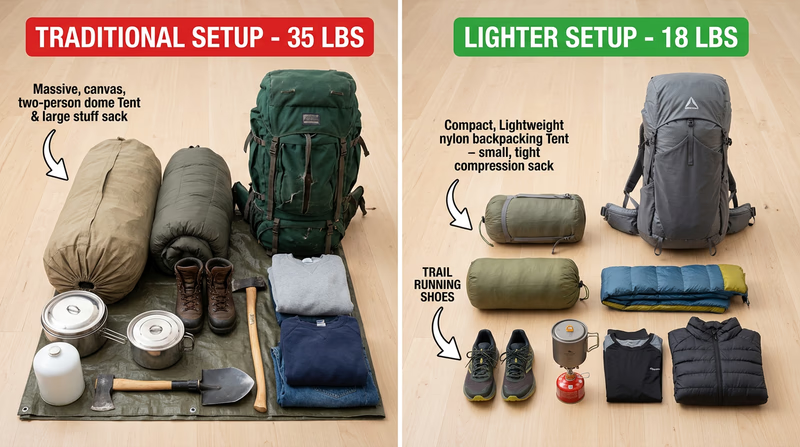
7. Use a smaller pack. A 70-liter pack weighs more than a 50-liter pack. More importantly, a bigger pack tempts you to fill it with things you do not need. Choose a pack that fits your gear — not one that has room for “just in case” extras.
8. Plan your meals carefully. Freeze-dried meals, instant oatmeal, and trail mix have high calorie-to-weight ratios. Avoid canned food (too heavy) and fresh produce that spoils quickly. Calculate exactly how much food you need — bringing three days of extra food “just in case” adds pounds you do not need to carry.
9. Carry only the water you need between sources. If you know you will pass a reliable water source every hour, there is no reason to carry three liters. Study your map, identify water sources along your route, and carry just enough to get to the next one — plus a reasonable safety margin.
10. Weigh your gear before you go. Use a kitchen scale to weigh every single item. Write the weights down. You will quickly spot the heavy outliers — the 12-ounce camp mug, the 2-pound stuff sack full of “just in case” items. What gets measured gets managed.
The Line Between Light and Unsafe
There is a difference between going lighter and going reckless. Never cut these corners:
- Do not skip the first-aid kit
- Do not leave behind rain gear or insulation
- Do not go without a map and compass
- Do not carry less water than you need between reliable sources
- Do not skip sun protection
Going light is about being smarter, not less prepared. The goal is efficiency — carrying exactly what you need and nothing more.