Req 3 — Crew Organization & Safety
This requirement covers four topics about organizing and leading a safe backpacking crew:
- Crew size — how many people should be in your group
- Crew organization — roles and responsibilities
- Risk management — minimizing danger on the trail
- Emergency planning — what to do when things go wrong
3a. Trek Crew Size
The size of your crew affects everything — safety, environmental impact, group dynamics, and logistics. Too few people and you lack support in an emergency. Too many and you damage the trail, overwhelm campsites, and move at the pace of your slowest member.
Recommended crew size: 4 to 10 people.
- Minimum of 4: If one person gets injured, one person stays with them while two go for help. With fewer than four, this buddy-system approach breaks down.
- Maximum of 8–10: Larger groups are harder to manage, move more slowly, and have a bigger impact on campsites and trails. Many wilderness areas have permit limits of 8–12 people per group.
For Scouting activities, BSA policy requires a minimum of four people (two of whom must be adults) for any backcountry trek. Your crew should be large enough to handle emergencies but small enough to travel efficiently and minimize your footprint.
3b. Crew Organization
A well-organized crew runs like a team where everyone has a job. Here are the key roles:
- Crew Leader — sets the pace, makes route decisions, and coordinates the group. This person should have the most backcountry experience.
- Navigator — carries the map and compass, tracks the group’s position, and calls out trail junctions. This is a great learning role for Scouts building navigation skills.
- Sweep (Tail) — hikes at the back of the group to make sure nobody falls behind. The sweep should be a strong, experienced hiker.
- First Aider — carries the crew first-aid kit and takes the lead on treating injuries. Ideally, this person has Wilderness First Aid training.
- Cook/Quartermaster — plans meals, manages the food supply, and oversees cooking. This person ensures food is stored properly (bear canisters or hang bags) each night.
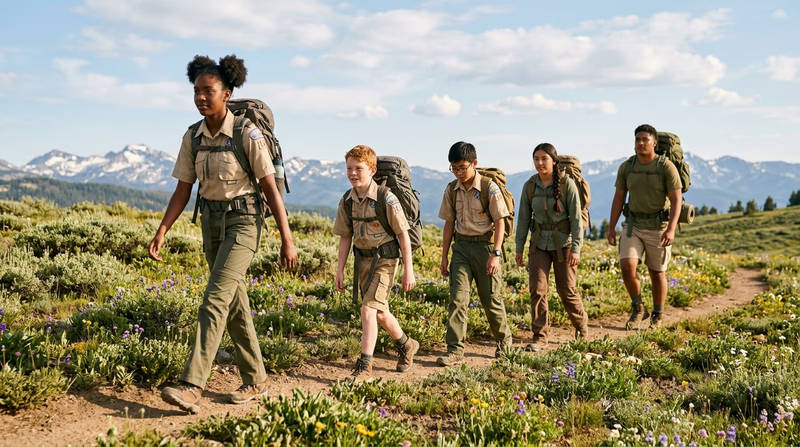
Not every trek needs all of these as separate people. On a small crew, one person might be both the navigator and the first aider. The important thing is that every responsibility is covered and everyone knows their role before the trek begins.
3c. Minimizing Risk
Risk management is about thinking ahead. You cannot eliminate all risk in the backcountry — that is part of the adventure — but you can reduce it dramatically with good planning.
Risk Reduction Strategies
Steps to take before and during every trek
- File a detailed trip plan with a responsible adult who is not going on the trek.
- Check weather forecasts for the entire duration of your trek and have a plan for severe weather.
- Ensure every crew member has the fitness level and experience for the planned route.
- Inspect all gear before departure — test stoves, check tent poles, verify first-aid supplies.
- Carry appropriate emergency communication (whistle, signal mirror, or satellite communicator in remote areas).
- Establish a turn-around time — a point by which you will head back regardless of progress.
- Stay together on the trail. Never let anyone hike alone.
- Brief the entire crew on the route, potential hazards, and emergency procedures before starting.
3d. Emergency Response Plan
An emergency response plan is a written document that your crew creates before the trek. It answers one critical question: “If something goes wrong, what do we do?”
A good emergency response plan includes:
- Emergency contacts — phone numbers for local ranger stations, search and rescue, and each crew member’s family
- Nearest evacuation routes — the fastest way out from each section of your route (this may change as you move along the trail)
- Communication plan — how you will call for help (cell coverage, satellite communicator, emergency whistle signals)
- Medical information — allergies, medications, and medical conditions for every crew member
- Roles in an emergency — who calls for help, who administers first aid, who stays with the patient
The plan should be printed and carried by at least two crew members. Review it together before the trek begins so everyone knows the plan and there is no confusion under stress.