Extended Learning
A. Introduction
You have completed the requirements for the Basketry merit badge — congratulations! You have learned to identify basket types, describe weaving techniques, and weave three projects with your own hands. But basketry is a craft with endless depth, and there is so much more to explore beyond these basics.
B. Deep Dive: Natural Materials and Foraging
The reed you used for your merit badge projects was commercially prepared — cut, dried, and ready to soak. But traditional basket makers around the world gather their own materials directly from the land. Learning to identify and harvest natural materials opens up an entirely new dimension of the craft.
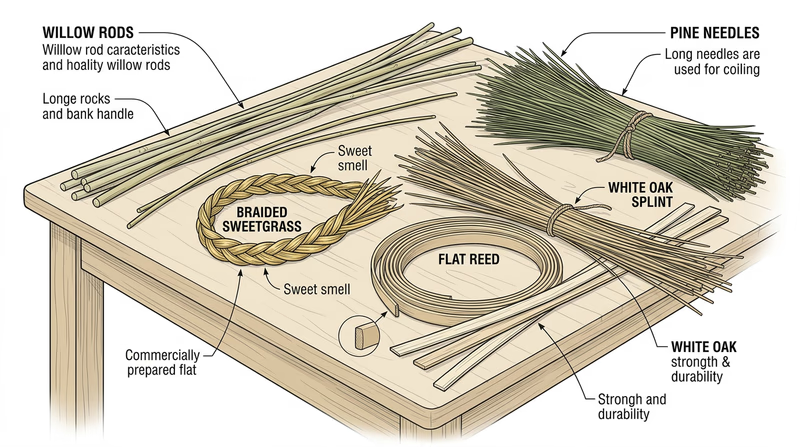
Willow is the classic European basket-making material. Basket willows are grown specifically for weaving — they are coppiced (cut back to the base) each winter, and the long, straight shoots that grow the following year are harvested in fall. Fresh willow must be dried and then re-soaked before weaving, but it produces baskets with a beautiful, organic feel that commercial reed cannot match.
White oak splint is a traditional material in Appalachian basketry. A freshly felled white oak log is pounded with a mallet until the growth rings separate into thin, flexible strips. This process, called “riving,” requires considerable strength and skill, but the resulting splints are incredibly strong and durable.
Sweetgrass, pine needles, and raffia are commonly used in coiled baskets. Sweetgrass (Hierochloe odorata) is especially prized by Native American weavers — it has a pleasant vanilla-like fragrance that lasts for years. Pine needles are abundant, free, and surprisingly strong when bundled and stitched into coils.
Birch bark has been used for centuries by Indigenous peoples of the northern forests to create lightweight, waterproof containers. Bark is carefully peeled from living trees (without harming the tree), and then folded and stitched into baskets, canoes, and storage vessels.
C. Deep Dive: Basketry Traditions Around the World
Basketry is a universal craft — every culture on Earth has its own basket-making traditions. Understanding these traditions deepens your appreciation for what you are doing and connects your work to a global community of makers.
Gullah-Geechee sweetgrass baskets (Southeast United States) are coiled baskets made from sweetgrass, bulrush, and palmetto, sewn with strips of palm leaf. This tradition was brought to the Carolina Lowcountry by enslaved West Africans and has been passed down through families for over 300 years. Today, Gullah basket makers sell their work in the historic Charleston City Market and at roadside stands along Highway 17 in South Carolina. In 2023, Gullah sweetgrass basket making was recognized on the UNESCO Representative List of the Intangible Cultural Heritage of Humanity.
Japanese bamboo basketry (called take zaiku or chikugei) produces incredibly refined, sculptural works using thin bamboo strips. Japanese basket makers train for years to master the intricate plaiting and twisting techniques required. Some bamboo baskets are designated as Important Cultural Properties and are displayed in museums alongside paintings and ceramics.
Navajo wedding baskets are ceremonial coiled baskets with specific symbolic designs. The red-and-black pattern represents mountains, clouds, and the journey of life. These baskets are used in traditional Navajo ceremonies and are always woven with an intentional gap in the rim design called a “spirit line.”
English willow baskets have been woven in Somerset, England, for centuries. The Somerset Levels — flat, marshy lowlands — are ideal for growing basket willow, and the region remains the center of British willow basketry. Traditional forms include shopping baskets, lobster pots, and hampers.
D. Deep Dive: Advanced Techniques to Try
Once you have mastered the basics, here are some techniques that will push your skills further.
Twill patterns and color weaving. By using dyed reed in different colors and varying the over-under count, you can create intricate geometric patterns in your baskets — diamonds, arrows, spirals, and more. Start by planning your pattern on graph paper before you weave.
Continuous weave baskets. Instead of weaving row by row, some basket makers use a single continuous weaver that spirals up the basket without stopping. This creates a seamless, flowing surface and requires careful management of tension and material length.
Handles and lids. Adding a handle transforms a basket from a container into a carrying tool. Handles can be wrapped, braided, or carved from a single piece of wood. Lids add functionality — a lidded basket can store and protect its contents. Both require careful fitting and attachment.
Dyeing and finishing. Reed can be dyed with fabric dyes, natural plant dyes (walnut hulls, onion skins, berries), or commercial wood stains. Finished baskets can be sealed with a light coat of polyurethane or lacquer to increase durability and water resistance.
E. Real-World Experiences
Visit a Basketry Guild Workshop
Charleston Sweetgrass Basket Makers
Appalachian Craft Fairs
Smithsonian Folklife Festival
F. Organizations
A nonprofit dedicated to promoting and preserving the art and craft of basketry through education, exhibitions, and community.
A statewide organization that hosts workshops, retreats, and an annual convention for basket weavers of all skill levels.
A British organization promoting traditional and contemporary basketry, offering workshops and connecting weavers worldwide.
One of the largest basketry guilds in the U.S., offering an annual convention with classes taught by nationally known basket makers.
Documents and celebrates living cultural traditions including basketry through festivals, recordings, and educational programs.