Req 2 — Basket Types & Weaves
This requirement covers two topics that build your basketry knowledge:
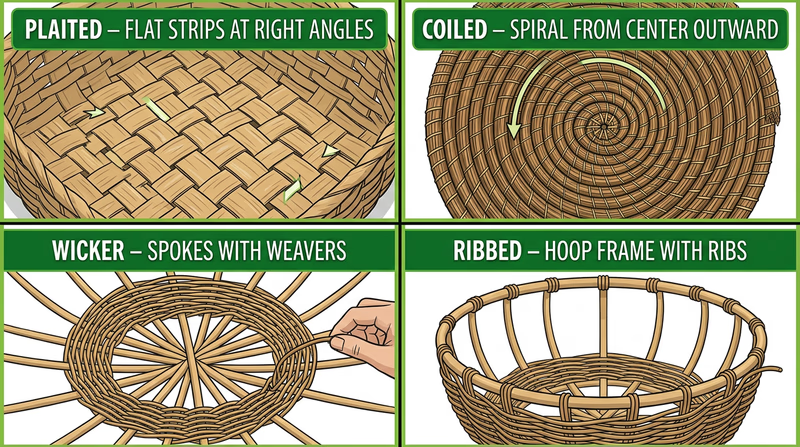
- Requirement 2a — Identify four types of baskets: plaited, coiled, ribbed, and wicker.
- Requirement 2b — Describe three different types of weaves.
Requirement 2a — Identifying Basket Types
You got a preview of these four basket types on the Introduction page. Now let’s go deeper so you can confidently identify each one when your counselor shows you examples.
Plaited Baskets
Plaited baskets are made by interlacing flat strips of material at right angles. The most basic version is a simple over-one, under-one pattern — exactly like weaving strips of paper in elementary school. More advanced plaiting uses twill patterns (over-two, under-two, or other variations) to create diagonal lines and geometric designs.
Key identification features:
- Flat, ribbon-like strips of material
- Grid-like structure with strips crossing at right angles
- Clean, geometric appearance
- Often made from flat reed, splint, birch bark, or palm leaves
Common uses: Market baskets, storage bins, mats, and trays.
Coiled Baskets
Coiled baskets are built by spiraling a bundle of material (the “core” or “foundation”) outward from a center point and stitching each new row to the previous one. The stitching material wraps around the core and attaches it to the row below, building up the walls of the basket one coil at a time.
Key identification features:
- Visible spiral pattern from center outward
- Stitching that wraps around and connects each coil
- Smooth, rounded forms
- Often made from sweetgrass, pine needles, raffia, or other flexible materials
Common uses: Decorative bowls, storage containers, and ceremonial objects.
Wicker Baskets
Wicker baskets use a framework of rigid spokes (also called “stakes” or “ribs”) with flexible weavers woven in and out around them. The spokes provide structure, while the weavers fill in the walls. Wicker is the most common basket style in Western traditions.
Key identification features:
- Rigid spokes radiating from the base
- Round, flexible weavers going over and under the spokes
- Three-dimensional, often cylindrical or rounded shape
- Typically made from willow, rattan, or round reed
Common uses: Laundry hampers, picnic baskets, furniture, garden planters.
Ribbed Baskets
Ribbed baskets start with a frame — usually two intersecting hoops that form the rim and handle. Flexible ribs (thin, curved sticks) are inserted along the frame, and then weavers are worked in and out of the ribs to fill in the basket’s walls. The result is a distinctive rounded, boat-like or melon-like shape.
Key identification features:
- Visible hoop frame at the rim and/or handle
- Curved ribs giving the basket its shape
- Weavers filling in between the ribs
- Rounded, three-dimensional form often wider in the middle
Common uses: Egg baskets, gathering baskets, wall decorations, and Appalachian-style baskets.
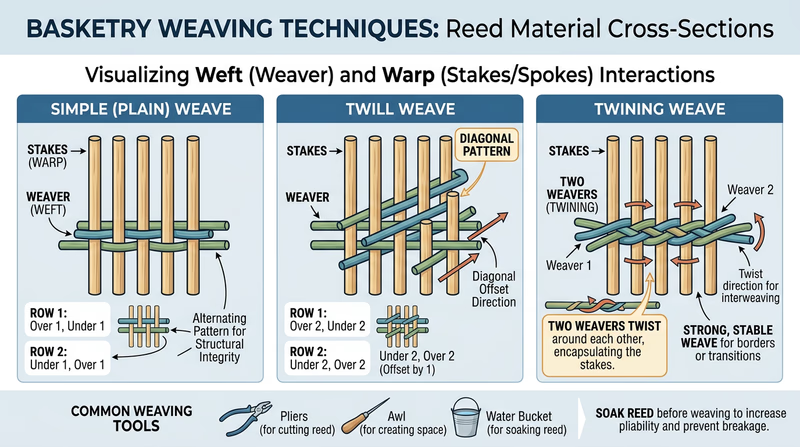
Requirement 2b — Types of Weaves
A “weave” is the specific pattern used to interlace the materials. Different weaves create different textures, strengths, and visual effects. Here are the most common weaves you should know:
Simple (Plain) Weave
The simplest and most fundamental weave pattern. The weaver goes over one spoke, under the next, over one, under one — alternating all the way around. On the next row, the pattern reverses so each spoke that was covered is now exposed.
- Look: Even, uniform surface
- Strength: Good for everyday baskets
- Best for: Beginners and most basic basket projects
- Requirement: Requires an odd number of spokes so the pattern alternates correctly on each row
Twill Weave
A variation of plain weave where the weaver passes over two (or more) spokes and under two (or more). By shifting the pattern one spoke over on each row, the weave creates a diagonal line across the surface. This is the same principle used in twill fabric like denim.
- Look: Diagonal lines or zigzag patterns across the surface
- Strength: Slightly stronger than plain weave because of the longer floats
- Best for: Plaited baskets and adding visual interest to flat-woven projects
Twining
Twining uses two weavers at the same time. The weavers twist around each other between each spoke — one goes in front of the spoke while the other goes behind, and then they switch. This creates a very secure, locked weave that holds spokes firmly in place.
- Look: Twisted rope-like rows with each pair of weavers wrapping around each other
- Strength: Very strong — excellent for securing the base of a basket or locking spokes into position
- Best for: Starting the base of round baskets and reinforcing structural areas
Other Weaves Worth Knowing
While you only need to describe three weaves, here are two more that you may encounter:
- Randing — A simple over-one, under-one weave using a single weaver, common in wicker baskets. Very similar to plain weave but specifically used with round reed on round forms.
- Coiling stitch — Used in coiled baskets. The stitching wraps around the core and attaches to the previous row. There are many named stitches (lazy squaw, figure-eight, Navajo), each producing a different look.