Req 3b — Round Basket
Your second project is a round basket. If the square basket taught you the basics of weaving flat reed in straight lines, the round basket introduces you to working with curves, round reed, and the spoke-and-weaver system. This is where basketry starts to feel like a real craft.
What Makes a Round Basket Different?
A square basket’s base is a flat grid of interlocking strips. A round basket’s base is a set of spokes radiating outward from a center point — like the spokes of a wheel. The weaver goes around and around the spokes in a spiral, building the base outward and then curving up to form the walls.
This change in structure means you will be working with round reed for the spokes and either round reed or flat reed for the weavers, depending on your design.
Planning Your Round Basket
Just like the square basket, planning comes first:
- Size: A 5- to 7-inch diameter base with 3- to 4-inch walls is a manageable first round basket.
- Materials: Round reed for spokes (sizes #3 to #6 are common) and round or flat reed for weavers (a size or two thinner than the spokes).
- Number of spokes: An odd number works best for simple weave — this ensures the over-under pattern alternates on each round. Start with 7 or 9 spokes.
Materials You Will Need
Round Basket Supply List
What to gather
- Round reed (#5 or #6): For spokes.
- Round reed (#3) or flat reed (1/4 inch): For weavers.
- Reed cutters: For trimming.
- Awl: For opening spaces and adjusting spoke positions.
- Clothespins or spring clamps: For holding pieces in place.
- Bucket of warm water: For soaking.
- Spray bottle: For keeping reed damp.
- Towel: For drying hands.
Step-by-Step Overview
1. Prepare Your Spokes
Cut your spokes to length — the diameter of the base plus twice the wall height plus a few extra inches for tucking at the rim. Soak them in warm water until they are flexible (10–15 minutes for round reed).
2. Create the Base Cross
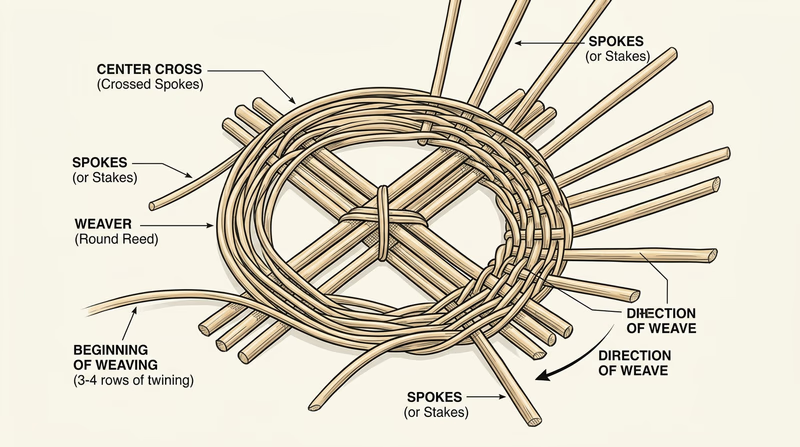
Group your spokes into two bundles. Lay one bundle horizontally and the other vertically, crossing them at the center. This cross is the foundation of your entire basket.
Some weavers split the center of one bundle and thread the other through it to lock them together. Others lash the cross with a short piece of weaving reed. Either method works — the goal is a stable center that will not shift as you start weaving.
3. Weave the Base
Begin twining (or simple weaving) around the cross, treating each bundle of spokes as a single unit for the first few rows. After 2–3 rows, fan the spokes apart so each one is separate and evenly spaced. Continue weaving outward in a spiral until the base reaches your target diameter.
4. Upset the Spokes
Just like the square basket, you need to bend the spokes upward to create walls. Gently bend each spoke at the edge of the base so it points upward. Because round reed is already somewhat curved, this step usually feels more natural than with flat reed.
Soak the base in water again if the reed has dried out — cracking a spoke at this point means starting over.
5. Weave the Walls
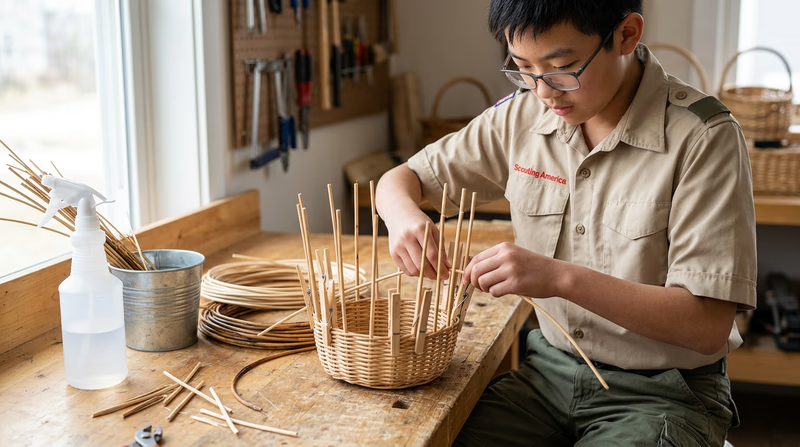
Continue weaving around the upright spokes, building the walls row by row. Keep the spokes evenly spaced and maintain consistent tension. If you notice the basket pulling inward, ease your tension. If it is flaring outward, tighten slightly.
This is where the basket takes shape. You will feel the rhythm of the weave — over, under, over, under — and each row reinforces the structure.
6. Finish the Rim
Trim the spokes to about 2–3 inches above the last row of weaving. Soak the spoke ends, then bend each one over and tuck it down alongside its neighbor into the weave. This creates a clean, woven border.
For a sturdier rim, you can add a “lashing” — a piece of reed wrapped around the top edge to reinforce it.
7. Dry and Inspect
Set the basket on a flat surface to dry completely. Check that the base sits flat and the walls are even. Minor adjustments can be made while the basket is still slightly damp.
How Round Baskets Differ from Square
| Feature | Square Basket | Round Basket |
|---|---|---|
| Base construction | Flat grid of interlocking strips | Spokes radiating from a center cross |
| Primary material | Flat reed | Round reed (spokes) with round or flat weavers |
| Wall shape | Straight sides, sharp corners | Curved walls, no corners |
| Weave pattern | Usually plain weave | Often starts with twining, then plain weave |
| Difficulty | Beginner | Intermediate |