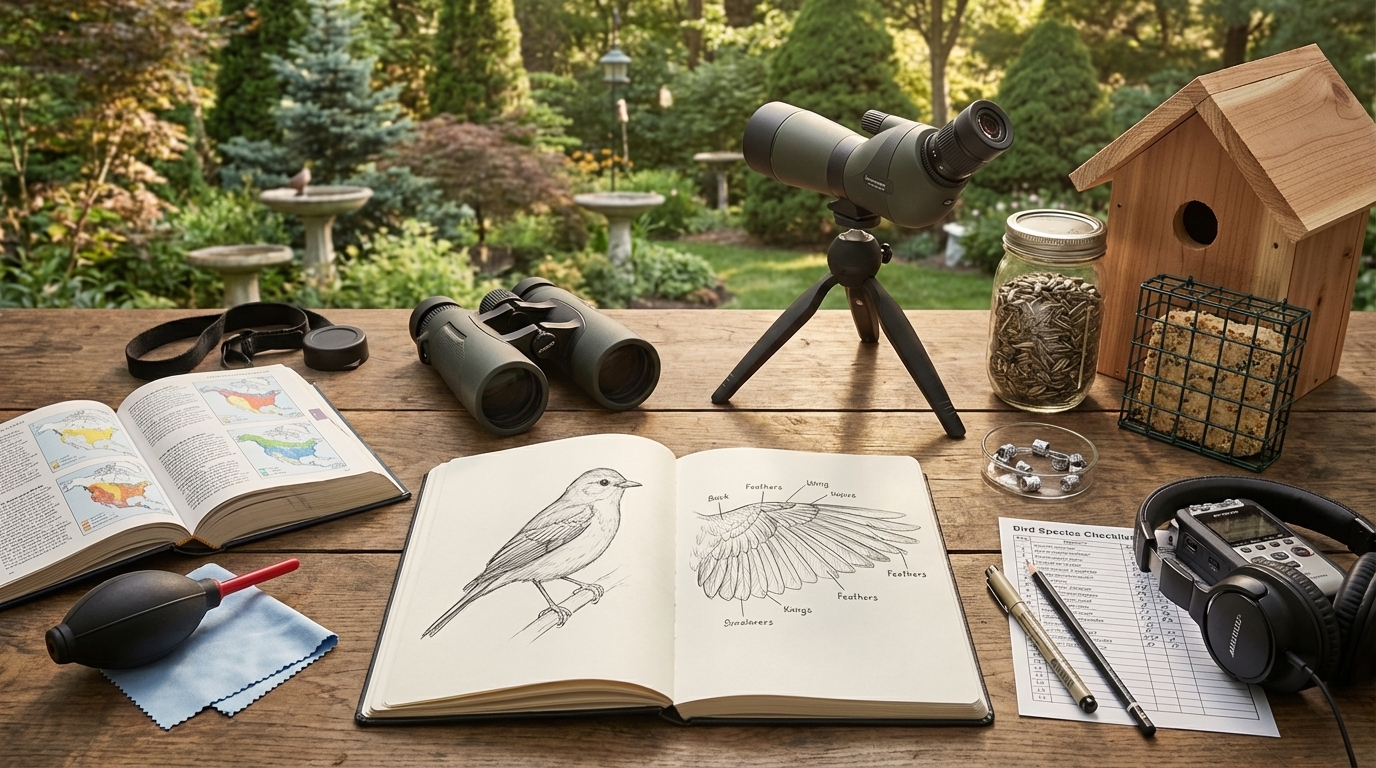
 Getting Started
Introduction & Overview
Look up. Listen. That flash of red in the tree, the tiny silhouette gliding overhead, the song that wakes you at dawn — birds are everywhere, and once you start paying attention to them, the world gets a whole lot more interesting.
Bird Study is one of the most rewarding merit badges you can earn. It takes you outside, sharpens your observation skills, and opens the door to a lifelong hobby enjoyed by millions of people around the world. Whether you are scanning the sky from your backyard or hiking through a national wildlife refuge, this badge will teach you how to find, identify, and understand the birds that share your world.
Then and Now
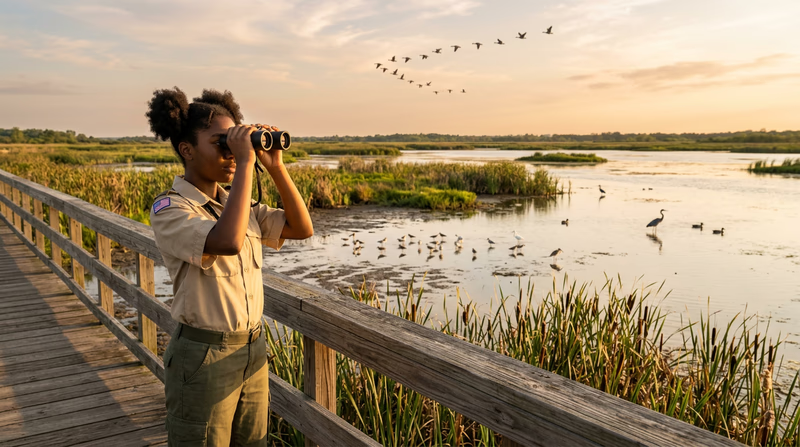
Then — The Naturalist Tradition
For centuries, learning about birds meant collecting them. Naturalists like John James Audubon shot hundreds of birds so he could pose them and paint their portraits in exacting detail. His masterwork, The Birds of America (1827–1838), contained 435 life-size illustrations — and every single subject was a specimen. Egg collecting was a popular hobby, and museum drawers filled with preserved skins were the primary tools of ornithology.
It was a different time. There were no binoculars powerful enough for field identification, no field guides small enough to carry in a pocket, and no cameras fast enough to freeze a bird in flight. If you wanted to study a bird up close, you had to hold it in your hand.
- Tools: Shotguns, specimen trays, hand-painted illustrations
- Approach: Collect first, study later
- Legacy: The detailed records left by early naturalists still inform science today
Now — The Citizen Science Revolution
Today, a smartphone in your pocket is more powerful than any tool Audubon ever had. Apps like Merlin can identify a bird by its song in seconds. The eBird platform, run by the Cornell Lab of Ornithology, collects millions of bird sightings from everyday observers around the world — making birders the largest network of wildlife monitors on the planet.
Modern bird study is about observation, not collection. You watch, you listen, you record what you see, and your data joins a global effort to understand and protect birdlife.
- Tools: Binoculars, field guides, smartphone apps, acoustic recorders
- Approach: Observe, identify, and contribute to science
- Impact: Citizen science data drives real conservation decisions
Get Ready! You are about to join a community of observers, scientists, and nature lovers who find wonder in the world of birds. Grab a pair of binoculars, a notebook, and your curiosity — the birds are waiting.
Kinds of Birding
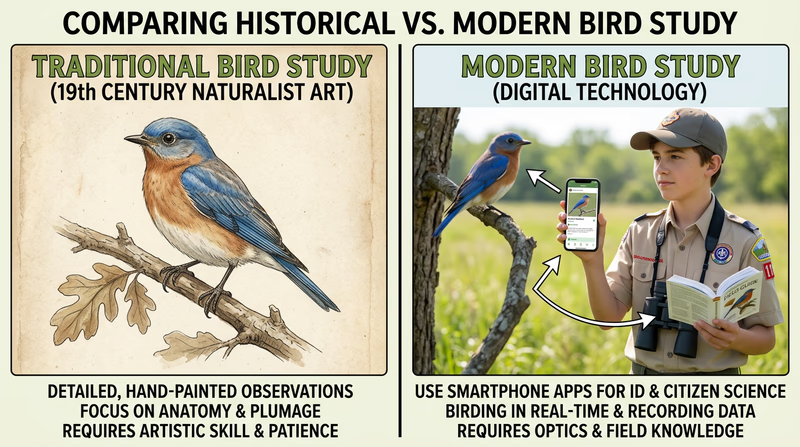
Birding comes in many flavors. Before you head out, here is a look at the different ways people enjoy watching birds.
Backyard Birding
You do not need to go anywhere special to start birding. A feeder, a birdbath, or even a window with a view of some trees is all it takes. Backyard birding is how many of the world’s best birders got their start. You will be surprised how many species visit your own yard once you know what to look for.
Field Birding
Field birding means heading out to parks, wildlife refuges, forests, and shorelines to find birds in their natural habitats. You bring binoculars, a field guide, and a notebook. This is the heart of the Bird Study merit badge — getting out into the field and observing birds where they live.
Pelagic Birding
Pelagic birding takes you offshore on boats to find seabirds that never come close to land. Albatrosses, petrels, shearwaters, and puffins are just some of the species you can only see far out at sea. These trips are led by experienced guides and are a thrilling adventure for any birder.
Hawk Watching
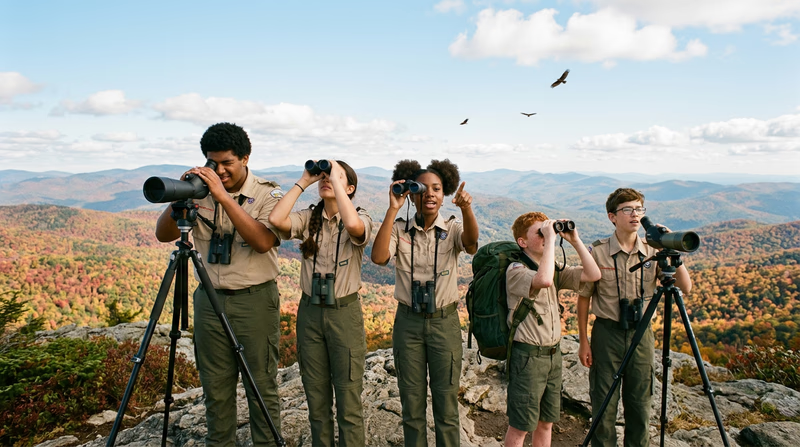
Every fall, raptors — hawks, eagles, falcons, and vultures — migrate south along mountain ridges and coastlines. Hawk watch sites are places where birders gather to count and identify these birds of prey as they stream overhead, sometimes by the thousands in a single day.
Birding by Ear
Many experienced birders identify more birds by sound than by sight. Learning bird songs and calls takes practice, but it is one of the most valuable skills you can develop. A bird hidden deep in a thicket can still be identified by its voice — and Requirement 7 of this badge will challenge you to do exactly that.
Big Day and Big Year Birding
Competitive birding is a real thing. A “Big Day” is a race to identify as many species as possible in 24 hours. A “Big Year” stretches the challenge across an entire calendar year. These events inspire birders to explore new habitats and push their identification skills to the limit.
Ready to discover why birds matter — and why scientists consider them some of the most important animals on the planet? Let’s start with Requirement 1.