Req 1 — Birds & the Environment
This requirement asks you to understand three big ideas:
- Why we study birds — what makes them worth paying attention to
- Why birds are environmental indicators — how their health reflects the health of the world around them
- How birds fit into ecosystems — the roles they play in nature’s web
Why Study Birds?
Birds are found on every continent, in every habitat, from frozen Antarctic shores to scorching desert canyons. There are roughly 10,000 known bird species worldwide, and about 900 of those have been recorded in North America. That variety alone makes them fascinating — but there are practical reasons to study birds, too.
Birds are relatively easy to observe. Unlike many mammals that are nocturnal or hide underground, most birds are active during the day, visible, and vocal. This makes them one of the most accessible groups of wild animals to study. Scientists have been keeping detailed records of bird populations for over a century, which gives us a long, reliable timeline to compare against.
Birds as Environmental Indicators
An environmental indicator is a species whose health and population trends tell us something about the overall health of an ecosystem. Birds are outstanding indicators for several reasons:
- They respond quickly to change. When a habitat is damaged — by pollution, development, or climate shifts — bird populations often decline before other species. They act as an early warning system.
- They occupy many levels of the food chain. Some birds eat seeds, some eat insects, some eat fish, and some eat other birds. A decline in bird populations can signal problems anywhere in the food web.
- They are widespread and diverse. Because birds live in so many habitats, changes in their populations can reveal environmental problems across entire regions.
- They are easy to count. Citizen science programs like the Christmas Bird Count and eBird give scientists massive datasets to analyze.
The Canary in the Coal Mine
You may have heard the phrase “canary in a coal mine.” In the early 1900s, coal miners brought caged canaries underground with them. If toxic gases like carbon monoxide built up, the canary — being smaller and more sensitive — would show symptoms before the miners did, giving them time to evacuate. Birds still serve this role in a broader sense: when bird populations drop, something in the environment is going wrong.
Real-World Examples
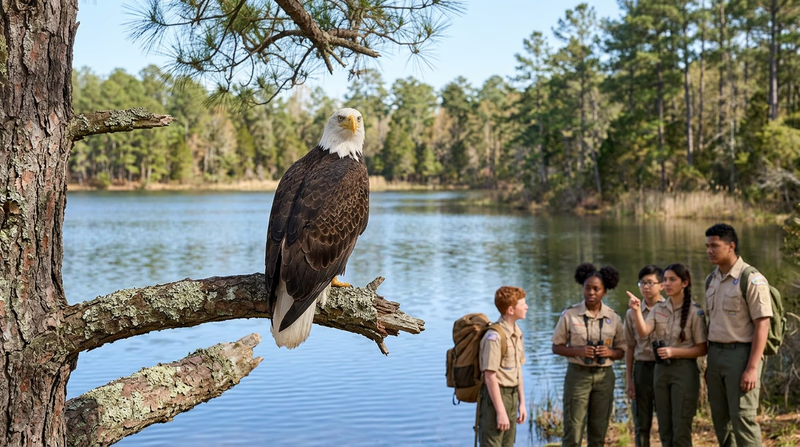
- Bald Eagle and DDT: DDT pesticide caused eggshell thinning in Bald Eagles and other raptors, crashing their populations. The ban on DDT in 1972 — prompted in part by Rachel Carson’s book Silent Spring — allowed eagle populations to recover.
- Spotted Owl and Old-Growth Forests: The Northern Spotted Owl’s decline signaled that old-growth forests in the Pacific Northwest were being logged too quickly.
- Grassland Birds and Agriculture: Species like the Eastern Meadowlark have declined steeply as native grasslands have been converted to cropland, revealing the impact of large-scale farming on ecosystems.
Birds in the Ecosystem
An ecosystem is a community of living organisms interacting with each other and their physical environment. Birds play several critical roles in these systems:
Seed Dispersal
Many birds eat fruits and berries, then fly to a new location before excreting the seeds. This spreads plants across the landscape, helping forests and grasslands regenerate. Some plants depend almost entirely on birds for seed dispersal.
Pollination
Hummingbirds, sunbirds, and honeyeaters pollinate flowers as they feed on nectar. In some ecosystems, certain plants cannot reproduce without their bird pollinators.
Pest Control
A single barn swallow can eat up to 850 insects per day. Warblers, flycatchers, and woodpeckers consume enormous quantities of insects that would otherwise damage crops and forests. Birds provide billions of dollars in natural pest control every year.
Scavenging
Vultures and other scavengers clean up dead animals, preventing the spread of disease. In regions where vulture populations have crashed, carcass decomposition slows and disease rates in other animals — including livestock — increase.
Food Web Connections
Birds are prey for larger predators like hawks, owls, foxes, and snakes. They are also predators themselves, keeping insect and rodent populations in check. Remove birds from an ecosystem, and the entire food web shifts out of balance.
All About Birds — Cornell Lab of Ornithology The Cornell Lab's free bird guide with species profiles, range maps, sounds, and ID tips for every North American bird.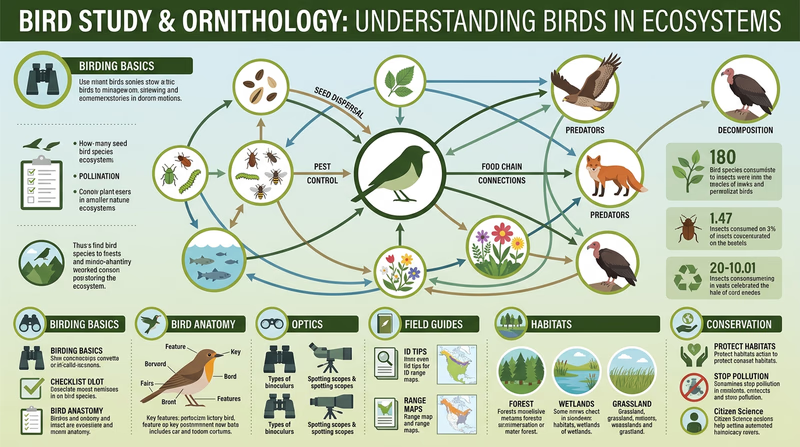
Now that you understand why birds matter, it is time to learn their anatomy — starting with the parts of a perched bird.