Req 11 — Non-Native Birds
A non-native (or introduced) bird is a species that did not originally live in North America but was brought here — intentionally or accidentally — by humans. Some introduced species have become invasive, meaning they spread aggressively, outcompete native species, and damage ecosystems. This requirement asks you to identify one and understand why non-native species can be harmful.
Major Non-Native Birds in North America
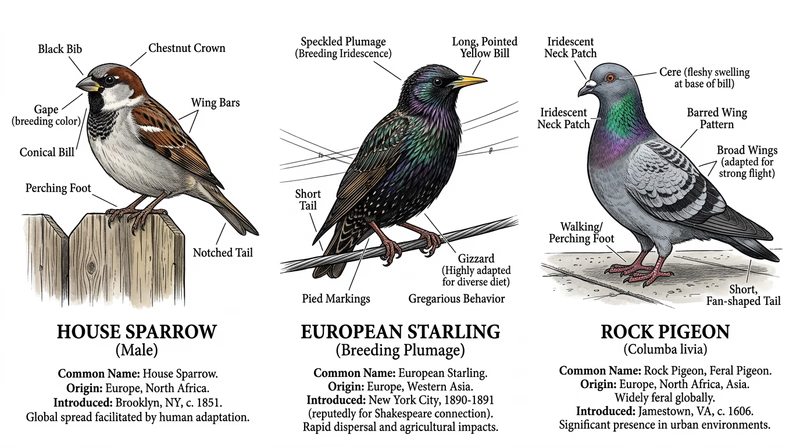
House Sparrow (Passer domesticus)
Origin: England and continental Europe
How it got here: In 1851, a group of about 100 House Sparrows was deliberately released in Brooklyn, New York. The idea was that they would eat insects harmful to crops (they did not — House Sparrows are primarily seed eaters). More releases followed throughout the 1850s and 1860s. By 1900, the House Sparrow had spread across the entire continent.
Ecological damage:
- Nest competition — House Sparrows aggressively take over nest cavities used by native species like Eastern Bluebirds, Tree Swallows, and Purple Martins. They will kill adult birds and nestlings, destroy eggs, and build their own nests on top of the remains.
- Disease — They can spread diseases to native bird populations.
- Abundance — With no natural predators adapted to controlling them, House Sparrow populations are enormous.
European Starling (Sturnus vulgaris)
Origin: Europe and western Asia
How it got here: In 1890, a man named Eugene Schieffelin released 60 European Starlings into New York City’s Central Park. He was part of a society that wanted to introduce every bird species mentioned in the works of Shakespeare to North America. (The starling appears in Henry IV, Part 1.) A second release of 40 birds followed in 1891. From those 100 birds, the North American starling population has exploded to over 200 million.
Ecological damage:
- Cavity competition — Starlings take over nesting cavities from woodpeckers, bluebirds, and other native cavity nesters.
- Agricultural damage — Massive starling flocks consume and contaminate livestock feed, damage fruit crops, and cost the agricultural industry hundreds of millions of dollars per year.
- Flocking hazards — Large starling roosts create noise, mess, and can pose health risks from accumulated droppings.
Rock Pigeon (Columba livia)
Origin: Europe, North Africa, and western Asia
How it got here: Rock Pigeons were brought to North America by European colonists in the early 1600s, originally as a food source and for carrying messages. Escaped and released birds established wild populations in cities across the continent.
Ecological damage:
- Structural damage — Pigeon droppings are acidic and corrode buildings, bridges, and statues.
- Disease — Pigeons can carry diseases transmissible to humans, including histoplasmosis and cryptococcosis.
- Competition — They compete with native species for food and roosting sites in urban areas.
How Non-Native Birds Become Damaging
Not every introduced bird becomes a problem, but those that do tend to share certain traits:
Why Some Species Succeed (and Cause Harm)
- Generalist diet — They eat a wide variety of foods, so they can thrive in many environments. House Sparrows eat seeds, insects, garbage, and almost anything else.
- Aggressive behavior — They outcompete native species for nest sites, food, and territory through intimidation or violence.
- High reproductive rate — They produce many offspring in a single year, allowing their populations to grow quickly.
- Adaptability — They thrive in human-modified habitats (cities, farms, suburbs) where native species may struggle.
- No natural predators — They evolved in a different ecosystem, so North American predators may not control them effectively.
The Impact on Native Species
When non-native birds outcompete natives for nest sites, food, or territory, the native populations decline. This can trigger a cascade of ecological effects:
- Fewer native cavity nesters → fewer predators of forest insects → increased insect damage to trees
- Fewer native seed-dispersing birds → reduced plant regeneration → habitat degradation
- Fewer native pollinators → reduced pollination of native plants → ecosystem simplification
You understand the threat of non-native species. Now let’s connect bird study to the outdoor ethics you practice as a Scout.