Req 2a — Bird Body Parts
Knowing the parts of a bird is like knowing the positions on a soccer field — it gives you a shared language to describe what you see. When you spot a bird and want to identify it or describe it to someone else, you need to know whether that flash of color was on the bird’s crown, its nape, or its rump. This requirement builds that vocabulary.
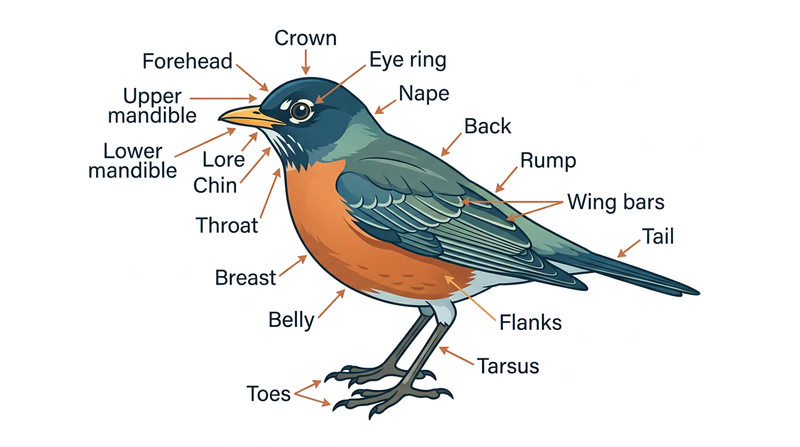
The 15 Parts You Need to Know
Here are the major external parts of a perched bird. You will sketch or trace a bird and label at least 15 of these:
Head Region
- Crown — The top of the head. Many species have distinctive crown colors or patterns (think of the Ruby-crowned Kinglet’s hidden red patch).
- Forehead — The area between the base of the bill and the crown.
- Nape — The back of the neck, just below the crown. Some warblers have distinctive nape patterns.
- Eye ring — A ring of color (often white or pale) surrounding the eye. This is a key field mark for many species.
- Lore — The small area between the eye and the base of the bill. Dark lores can give a bird a “masked” appearance.
- Chin — The small area directly below the bill.
- Throat — Below the chin, the front of the neck. Many birds have brightly colored throats (like the Ruby-throated Hummingbird).
Bill
- Upper mandible — The top half of the bill.
- Lower mandible — The bottom half of the bill.
Bill shape is one of the most important clues for identifying a bird’s diet and family group. You will explore this more in Requirement 6.
Body
- Breast — The upper front of the body, below the throat. The American Robin’s orange breast is one of the most recognized field marks in North America.
- Belly — The lower front of the body, below the breast.
- Flanks — The sides of the body, between the breast/belly and the wings.
- Back — The upper surface of the body between the wings.
- Rump — The lower back area, just above the tail. The Yellow-rumped Warbler gets its name from this feature.
Wings and Tail
- Wing bars — Pale or colored stripes across the folded wing, formed by the tips of the wing coverts. Many species have two wing bars.
- Tail — The fan of feathers extending behind the body. Tail shape (forked, rounded, squared) is a useful field mark.
Legs and Feet
- Tarsus — The lower leg (the visible “leg” of a perched bird, which is actually equivalent to your foot and ankle).
- Toes — Most perching birds have three toes forward and one back, an arrangement called anisodactyl.
Tips for Your Sketch
You do not need to be an artist to complete this requirement. The goal is to learn where each part is located, not to create a museum-quality drawing. Here are some tips:
Sketching Success
Follow these steps for a clean, labeled drawing
- Find a reference image: Use a clear side-view photo from a field guide or the Cornell Lab website.
- Trace or sketch the outline: Focus on the overall shape — head, body, tail, legs.
- Add major features: Bill, eye, wing, tail feathers.
- Label each part: Use lines that point clearly to each feature, and write the name at the end of each line.
- Include at least 15 labels: Choose from the list above.
- Keep labels on one side if possible: This keeps the drawing clean and readable.

Now that you know the parts of a perched bird, it is time to zoom in on the wing and learn the different types of feathers.