Req 2b — Wing Feathers
A bird’s wing is an engineering marvel. Every feather has a specific job, and together they create the lift, thrust, and maneuverability that make flight possible. This requirement teaches you to identify the six main types of wing feathers so you can understand how a wing works.
The Six Types of Wing Feathers
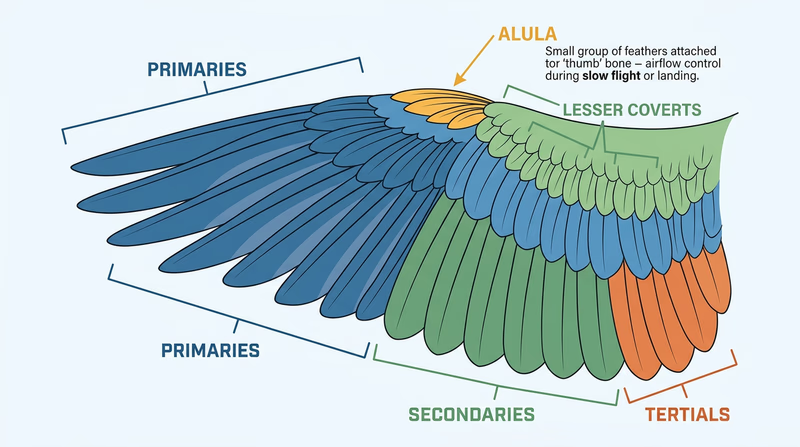
When you look at a bird’s wing fully extended (spread open), the feathers are arranged in overlapping layers from the leading edge to the trailing edge. Here are the six types you need to label:
1. Primaries
The primaries are the long, stiff feathers at the outer tip of the wing. Most birds have 10 primaries on each wing. These feathers provide thrust — they are the “engine” that pushes the bird through the air. Primaries are attached to the bones of the bird’s “hand” (equivalent to your fingers and palm).
2. Secondaries
The secondaries are the long feathers on the inner part of the wing, between the primaries and the body. They are attached to the bird’s “forearm” (the ulna bone). Secondaries provide lift — they are the “wing” that keeps the bird in the air. The number of secondaries varies by species: a hummingbird has 6, while an albatross has over 30.
3. Tertials
The tertials (sometimes called tertiaries) are the innermost flight feathers, closest to the body. They overlap the secondaries when the wing is folded and help create a smooth aerodynamic surface. In many species, tertials have distinctive patterns that are useful for identification.
4. Greater Coverts
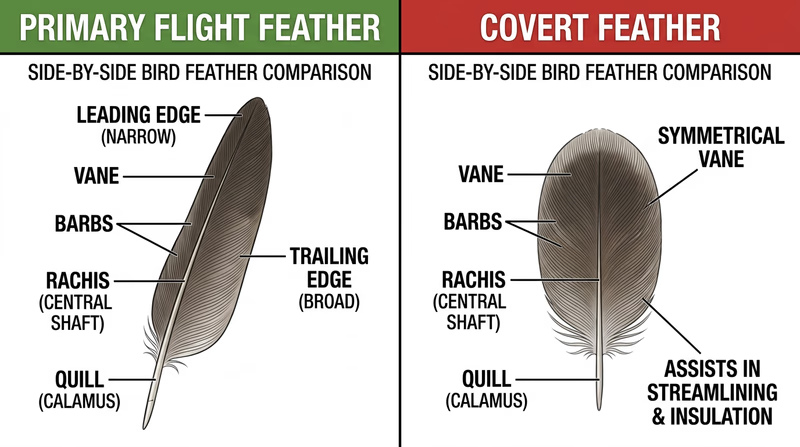
The greater coverts are a row of feathers that overlap the base of the secondaries. They smooth out the wing surface and help air flow cleanly over the flight feathers. “Covert” means “covering” — and that is exactly what they do.
5. Lesser Coverts
The lesser coverts are smaller feathers covering the area between the greater coverts and the leading edge of the wing. They fill in gaps and create the smooth, rounded shape of the upper wing surface.
6. Alula
The alula (sometimes called the “bastard wing”) is a small group of feathers — usually three to five — attached to the bird’s “thumb.” The alula works like the slats on an airplane wing: when the bird raises it during slow flight or landing, it prevents stalling by directing airflow over the wing surface. Watch a bird come in for a landing and you might see the alula pop up.
Tips for Your Wing Sketch
Like the body sketch in Req 2a, this does not need to be a work of art. The goal is learning where each feather group is located.
Wing Sketching Guide
Steps for a clear, labeled wing drawing
- Find a reference image: Search for “bird wing anatomy diagram” or use the Cornell Lab’s resources.
- Draw or trace the wing outline: Show it fully extended with feathers spread.
- Mark the feather groups: Start from the tip (primaries) and work inward.
- Use bracket lines: Draw brackets along each feather group rather than pointing to a single feather.
- Label all six types: Primaries, secondaries, tertials, greater coverts, lesser coverts, alula.
- Add a directional note: Mark which end is the wingtip and which is closest to the body.
How Feathers Work Together
Understanding feather types is not just about labeling — it helps you understand flight. Each feather group has a job:
| Feather Type | Job | Analogy |
|---|---|---|
| Primaries | Generate thrust | Propeller |
| Secondaries | Generate lift | Airplane wing |
| Tertials | Smooth body-to-wing transition | Fairing on a car |
| Greater coverts | Smooth airflow over flight feathers | Roof shingles |
| Lesser coverts | Fill gaps at the leading edge | Weatherstripping |
| Alula | Prevent stalling at low speed | Airplane slat |
You now know both the external parts of a bird and the anatomy of its wing. Next, you will learn about the tools that help you see birds up close — binoculars, spotting scopes, and monoculars.