Req 3d — Choosing Your Optics
Binoculars, spotting scopes, and monoculars each have strengths and limitations. The best birders know when to reach for each one — and sometimes they use more than one on the same outing.
Binoculars — The Everyday Essential
Binoculars are the single most important tool in birding. They are versatile enough for almost any situation.
Best for:
- Woodland and forest birding — Birds move quickly through trees, and binoculars let you scan and follow them with both eyes.
- Backyard birding — Quick and easy to grab when a bird appears at the feeder.
- Hiking and field trips — Lightweight enough to carry all day around your neck.
- General-purpose scanning — A wide field of view makes it easy to find birds in flight or flitting through brush.
Limitations:
- Not powerful enough for very distant birds (shorebirds on a mudflat, waterfowl far out on a lake).
- At magnifications above 10x, image shake becomes noticeable without a rest.
Recommended for Bird Study
For this merit badge, binoculars will be your primary tool. If you can only have one optic, make it binoculars.
Spotting Scope — The Long-Range Specialist
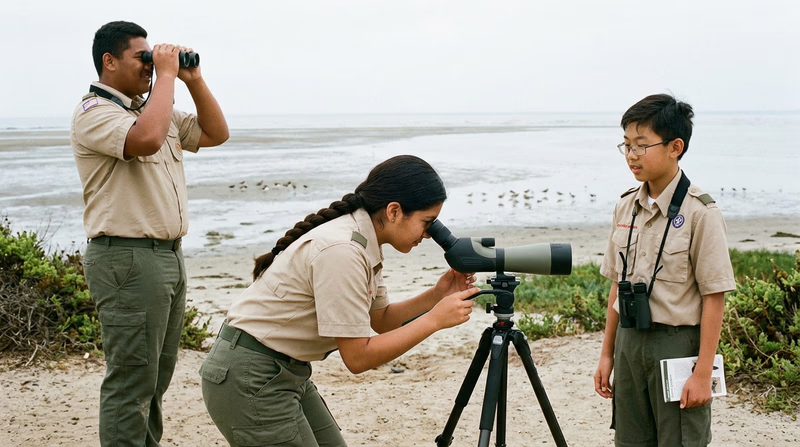
A spotting scope is a small telescope designed for field use, mounted on a tripod for stability.
Best for:
- Shorebird and waterbird observation — Birds feeding on distant mudflats or swimming far from shore.
- Hawk watching — Identifying raptors soaring high overhead or riding thermals far away.
- Stationary observation points — Set up at one location and watch birds come and go.
- Studying details — At 30x–60x magnification, you can see feather patterns, eye color, and leg bands that are invisible through binoculars.
Limitations:
- Heavy and awkward to carry on long hikes.
- Requires a tripod — not a grab-and-go tool.
- Narrow field of view at high magnifications makes finding birds harder.
- Not practical for quick-moving woodland birds.
Monocular — The Compact Backup
A monocular is essentially one half of a pair of binoculars. It fits in a pocket and weighs almost nothing.
Best for:
- Quick checks — You hear a bird and want a quick look without pulling out binoculars.
- Weight-conscious outings — When every ounce matters (long backpacking trips).
- Budget birding — A decent monocular costs less than binoculars of similar quality.
- Supplemental use — Pair with binoculars as a lightweight backup.
Limitations:
- Viewing with one eye is less comfortable and reduces depth perception.
- Generally lower image quality than comparable binoculars.
- Harder to hold steady than two-barreled binoculars.
Choosing the Right Tool for the Habitat
| Habitat / Situation | Best Device | Why |
|---|---|---|
| Forest or woodland | Binoculars | Quick tracking of fast-moving birds in dense cover |
| Open shoreline or mudflat | Spotting scope | Distant shorebirds need high magnification |
| Backyard or feeder | Binoculars | Convenient, quick to use |
| Long hike or backpacking | Binoculars (compact) | Lightweight and versatile |
| Hawk watch overlook | Spotting scope + binoculars | Scope for distant IDs, binoculars for scanning |
| Boat or canoe | Binoculars (waterproof) | Stable viewing from an unstable platform |
| Quick field check | Monocular | Fastest to deploy from a pocket |
You now know your optics inside and out. Next up: learning to use the most important reference tool in bird study — the field guide.