Req 5 — Field Notebook
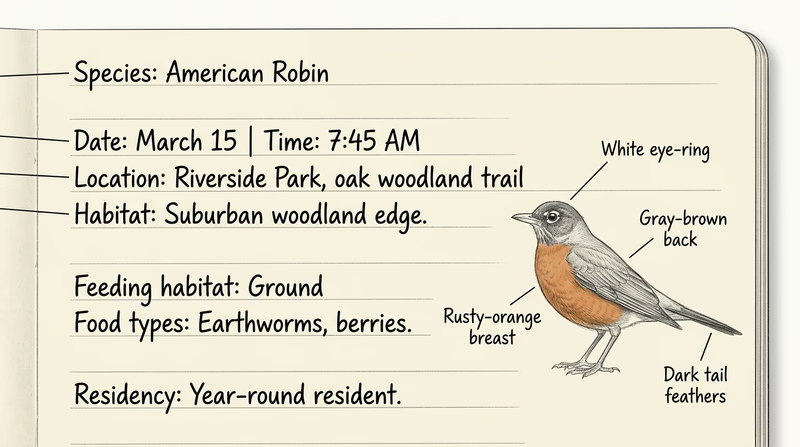
This requirement is the heart of the Bird Study merit badge. You will go outside, observe real birds, and build a field notebook with 20 species entries. For each species, you need to record:
- (a) Date and time of observation
- (b) Location and habitat
- (c) Main feeding habitat and two likely food types
- (d) Whether the bird is a migrant or a summer, winter, or year-round resident
Setting Up Your Field Notebook
Your field notebook can be a physical notebook, a binder with printed pages, or a digital document — but a physical notebook is traditional and practical in the field. Whatever format you choose, create a consistent layout for each entry so you do not forget any of the required information.
Bird Study Field Notebook WorksheetWhat Each Entry Should Include
Date and time — When did you observe the bird? Record the date and the approximate time. Early morning observations are different from midday sightings — many birds are most active at dawn.
Location and habitat — Where were you? Be specific: “Oak woodland trail behind Sunset Elementary School” is better than “a park.” Describe the habitat type: forest, grassland, wetland, suburban yard, lakeshore, etc.
Main feeding habitat and two food types — Where does this species typically feed? On the ground? In the tree canopy? Over water? Then list two types of food the bird is likely to eat. You can observe this directly (you watched a robin pull a worm from the ground) or research it in your field guide.
Residency status — Is this bird a year-round resident, a summer breeder, a winter visitor, or a migrant passing through? Your field guide’s range map will help you determine this. Check what color your area falls in on the range map.
How to Find 20 Species
Twenty species might sound like a lot, but it is very achievable. Here are strategies for building your list:
Start in Your Yard
You can probably find 5–10 species without leaving home. Common backyard birds include American Robin, Northern Cardinal, Blue Jay, House Sparrow, Mourning Dove, American Goldfinch, Black-capped Chickadee, and White-breasted Nuthatch. Set up a feeder or birdbath to attract more visitors.
Visit Different Habitats
Different habitats hold different birds. A trip to a local pond will give you waterfowl and wading birds. A walk through a forest will reveal woodpeckers, warblers, and thrushes. A visit to an open field might produce hawks, sparrows, and meadowlarks.
Habitat Hopping
Visit these habitats to diversify your species list
- Your backyard or neighborhood: Common songbirds, sparrows, doves.
- A pond, lake, or stream: Ducks, geese, herons, kingfishers.
- A wooded park or forest: Woodpeckers, warblers, thrushes, owls (listen at dusk).
- An open field or meadow: Hawks overhead, sparrows in the grass, swallows in flight.
- A shoreline or mudflat: Gulls, sandpipers, plovers.
Go at the Right Time
Birds are most active during the first two hours after sunrise and the last hour before sunset. These are the best times to observe and identify the most species. Midday tends to be quieter, especially in warm weather.
Recording Feeding Habitat and Food Types
For each species, you need to note the bird’s main feeding habitat and list two types of food it is likely to eat. Here are some common patterns:
| Feeding Habitat | Example Species | Typical Foods |
|---|---|---|
| Ground | American Robin | Earthworms, berries |
| Tree trunk/bark | Downy Woodpecker | Insects (beetle larvae), suet |
| Tree canopy | Yellow Warbler | Caterpillars, small insects |
| Air (catching insects in flight) | Barn Swallow | Flying insects, beetles |
| Water surface | Mallard | Aquatic plants, seeds |
| Shoreline | Great Blue Heron | Fish, frogs |
Determining Residency Status
Use your field guide’s range map to determine whether each species is:
- Year-round resident — Lives in your area all year (shown in purple/green on most maps).
- Summer resident (breeder) — Nests in your area during spring and summer, migrates south for winter (shown in red/orange).
- Winter resident — Spends the cold months in your area, breeds farther north (shown in blue).
- Migrant — Passes through your area during spring or fall migration but does not stay to nest or overwinter (shown in yellow, if indicated).
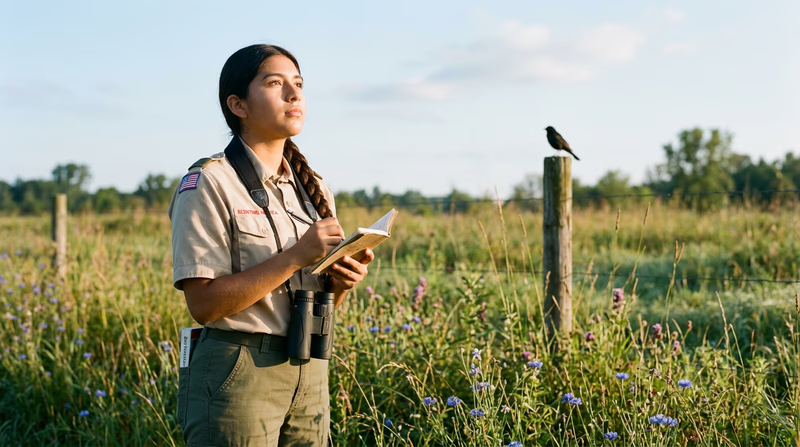
You are building your bird list and recording your observations. Next, you will learn how different birds are uniquely adapted to their habitats.