Req 8 — Choose Your Adventure
For this requirement, you choose one of three birding experiences. Read through all three options below, then pick the one that works best for your location and interests.
- Option A: Go on a field trip with a local birding club or experienced birders
- Option B: Research the Christmas Bird Count nearest your home
- Option C: Participate in a bird banding program
Option A — Birding Field Trip
Go on a field trip with a local birding club or with others who are knowledgeable about birds in your area. This is a great option if you have an Audubon chapter, nature center, or birding group nearby.
What You Need to Do
- Keep a list of all birds your group observed during the trip.
- Tell your counselor which birds you saw and why some species were common while others were present in small numbers.
- Explain what makes the area you visited good for finding birds.
How to Find a Field Trip
- Local Audubon Society chapters regularly lead free bird walks open to the public. Search your local chapter at audubon.org.
- Nature centers and wildlife refuges often schedule guided bird walks, especially during spring and fall migration.
- Your merit badge counselor may know local birding experts who would be willing to take you out.
- eBird Hotspots — Check eBird for hotspot locations near you. These are places where birders report lots of species.
Why Are Some Birds Common and Others Rare?
After the trip, your counselor will want to know why certain species were abundant while others were scarce. Think about these factors:
- Habitat match — Species whose habitat needs are met at that location will be common. A pond attracts ducks; a forest attracts woodpeckers.
- Food availability — Birds go where the food is. A meadow full of seed-bearing grasses will attract sparrows and finches.
- Time of year — Migration seasons bring temporary visitors. Breeding season concentrates certain species in their nesting habitats.
- Range and population — Some species simply have smaller populations or more restricted ranges.
Option B — Christmas Bird Count
The Christmas Bird Count (CBC) is the longest-running citizen science bird survey in the world, organized by the National Audubon Society since 1900. Every year between December 14 and January 5, tens of thousands of volunteers count every bird they can find within designated 15-mile-diameter circles across the Americas.
What You Need to Do
- Find the name and location of the Christmas Bird Count circle nearest your home.
- Obtain the results of a recent count.
- Explain what kinds of information are collected during the event.
- Tell your counselor which species were most common and why they are abundant.
- Identify uncommon species, explain why they were present in small numbers, and discuss whether their populations are declining and what could be done.
Finding Your Local Count
Visit the Audubon Society’s Christmas Bird Count website to search for count circles near you. Each circle has a compiler — a volunteer coordinator — who can share recent results and may welcome your participation.
Audubon Christmas Bird Count Find your nearest Christmas Bird Count circle, view results from past years, and learn how to participate.What Data Is Collected
Each CBC circle records:
- Total number of each species observed within the circle during the count day
- Number of observers and party-hours (total hours spent in the field by all groups)
- Weather conditions during the count
- Effort data — miles driven, walked, and hours at feeders
This data, accumulated over more than 120 years, provides one of the most valuable long-term datasets in ornithology. Scientists use it to track population trends, range shifts, and the effects of climate change.
Option C — Bird Banding
Bird banding involves capturing wild birds, attaching a small, uniquely numbered aluminum band to their leg, recording measurements, and releasing them unharmed. When a banded bird is recaptured or found later, scientists learn about its movements, lifespan, and population health.
What You Need to Do
- Participate in a banding session with an approved federal or state agency, university researcher, bird observatory, or certified private individual.
- Explain who is able to band birds and why (it requires a federal permit).
- Explain why birds get banded.
- Explain what kinds of birds get banded.
- Describe how the birds were captured, the number of species recorded during your visit, and your role in the program.
Who Can Band Birds?
Bird banding in the United States requires a federal Bird Banding Permit issued by the U.S. Geological Survey (USGS) Bird Banding Laboratory. Only trained, licensed individuals may handle and band wild birds. This protects the birds from injury and ensures data quality. Permit holders have demonstrated their ability to safely handle birds, identify species, and take accurate measurements.
Why Band Birds?
- Track migration — Where does a specific bird go in winter? Banding reveals migration routes and timing.
- Study survival — How long do birds live? Recapturing banded birds provides lifespan data.
- Monitor populations — Are populations growing, stable, or declining? Banding data provides population estimates.
- Understand behavior — Do birds return to the same nesting site? How far do young birds disperse from where they hatched?
How to Find a Banding Station
Contact your local bird observatory, wildlife management area, or university biology department. Many banding stations welcome volunteers and visitors, especially during fall migration when they are busiest.
USGS Bird Banding Laboratory Learn about the federal bird banding program, find banding stations, and report a banded bird.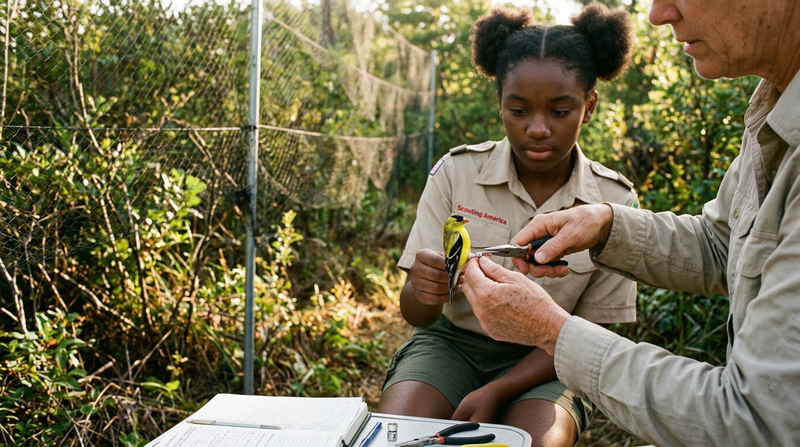
Whichever option you chose, you have gained hands-on experience in the field. Next, you will build something to attract birds to your own backyard.