 Getting Started
Introduction & Overview
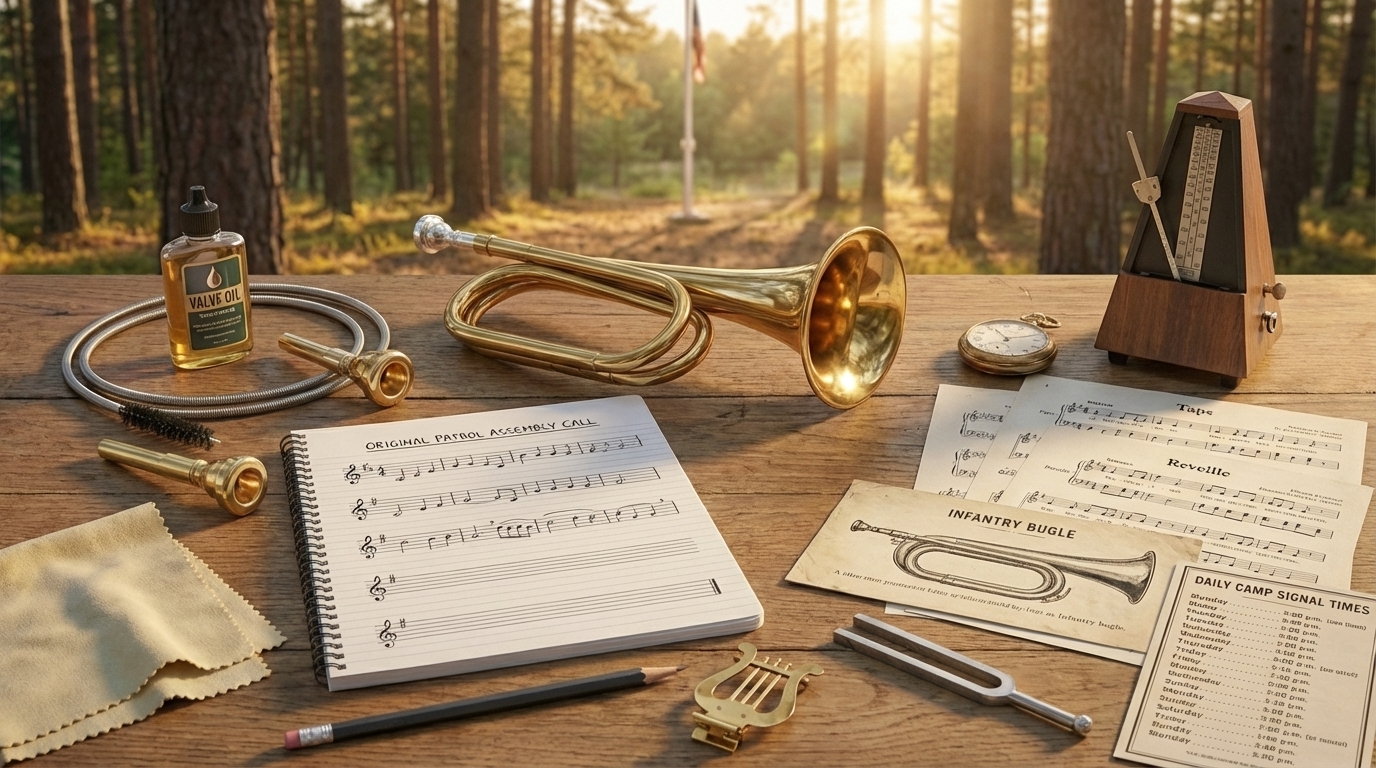
There is something powerful about a single brass instrument cutting through the morning air. No chords, no backup band — just one clear voice calling everyone to attention. That is the bugle, and for hundreds of years it has been the sound of duty, honor, and camp life.
The Bugling merit badge connects you to a tradition that stretches from ancient battlefields to modern Scout camps. You will learn how this simple instrument works, master the calls that have signaled soldiers and Scouts for generations, and serve your troop as its official bugler.
Then and Now
Then — The Voice of the Battlefield
Long before radios or cell phones, commanders needed a way to send orders across a noisy battlefield. Drums worked for marching, but a piercing brass signal could cut through the chaos of combat. Ancient Roman armies used a curved horn called the cornu. Medieval armies carried hunting horns. By the 1700s, the modern bugle had taken shape — a simple, valveless brass tube coiled into a compact loop.
During the American Civil War, buglers were essential. A single teenager with a bugle could communicate orders to thousands of troops spread across miles of terrain. Calls like “Charge,” “Retreat,” and “Taps” were literally a matter of life and death. Every regiment had its own bugler, and many were boys not much older than you.
- Purpose: Battlefield communication, signaling troop movements, regulating daily camp life
- Mindset: The bugler’s call was an order — miss it, and you missed the message
Now — Tradition, Ceremony, and Scout Camp
Today, the bugle is no longer needed to relay battlefield commands. But its role has only grown in meaning. “Taps” is played at military funerals and memorial services across the country. “Reveille” still wakes service members at military installations every morning. At Scout camps, the bugle marks the rhythm of the day — from the first notes of “Reveille” at sunrise to the final haunting tones of “Taps” at lights out.
- Purpose: Ceremony, tradition, Scout camp daily routine, memorial services
- Mindset: Honor the tradition — every note carries history
Get Ready! You are about to learn one of the oldest communication instruments in the world. Whether you have never touched a brass instrument or you already play trumpet in the school band, this badge will challenge and reward you.
Kinds of Bugling
The bugle may look simple, but it shows up in many different settings. Here are the main ways bugling is practiced today.
Military Bugling
Military bugling is the original form. Buglers serve at military installations, playing the daily sequence of calls that structure life on post — from “Reveille” at dawn to “Taps” at night. Military buglers also play at ceremonies, funerals, and official events. The U.S. Army even maintains a ceremonial bugle unit at Arlington National Cemetery, where “Taps” is sounded for every burial.
Scout Camp Bugling
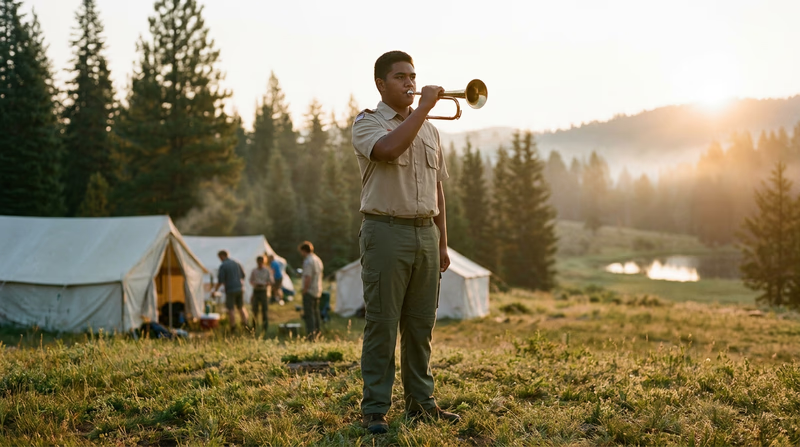
At Scout camp, the bugler is one of the most recognized members of the troop. The camp bugler sounds “Reveille” to start the day, “Mess” to call everyone to meals, “Swimming” to announce free swim, and “Taps” to close the night. Being the camp bugler is a position of responsibility and honor — everyone depends on you to keep the schedule running.
Ceremonial Bugling
Ceremonial bugling happens at memorials, parades, flag ceremonies, and civic events. “Taps” at a Veterans Day service, “To the Colors” during a flag-raising, or “Retreat” at sunset — these moments carry deep emotional weight. A well-played bugle call can bring an entire crowd to silence.
Drum and Bugle Corps
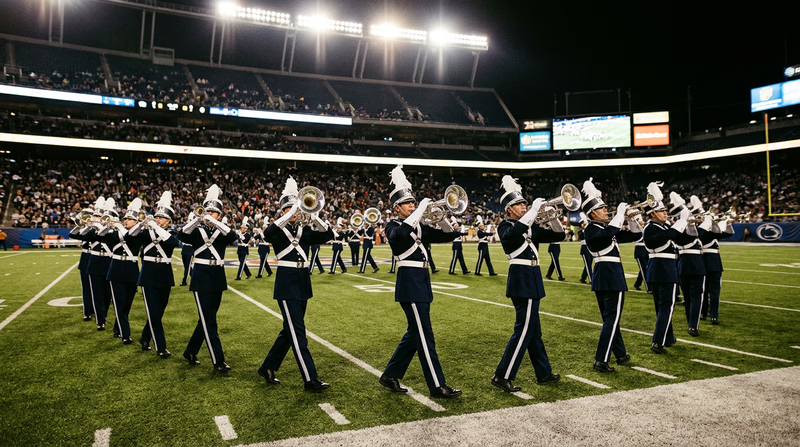
Drum and bugle corps (often called “drum corps”) are competitive marching ensembles that combine brass instruments, percussion, and colorful visual displays. While modern drum corps use a range of brass instruments beyond the traditional bugle, the art form traces its roots directly to military bugling. Groups like the Blue Devils and the Cavaliers perform at stadiums across the country every summer.
Now let’s explore the history of the bugle and begin your journey toward earning this badge.