Extended Learning
A. Congratulations, Bugler
You have earned one of Scouting’s most distinctive merit badges. You can trace the bugle’s history from ancient animal horns to modern ceremony, you understand the physics of how brass produces sound, and you can sound the calls that have organized military and Scout life for generations. More importantly, you have served your troop as its bugler — a tradition that connects you to Scouts and soldiers stretching back centuries. Here is where you can take it next.
B. From Bugle to Trumpet and Beyond
The bugle gave you the foundation of brass playing: embouchure, breath control, and tone production. If you enjoyed the bugle, the trumpet is the natural next step. A trumpet adds three valves to the bugle’s design, opening up the full chromatic scale — every note, not just the five of the harmonic series. Everything you learned on the bugle transfers directly.
Many school band programs welcome students who already have brass experience. If your school has a concert band, jazz band, or marching band, your embouchure strength and ear training give you a real head start. The fingering system for trumpet is straightforward, and most beginners who already play bugle can be playing simple melodies within their first week.
Beyond trumpet, the brass family offers a wide range of instruments. The flugelhorn has a warmer, mellower tone and is popular in jazz. The French horn produces a rich, complex sound used in orchestras and wind ensembles. The trombone uses a slide instead of valves, creating a smooth, gliding tone. And the tuba anchors the low end with deep, powerful notes. Every one of these instruments uses the same buzzing-lips technique you mastered on the bugle.
If you already play trumpet or another brass instrument, consider exploring historical brass. Replica Civil War bugles, natural trumpets (the valveless predecessors to modern trumpets), and baroque horns offer a different playing experience that connects you even more deeply to the music of the past.
C. Drum and Bugle Corps
Drum and bugle corps (DCI — Drum Corps International) is the competitive pinnacle of brass and percussion performance. Corps like the Blue Devils, the Cavaliers, Carolina Crown, and the Bluecoats tour the country every summer, performing elaborate shows that combine brass instruments, percussion, and choreographed movement on football fields.
DCI has divisions for different age groups and experience levels. World Class corps feature performers ages 16–22 who rehearse full-time during the summer. Open Class corps are often smaller and serve as a stepping stone. And many communities have all-age corps that welcome members of any experience level.
The rehearsal demands are intense — corps rehearse 10–14 hours a day during summer tour — but members describe it as a life-changing experience. You learn discipline, teamwork, and musical excellence at a level most people never encounter. If competitive marching performance appeals to you, start by attending a DCI show to see what it is all about.
Even if competitive drum corps is not your goal, many local community drum and bugle corps exist purely for fun. They march in parades, perform at civic events, and welcome beginners. Search for corps in your area through the DCA (Drum Corps Associates) website.
D. The Bugle in Ceremony and Service
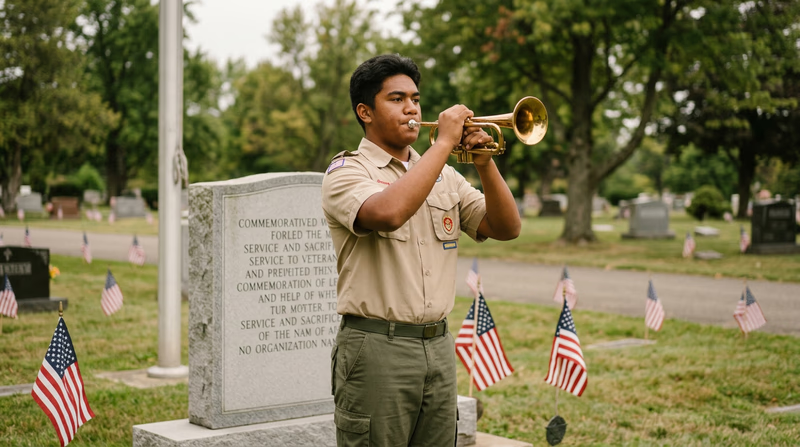
Your bugling skills can serve your community in meaningful ways beyond Scout camp. “Taps” is played at military funerals, Veterans Day ceremonies, Memorial Day services, and other commemorative events across the country. The demand for live buglers at these events far exceeds the supply — many ceremonies rely on electronic recordings because no live bugler is available.
The organization Taps for Veterans (formerly Bugles Across America) connects volunteer buglers with families and organizations that need a live performance of “Taps” at funerals and memorial events. Volunteers commit to being available for ceremonies in their area. If you can play “Taps” cleanly and reliably, you meet the requirements. It is one of the most personally rewarding forms of community service a musician can perform — standing at a graveside or memorial, playing the 24 notes that honor a veteran’s service.
Beyond funerals, many communities welcome a bugler at patriotic events: Fourth of July ceremonies, Veterans Day observances, flag retirement ceremonies, and civic gatherings. Contact your local VFW post, American Legion hall, or town government to offer your services. You may be surprised how many invitations follow.