Req 1 — History of the Bugle
The bugle has one of the longest histories of any instrument still in regular use. Understanding where it came from helps you appreciate every note you play.
Ancient Roots
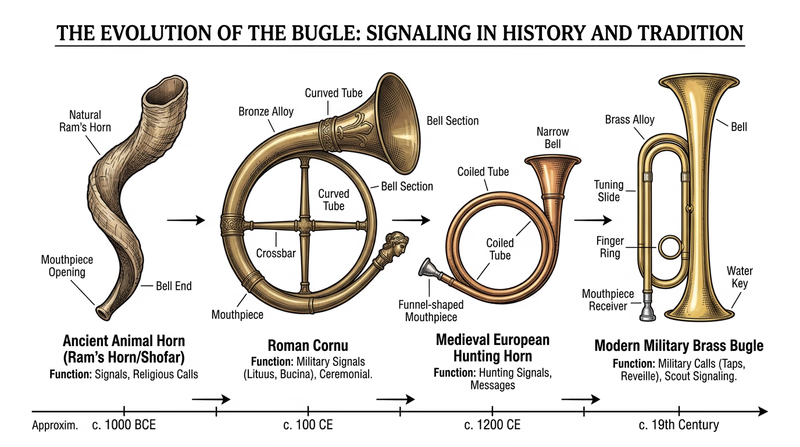
The earliest “bugles” were not metal at all. Ancient peoples used animal horns — from cattle, rams, and even elephants — to send signals across distances. The shofar, a ram’s horn still blown in Jewish religious services today, dates back over 3,000 years. Roman legions carried the cornu, a large circular bronze horn, and the bucina, a smaller curved horn used for camp signals. These instruments could produce only a few notes, but that was enough to communicate simple commands.
The Bugle Takes Shape
By the Middle Ages, hunters across Europe used brass and copper horns to coordinate during hunts. In Germany, the Flügelhorn (meaning “wing horn”) was carried by a scout who rode on the flank — the “wing” — of an army, signaling troop movements.
The modern bugle emerged in the 1700s when military instrument makers settled on a standard design: a single tube of brass, coiled into a compact shape, with no valves, keys, or slides. This simplicity was the point. A bugle needed to be loud, durable, and easy to carry into battle. A soldier could learn the basic calls in weeks, not years.
The Bugle in American History
The bugle played a critical role in the American military from the Revolutionary War through World War I. During the Civil War, every infantry and cavalry regiment had at least one bugler. These buglers were often teenagers — some as young as 12 or 13. They did not fight, but they were right in the middle of the action, sounding the calls that told thousands of soldiers when to advance, retreat, or hold their ground.
Some of the most famous bugle calls in American history were composed during this era:
- “Taps” was written in 1862 during the Civil War by Union General Daniel Butterfield, who wanted a more dignified call to signal “lights out” than the standard one borrowed from the French. He hummed the melody to his brigade bugler, Oliver Willcox Norton, who played it that night. Within months, both Union and Confederate units had adopted it.
- “Reveille” became the standard wake-up call for American troops, adapted from a French military signal.
- “Assembly” gathered soldiers to form ranks — the equivalent of a modern announcement over a loudspeaker.
The Bugle in Scouting
When Lord Baden-Powell founded the Scouting movement in 1907, he borrowed heavily from military traditions — including the bugle. Scout troops used bugle calls to organize camp life, and the role of troop bugler became an honored position. In the United States, the Bugling merit badge has been offered by the Boy Scouts of America (now Scouting America) since the earliest days of the program.
At Scout camps, the bugle still serves the same purpose it served on the battlefield: communicating clearly to a large group without electricity, speakers, or technology.
The Bugle Today
The bugle is no longer needed for battlefield communication, but its ceremonial role is stronger than ever. “Taps” is played at every military funeral. “Reveille” still sounds at installations worldwide. And at Scout camps across the country, a bugler marks the rhythm of each day — the same way buglers have done for centuries.
Now that you know where the bugle came from, let’s find out how it actually works.