Req 2a — How It Makes Sound
This requirement has two parts: understanding the physics of how a bugle produces sound, and understanding where the bugle fits in the brass instrument family.
How the Bugle Makes Sound
A bugle is one of the simplest instruments you will ever play — and that simplicity makes the physics easy to understand.
Your Lips Are the Engine
The bugle itself does not vibrate to make sound. You do. When you press your lips against the mouthpiece and blow, your lips vibrate rapidly — buzzing like a bee. This buzzing creates a vibrating column of air inside the brass tubing. The tube amplifies that vibration and shapes it into a clear, powerful tone that carries across long distances.
This is how every brass instrument works. The player’s buzzing lips are the sound source. The instrument is the amplifier and shaper.
Changing Notes Without Valves
A trumpet has three valves that open and close different lengths of tubing to change the pitch. A bugle has no valves at all. So how do you play different notes?
The answer is your embouchure (pronounced “AHM-buh-shur”) — the way you shape your lips, jaw, and facial muscles around the mouthpiece. By tightening your lips, you make the air column vibrate faster, producing a higher pitch. By relaxing them, the vibration slows and the pitch drops.
A standard bugle in the key of B-flat can produce five distinct notes, called the harmonic series:
- B-flat (low) — The fundamental tone. Deep and full.
- B-flat (mid) — One octave higher. The most common starting note for calls.
- F — A fifth above the mid B-flat. Bright and strong.
- B-flat (high) — Two octaves above the fundamental. Clear and ringing.
- D (high) — The highest note most buglers reach. Sharp and piercing.
These five notes are all you need to play every standard bugle call. “Taps,” for example, uses just four of them.
The Bell and the Bore
The flared opening at the end of the bugle is called the bell. It projects the sound outward and gives the bugle its characteristic bright, carrying tone. The bore — the internal diameter of the tubing — affects the tone quality. A wider bore produces a warmer, mellower sound. A narrower bore creates a brighter, more focused tone.
The Brass Instrument Family
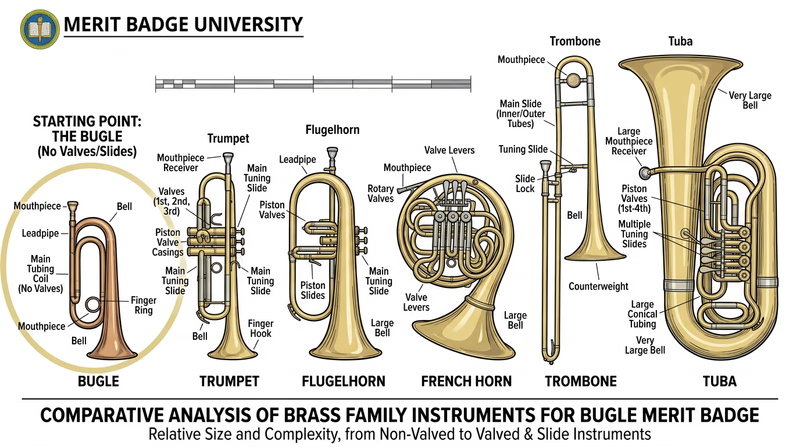
The bugle is the ancestor of the entire brass wind instrument family. All brass instruments share the same basic principle: the player buzzes their lips into a cup-shaped mouthpiece, and the instrument amplifies and shapes the sound. What separates them is how they change pitch.
| Instrument | How It Changes Pitch | Relation to Bugle |
|---|---|---|
| Bugle | Embouchure only (no valves) | The original |
| Trumpet | Three piston valves | A bugle with valves added |
| French Horn | Three rotary valves + hand in bell | Longer tubing, lower pitch |
| Trombone | Slide changes tubing length | Uses a slide instead of valves |
| Tuba | Three to six valves | Largest brass, lowest pitch |
| Flugelhorn | Three valves, wider bore | A bugle with valves and a wider bell |
The trumpet is the bugle’s closest relative. In fact, a trumpet is essentially a bugle with three valves added to give the player access to a full chromatic scale (every note) instead of just the harmonic series. If you can play bugle, you already have the foundation to play trumpet — and vice versa.
Now that you understand how the bugle works, it is time to get creative.