Req 6d — Backpacks
6d.
Tell the difference between internal- and external-frame packs. Discuss the advantages and disadvantages of each.
Your backpack is the piece of gear that carries everything else. Choosing the right type of pack affects your comfort, balance, and how much you can bring. There are two main categories: internal-frame and external-frame packs.
External-Frame Packs
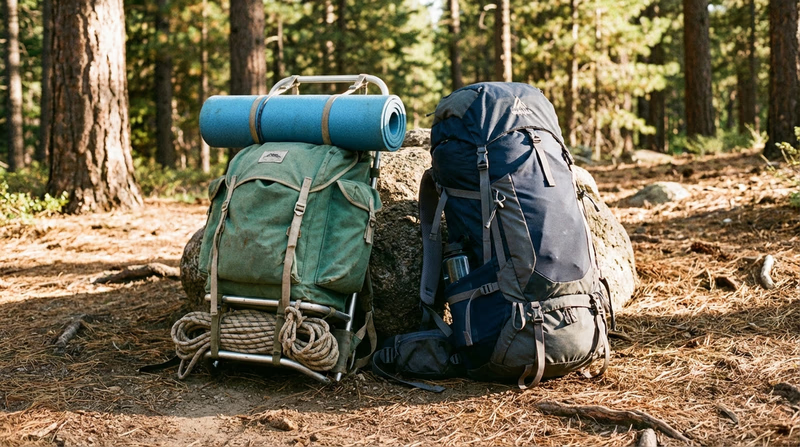
An external-frame pack has a rigid frame (usually aluminum) on the outside, with a fabric bag attached to it. The frame is visible, and gear can be lashed to the frame itself.
Advantages:
- Ventilation — The frame holds the pack away from your back, creating an air gap that keeps you cooler. This is a significant advantage on hot days.
- Load organization — The rigid frame makes it easy to organize and access gear. You can strap bulky items (like a sleeping bag or tent) directly to the outside of the frame.
- Affordability — External-frame packs are generally less expensive than comparably sized internal-frame packs.
- Upright posture — The frame distributes weight high, which encourages a more upright walking posture and works well on maintained trails.
Disadvantages:
- Less stable — The high center of gravity makes external frames less stable on rough, uneven terrain. You may feel more “sway” when scrambling over rocks or crossing streams.
- Snag hazard — The rigid frame and external gear can catch on branches, rocks, and brush during off-trail travel.
- Heavier — The metal frame adds weight compared to modern internal-frame designs.
- Less comfortable on technical terrain — On steep or uneven ground, the pack does not move with your body as naturally.
Internal-Frame Packs
An internal-frame pack hides its support structure inside the pack bag. Lightweight aluminum stays or a plastic framesheet provide rigidity, but the pack sits closer to your body and moves with you.
Advantages:
- Stability — The pack hugs your body and keeps the weight close to your center of gravity. This is a huge advantage on rough terrain, steep trails, and when scrambling.
- Streamlined profile — No external frame to snag on branches or rocks. Better for bushwhacking and off-trail travel.
- Lighter — Modern internal-frame packs use lightweight materials and minimal framing, saving weight.
- Versatility — Internal-frame packs are available in a wide range of sizes and configurations, from ultralight daypacks to expedition-size haulers.
Disadvantages:
- Less ventilation — The pack sits against your back, which means more sweat on hot days. Some models use suspended mesh back panels to improve airflow, but they still run warmer than external frames.
- Harder to organize — Without the rigid external frame, gear can shift inside the pack. Packing efficiently takes more practice.
- Cost — Quality internal-frame packs tend to be more expensive than external-frame options.
Which One Should You Choose?
| Factor | External Frame | Internal Frame |
|---|---|---|
| Trail type | Maintained trails | Any terrain |
| Weather | Best in hot weather (ventilation) | Works in all weather |
| Load weight | Handles heavy loads well | Handles moderate to heavy loads |
| Stability | Less stable off-trail | Very stable |
| Price | Generally lower | Generally higher |
| Best for | Summer car camping, trail hikes | Backpacking, rugged terrain |
Pack Fit Basics
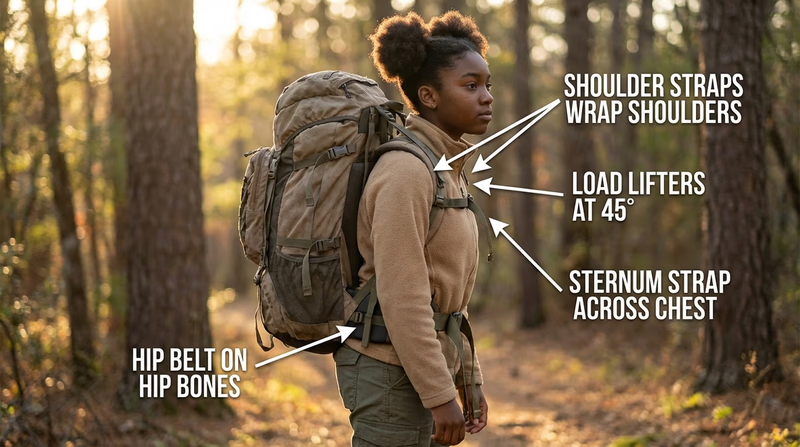
- Torso length matters more than your height. Measure from your C7 vertebra (the bump at the base of your neck) to the top of your hip bones.
- Hip belt should sit on top of your hip bones, not your waist. This is where 60–70% of the pack weight should rest.
- Shoulder straps should wrap over your shoulders and connect to the pack about 2 inches below the tops of your shoulders.
- Load lifter straps (the small straps that angle from the top of the shoulder straps to the top of the pack) should be angled at about 45 degrees.