Extended Learning
A. Congratulations, Paddler
You have earned the Canoeing merit badge — and with it, a set of skills that people have relied on for thousands of years. You can launch and land a canoe, handle it with precision, rescue a capsized crew, and navigate open water with your partner. That is no small thing. But there is a whole world of paddling beyond the requirements, and it is waiting for you.
B. Planning Your First Canoe Trip
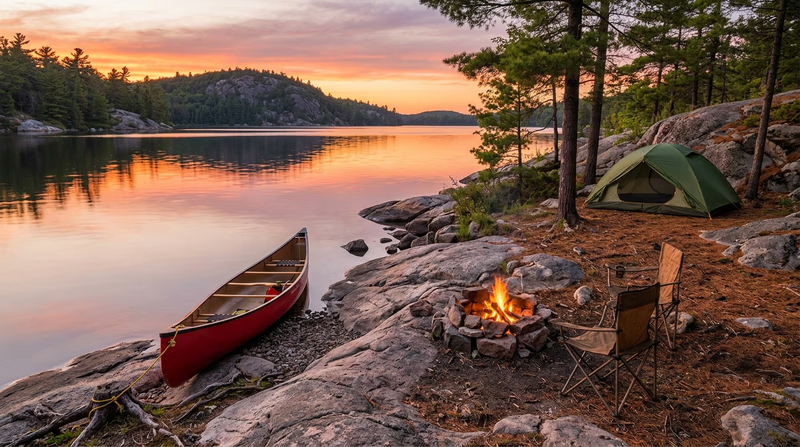
The Canoeing merit badge teaches you how to handle a canoe. A canoe trip teaches you how to live from one. Multi-day canoe trips combine paddling with backcountry camping, and they are one of the most rewarding outdoor experiences available to Scouts.
Choosing Your Route
Start with an established canoe route that has designated campsites. State and national parks with canoe trails publish maps showing distances, portages, and campsite locations. Look for routes with:
- Short daily distances for your first trip — 6 to 10 miles per day is plenty when you are also setting up camp, cooking, and portaging.
- Minimal portages until you are comfortable carrying a canoe and gear overland. Each portage requires multiple trips between water and trail.
- Known water conditions — calm lakes and slow rivers. Save moving water for after you have more experience.
Packing a Canoe for a Trip
Everything must fit in the canoe and stay dry. Use dry bags or waterproof containers for clothing, sleeping gear, and electronics. Pack heavy items low and centered in the canoe to keep the center of gravity stable. Secure all gear so nothing shifts during paddling or falls out during a capsize.
A typical packing order from bottom to top:
- Heavy items (food barrel, water jugs, cook kit) — centered on the hull bottom
- Sleeping gear (tent, sleeping bag in dry bags) — on top of heavy items
- Clothing and personal items — in dry bags, tucked along the sides
- Day-access items (snacks, water bottles, rain gear, map, sunscreen) — on top, within arm’s reach
Portaging
Portaging — carrying your canoe and gear overland between waterways — is the reality of wilderness canoeing. Most canoeists use the center thwart or yoke to carry the canoe inverted on their shoulders. Gear goes in packs (backpacks or specially designed portage packs called Duluth packs).
The standard approach: carry the canoe on one trip, come back for the packs, then carry the packs on a second trip. If your portage trail is short, you may be able to do everything in one trip by wearing a pack while carrying the canoe.
C. Reading Water and River Canoeing
Flatwater skills are the foundation, but rivers add a whole new dimension. Moving water has its own logic — understanding it is the key to safe and enjoyable river paddling.
Current and Eddies
A river’s current is fastest in the center and slower along the edges. Eddies are pockets of calm water that form behind obstacles like rocks and bridge pilings. The current actually reverses in an eddy, flowing upstream. Eddies are your rest stops, your parking spots, and your staging areas for scouting the next stretch of river.
Learning to “eddy turn” — paddling out of the main current into an eddy — is one of the first skills river canoeists develop. You cross the eddy line (the boundary between downstream current and upstream eddy flow) at an angle with forward momentum, and the eddy’s reverse current spins your canoe to face upstream.
Reading the Surface
Moving water communicates through its surface:
- Smooth, dark water — Usually deep. Safe passage.
- V-shapes pointing downstream — The V points to a clear channel between obstacles. Paddle through the point of the V.
- V-shapes pointing upstream — An obstacle (rock, log) just below the surface. The V’s point shows you where the hazard is.
- White, turbulent water — The river is flowing over or around shallow obstacles. May be navigable or may require portaging, depending on depth and severity.
- Horizon line — The water appears to disappear. This means a drop-off, ledge, or dam ahead. Pull over and scout from shore before proceeding.
River Classification
Rivers are classified on a scale from Class I (easy) to Class VI (extreme):
| Class | Description | Canoeing Suitability |
|---|---|---|
| I | Easy — small waves, few obstructions | Good for beginners with basic skills |
| II | Novice — straightforward rapids, wide channels | Intermediate canoeists with rescue skills |
| III | Intermediate — irregular waves, strong eddies | Experienced canoeists with whitewater training |
| IV–VI | Advanced to Expert | Beyond open canoe capability for most paddlers |
D. Canoe-Based Citizen Science
Your canoe gives you access to places most people never see — and that makes you a valuable contributor to environmental monitoring. Several citizen science programs welcome data from paddlers.
Water quality monitoring programs let you test pH, dissolved oxygen, turbidity, and temperature at locations along your route. Organizations like the Izaak Walton League run volunteer water monitoring networks across the country. Your data helps scientists track the health of rivers and lakes over time.
Invasive species reporting is another way paddlers contribute. You are often the first to notice invasive plants (like Eurasian watermilfoil) or animals (like zebra mussels) in waterways. Many states have apps and hotlines for reporting sightings.
Bird and wildlife surveys are a natural fit for canoe trips. Canoeing is quiet — you can get closer to wildlife than hikers or motorboaters can. Programs like eBird (from the Cornell Lab of Ornithology) accept sightings from anywhere, and your observations from remote waterways are especially valuable because few other observers reach those areas.
E. Real-World Experiences
Boundary Waters Canoe Area Wilderness Over one million acres and 1,100 lakes in northeastern Minnesota — the premier canoe trip destination in the United States. Permits are required. Plan well in advance. Everglades National Park — Wilderness Waterway A 99-mile canoe trail through Florida's Everglades, winding through mangrove tunnels, open bays, and coastal waterways. A completely different canoeing environment than northern lakes. National Park Service — Paddling Trails NPS guide to paddling opportunities across national parks and waterways throughout the United States. Attend a Canoe Skills Clinic The American Canoe Association offers paddlesport instruction programs ranging from beginner to advanced. Find a course near you to take your skills to the next level.F. Organizations
American Canoe Association (ACA) The national governing body for paddlesports in the United States. Offers certification courses, safety programs, and a network of local clubs. The ACA is the best resource for continuing your paddling education. Leave No Trace Center for Outdoor Ethics The seven principles of Leave No Trace apply directly to canoe camping — from campsite selection to waste disposal to minimizing your impact on waterways. Izaak Walton League of America A conservation organization focused on clean water, healthy habitats, and outdoor recreation. Their Save Our Streams program is a great way to combine paddling with environmental stewardship. National Oceanic and Atmospheric Administration (NOAA) — Water Safety NOAA provides weather forecasts, water condition reports, and safety information critical for planning paddling trips on lakes and coastal waterways. US Fish and Wildlife Service — National Wildlife Refuges Many national wildlife refuges have canoe trails and paddling opportunities. Combine your canoeing skills with wildlife observation in protected habitats.