Req 3 — Canoe Anatomy & Design
This requirement covers two topics about your canoe:
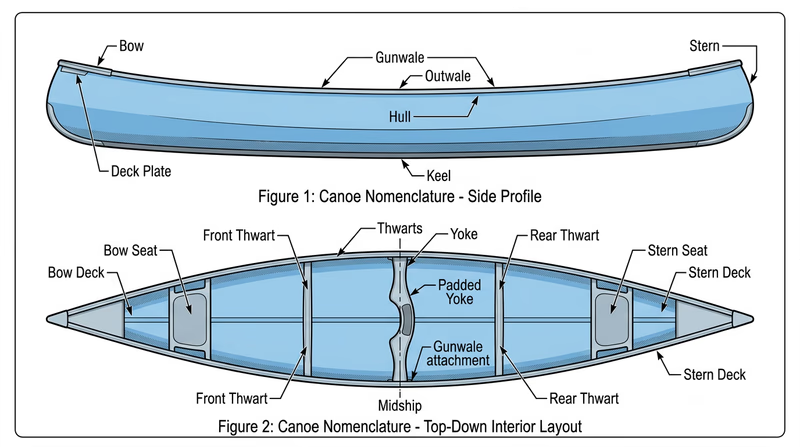
- Req 3a — Name and point out the major parts of a canoe
- Req 3b — Describe how the length and shape of a canoe affect its performance
Knowing your canoe inside and out is the foundation of good paddling. When your counselor says “grab the thwart” or “check the gunwale,” you need to know exactly what they mean — and when you are choosing a canoe for a trip, understanding how shape affects performance will help you pick the right boat.
Parts of a Canoe
A canoe has a deceptively simple design, but every part serves a purpose.
Hull and Structure
- Hull — The body of the canoe. Everything else is attached to or built into the hull. The hull’s shape determines how the canoe moves through water.
- Bow — The front end of the canoe. The bow paddler sits here.
- Stern — The back end of the canoe. The stern paddler sits here and is responsible for steering.
- Keel — A ridge or strip running along the bottom center of the hull from bow to stern. Not all canoes have a visible keel, but the keel line (the hull’s bottom centerline) is always there. A pronounced keel helps the canoe track straight; a flat or shallow keel makes it easier to turn.
- Gunwales (pronounced “gunnels”) — The top edges of the canoe running along both sides from bow to stern. Gunwales provide structural rigidity and give you a place to grip when carrying the canoe.
- Thwarts — Cross-pieces that span the canoe from gunwale to gunwale. Thwarts hold the canoe’s shape and provide structural support. The center thwart is often used as a yoke for portaging.
- Yoke — A specially shaped thwart (often with shoulder pads) at the center of the canoe, designed for carrying the canoe inverted on your shoulders during portages.
- Seats — Mounted between the gunwales near the bow and stern. Canoe seats are typically positioned so you face forward. The bow seat is wider and set farther from the end; the stern seat is narrower and closer to the end.
- Decks (or deck plates) — Small triangular pieces at the bow and stern that cap the gunwales where they come together. Decks add strength and provide a grab point.
- Ribs — Curved internal supports running across the bottom of the hull. Found mainly in traditional wood-and-canvas canoes, ribs give the hull its shape and strength.
- Planking — Thin strips of wood running lengthwise inside a wood-and-canvas canoe, layered over the ribs. In modern canoes, the hull material itself replaces traditional planking.
How Length and Shape Affect Performance
Two canoes can look similar at a glance but behave completely differently on the water. Length, width, hull shape, and rocker all affect how a canoe tracks, turns, and handles waves.
Length
- Longer canoes (17–18.5 feet) are faster, track straighter, and carry more gear. They are ideal for lake touring, tripping, and tandem paddling. The tradeoff: they are harder to turn and heavier to portage.
- Shorter canoes (14–16 feet) are more maneuverable and lighter. They turn quickly, making them better for rivers and tight spaces. The tradeoff: they are slower on open water and carry less.
Width (Beam)
- Wider canoes feel more stable when you first sit in them (called initial stability). They are forgiving for beginners. But they are slower because they push more water aside.
- Narrower canoes feel tippy at first but are actually more stable in rough water (called secondary stability or final stability). They slice through the water efficiently.
Hull Shape
The cross-section of the hull — what you see if you could slice the canoe in half and look at the cut edge — determines stability and speed.
- Flat bottom — High initial stability (feels steady). Good for calm water. Can feel unstable in waves.
- Rounded bottom — Lower initial stability (feels tippy). Excellent secondary stability and speed. Preferred for experienced paddlers and rough water.
- Shallow-V bottom — A compromise between flat and round. Good tracking with reasonable stability.
- Shallow arch — Similar to rounded but with a gentler curve. Efficient and stable. Common in modern touring canoes.
Rocker
Rocker is the upward curve of the hull from the center toward the bow and stern. Imagine setting a canoe on flat ground and looking at it from the side — a canoe with more rocker looks like a banana, while one with less rocker sits flat.
- More rocker — The canoe pivots easily and turns quickly. Great for rivers and maneuvering. Poor for tracking straight on a lake.
- Less rocker — The canoe tracks straight with less effort. Good for lakes and long-distance paddling. Harder to turn.
Canoe Materials
Modern canoes are made from a variety of materials, each with tradeoffs:
| Material | Weight | Durability | Cost | Best For |
|---|---|---|---|---|
| Aluminum | Medium | Very high | Low–Medium | Camp programs, rental fleets |
| Polyethylene | Heavy | Very high | Low | Beginner-friendly, rocky rivers |
| Fiberglass | Medium | Medium | Medium | Touring, recreational use |
| Kevlar | Very light | Medium | High | Portaging, long-distance tripping |
| Royalex/T-Formex | Medium | High | Medium–High | Whitewater, all-around |
| Wood/Canvas | Medium–Heavy | Low–Medium | High | Traditional craft, beauty |
Now that you know your canoe, let’s get to know your paddle — the tool that makes it all work.