Req 4 — Paddle Anatomy & Sizing
This requirement covers two topics about your paddle:
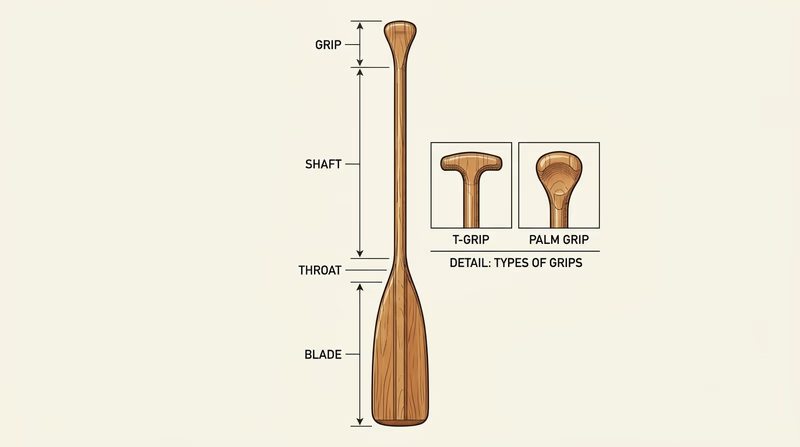
- Req 4a — Name and point out the parts of a paddle
- Req 4b — Demonstrate how to correctly size a paddle for sitting and kneeling positions
Your paddle is your engine, your rudder, and your brake — all in one tool. Understanding its parts and choosing the right size makes every stroke more efficient and every hour on the water more comfortable.
Parts of a Paddle
A canoe paddle has four main parts, each designed for a specific function.
Grip
The top of the paddle where your upper hand (the control hand) holds on. Grips come in two common shapes:
- T-grip — A horizontal bar that gives you a firm, precise hold. Preferred for whitewater and maneuvering because you can feel exactly what angle the blade is at.
- Palm grip (or pear grip) — A rounded, egg-shaped grip that fits comfortably in your palm. Preferred for long-distance paddling because it reduces hand fatigue.
Shaft
The long, straight section between the grip and the blade. Your lower hand (the power hand) grips the shaft. Shafts can be round, oval, or slightly flattened. An oval shaft helps you feel the blade angle without looking down. Some paddles have a bent shaft (angled about 12–14°) designed for flatwater efficiency.
Throat
The point where the shaft flares into the blade. The throat transfers your stroke force from the shaft into the blade. It is the transition zone — not a grip point.
Blade
The wide, flat section at the bottom of the paddle that moves through the water. The blade does the actual work of pushing water to propel and steer the canoe. Blades vary in width, length, and shape:
- Wider blades catch more water per stroke but require more effort.
- Narrower blades are easier on your body for long paddles but move less water per stroke.
- The power face is the side of the blade that pushes against the water during a forward stroke. The back face is the opposite side.
- The tip is the bottom edge of the blade.
Sizing a Paddle
Using a paddle that is too long or too short makes paddling harder and less efficient. The correct length depends on your body size and whether you paddle from a sitting or kneeling position.
Sizing for a Sitting Position
- Sit in the canoe seat (or on a chair that is the same height).
- Hold the paddle upside down so the grip rests on the seat between your legs.
- Reach out with one hand and grip the shaft at the throat (where it meets the blade).
- Your upper arm should be roughly parallel to the ground — bent at about a 90° angle at the elbow.
- If you have to reach up, the paddle is too long. If your arm angles downward, it is too short.
Quick rule of thumb: When sitting, the paddle should reach from the seat to your chin or nose.
Sizing for a Kneeling Position
Kneeling lowers your body closer to the water, so you need a shorter paddle.
- Kneel on the ground (or in the canoe) as you would when paddling.
- Use the same upside-down method: grip rests on the ground between your knees, reach for the throat.
- Your arm should again be at roughly a 90° angle.
Quick rule of thumb: When kneeling, the paddle should reach from the floor to your chin or just below.
Why Sizing Matters
A properly sized paddle means:
- Efficient strokes — The blade enters and exits the water at the right angle, maximizing power transfer.
- Less fatigue — You are not reaching too far or lifting too high with each stroke.
- Better control — A properly sized paddle responds predictably to steering strokes.
- Fewer injuries — Oversized paddles strain your shoulders and back over time.
Paddle Materials
Like canoes, paddles come in different materials:
| Material | Weight | Durability | Cost | Best For |
|---|---|---|---|---|
| Wood | Medium | Medium | Medium | Traditional feel, all-around use |
| Aluminum shaft / plastic blade | Medium | High | Low | Camp programs, rentals |
| Fiberglass | Light | Medium–High | Medium–High | Touring, recreational |
| Carbon fiber | Very light | Medium | High | Racing, long-distance touring |

You know your canoe and your paddle. Now let’s gear up with the most important piece of safety equipment — your life jacket.