Req 5c — Safety & Rescue Equipment
A life jacket keeps you afloat, but it is not the only safety equipment your canoe needs. Each piece of gear listed in this requirement solves a specific problem — and when that problem arises on the water, you will be very glad you brought it.
Sound Signal Device
A whistle is the simplest, most reliable sound signal. It works when your voice cannot carry over wind, waves, or distance. Three sharp blasts on a whistle is the universal distress signal on the water. Unlike your voice, a whistle does not get hoarse or drowned out by wind.
Clip a whistle to your life jacket where you can reach it without looking. Pealess whistles (like the Fox 40) work even when wet and have no moving parts to fail.
Extra Paddle
If your primary paddle breaks, slips out of your hands, or floats away during a capsize, you need a backup. An extra paddle keeps you from being stranded on the water with no way to move or steer. Carry at least one spare per canoe — stowed along the bottom or secured under the thwarts so it does not shift around.
Sponge
Water gets into canoes — from rain, splashing, wet gear, and paddle drip. A large sponge lets you soak up small amounts of water that collect in the bilge (the bottom of the hull). Keeping the canoe dry improves stability and prevents gear from getting soaked. A regular kitchen sponge or a boat sponge both work.
Bailer
A bailer handles larger amounts of water than a sponge can manage. The simplest bailer is a cut-open plastic jug — slice a gallon milk jug diagonally, keep the handle, and you have a lightweight scoop that moves a lot of water fast. A bailer is essential after a capsize recovery when the canoe is partially swamped.
Bilge Pump
A hand-operated bilge pump is a step up from a bailer. It moves water out of the canoe quickly and efficiently — useful for larger canoes or situations where a lot of water has come in. Not every canoe needs a bilge pump, but for open-water paddling or trips where swamping is more likely, it is worth carrying.
Rescue Sling
A rescue sling (also called a stirrup) is a loop of webbing or rope that hangs over the side of a canoe. A swimmer in the water can step into the sling and use it as a foothold to climb back into the canoe. Without a sling, reboarding a canoe from deep water is much harder — especially for tired or cold swimmers.
Ropes
Short lengths of rope (called painters) are typically attached to the bow and stern of the canoe. Painters are used for:
- Tying up the canoe at a dock or shore
- Towing a swamped canoe to shallow water
- Lining the canoe through shallow rapids (walking along the bank while guiding the canoe with ropes)
- Rescue — throwing a line to a swimmer or securing the canoe during an emergency
Painters should be 10–15 feet long, made of floating rope (polypropylene), and neatly coiled or stowed so they do not become a tangling hazard.
Throw Bag
A throw bag is a nylon bag filled with coiled rope, designed to be thrown to a person in the water. You grip the free end of the rope, toss the bag underhand toward the swimmer, and the rope pays out as the bag flies. Throw bags are standard rescue equipment for any paddlesport.
You will practice using a throw bag in Requirement 8f — where you need to land the rope within 3 feet of a swimmer 30 feet away.
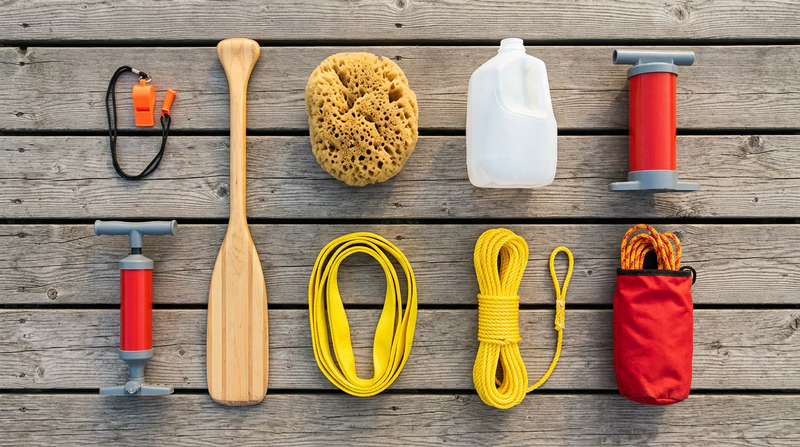
Canoe Safety Equipment
Required gear for every outing
- Sound signal device (whistle): Clipped to your PFD.
- Extra paddle: Stowed securely in the canoe.
- Sponge: For minor water removal.
- Bailer: Cut-jug or similar scoop for swamped canoe.
- Rescue sling: Loop of webbing for deep-water reboarding.
- Painters (bow and stern): 10–15 ft floating rope, neatly coiled.
- Throw bag: For reaching swimmers from shore or canoe.
You know the gear. Now let’s learn how to take care of it — along with your canoe and paddles.