Req 8d — Deep Water Canoe Rescue
8d.
In deep water, rescue a swamped canoe and its paddlers. After checking that those in the water do not need immediate assistance, empty the swamped canoe and help the paddlers safely reenter their boat without capsizing.
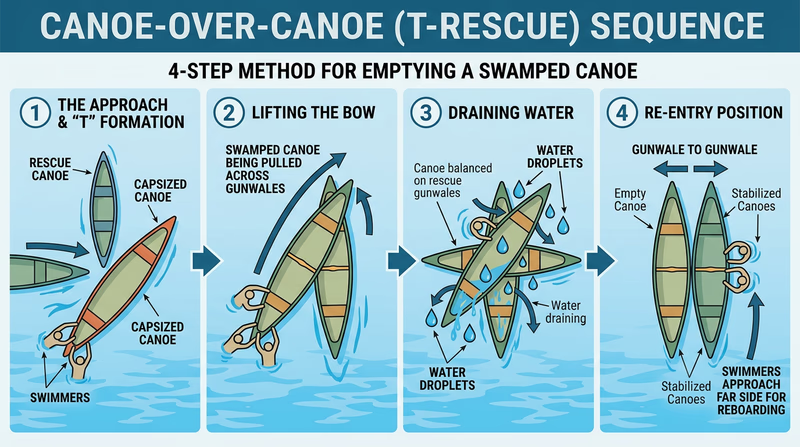
The canoe-over-canoe rescue (also called the T-rescue) is the classic deep-water technique for emptying a capsized or swamped canoe without going to shore. You perform it from your own canoe while the other paddlers float in the water. It is a team effort that requires communication, coordination, and practice.
Step 1: Approach and Assess
When you see a capsized canoe with paddlers in the water:
- Paddle to the scene quickly but calmly. Approach perpendicular (at a right angle) to the capsized canoe.
- Check on the swimmers first. Before touching the swamped canoe, make sure both paddlers are conscious, breathing, and not injured. Ask: “Are you okay? Is anyone hurt?”
- If anyone needs immediate help (unconscious, panicking, or injured), prioritize the swimmer rescue (see Requirement 8e) before dealing with the canoe.
- Direct the swimmers to hold onto the far end of their capsized canoe. This keeps them supported and out of the way during the rescue.
Step 2: Position for the T-Rescue
- Approach the capsized canoe broadside so the two canoes form a T shape — your canoe is the crossbar, their canoe is the stem.
- If the swamped canoe is upside down, the swimmers can flip it right-side up first. Or you can roll it during the next step. Either approach works.
- Your partner stabilizes your canoe by leaning to the opposite side as a counterbalance while you do the lifting.
Step 3: Lift and Drain
This is the physically demanding part:
- Grab the bow (or stern) of the swamped canoe and begin pulling it up and across your gunwales.
- Pull it across your canoe perpendicular to your gunwales — the swamped canoe slides across your canoe like a seesaw, with the center of the swamped canoe resting on your gunwales.
- As the canoe comes out of the water, it drains. Rock it gently back and forth to get the last of the water out.
- Slide the now-empty canoe back into the water right-side up, parallel to your canoe. The two canoes should be side by side, gunwale to gunwale.
Step 4: Stabilize for Reentry
- Hold the two canoes together gunwale to gunwale. Both you and your partner grip the gunwales of both canoes. This creates a very stable platform.
- Direct the swimmers to approach the far side of their now-empty canoe.
- One swimmer at a time reenters their canoe by pulling themselves over the far gunwale (the side away from your canoe). They enter near the center of the canoe, keeping weight low.
- The counterbalance from your canoe prevents the empty canoe from tipping as the swimmers climb in.
- Once both paddlers are aboard and settled, release the canoes and separate.
Communication During the Rescue
Clear communication makes this rescue work smoothly:
- Rescue canoe: “Are you both okay? Hold the far end of your canoe.”
- Rescue canoe: “I am going to pull your canoe across ours. Stay clear.”
- Rescue canoe: “Your canoe is drained. Come around to the far side.”
- Rescue canoe: “One at a time — climb in at the center, stay low.”
- Rescue canoe: “You are in. We are going to let go now.”
You can rescue a swamped canoe and its crew from deep water. Next, you will learn how to rescue a swimmer from your canoe.