Req 9 — Tandem Maneuvers
This requirement covers eight tandem maneuvers that put everything you have learned together. You and your partner will demonstrate these while paddling on opposite sides without switching, from both bow and stern positions. These are the strokes that make a canoe do exactly what you want it to do.
Before diving into each maneuver, you need to understand the individual strokes that make them work.
The Core Strokes
Forward Stroke
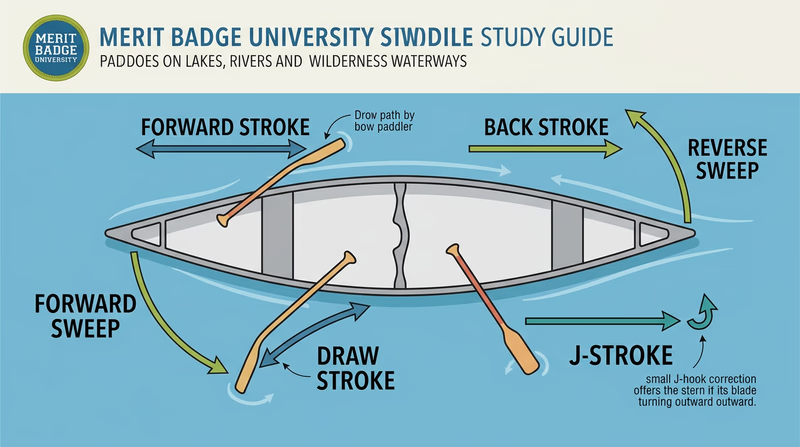
The foundation of paddling. Plant the blade fully in the water near the bow, pull straight back along the gunwale, and exit the blade at your hip. Keep the shaft vertical for maximum power. Your upper hand pushes forward while your lower hand pulls back.
Back Stroke (Reverse Stroke)
The forward stroke in reverse. Plant the blade at your hip and push forward toward the bow. Used for stopping and moving backward.
Draw Stroke
Pulls the canoe sideways toward your paddle. Reach out to the side (away from the canoe), plant the blade parallel to the keel line, and pull it straight toward you. Slice the blade back out through the water (or lift it out) and repeat.
Pushaway Stroke (Pry)
The opposite of the draw. Start with the blade alongside the canoe, near the hull, and push it away from the canoe. This moves the canoe away from your paddle side.
Forward Sweep
A wide, arcing stroke that starts at the bow and sweeps outward in a half-circle to the stern. Used to turn the canoe. In the bow, a forward sweep turns the canoe away from your paddle side. In the stern, a forward sweep turns the canoe toward your paddle side.
Reverse Sweep
The forward sweep in reverse — a wide arc from stern to bow. In the bow, a reverse sweep turns the canoe toward your paddle side.
J-Stroke
The essential stern steering stroke. Begin with a normal forward stroke, but at the end, rotate the blade outward and push away from the hull in a small “J” shape. This corrects the canoe’s natural tendency to turn away from the stern paddler’s stroke side. Keeps the canoe tracking straight without switching sides.
Thumb-Down Rudder Stroke
An alternative steering stroke for the stern. After a forward stroke, rotate your thumb down on the grip and trail the blade behind you at an angle, using it as a rudder. A slight push outward (stern pry) adds additional correction. Some paddlers find this more natural than the J-stroke.
The Eight Maneuvers
9a — Pivot (Spin) 180°
What you do: From a standstill, spin the canoe 180° to the right, stop, then spin 180° back to the left — staying within 2 boat lengths of your starting position.
How it works:
- To pivot right: The bow paddler (paddling on the left) does a forward sweep while the stern paddler (paddling on the right) does a reverse sweep. Or, the bow paddler draws while the stern paddler does a pushaway. Both actions rotate the canoe clockwise.
- To pivot left: Reverse the strokes. The bow paddler does a reverse sweep (or pushaway) and the stern paddler does a forward sweep (or draw).
- Stay in place: Keep the strokes balanced so the canoe spins around its center without drifting forward or backward.
9b — Move Sideways (Abeam)
What you do: Move the canoe sideways 10 feet in one direction, then return to the starting position. The canoe stays parallel to its original orientation — no turning.
How it works:
- Both paddlers use draw strokes on the same side to pull the canoe that direction. Or, one draws while the other pushes away — both moving the canoe the same way.
- To return: Switch — the paddler who was drawing now does a pushaway, and the other draws.
- Keep the canoe straight. If the bow or stern starts to lead, one paddler adjusts their stroke power or angle.
9c — Emergency Stop
What you do: While paddling forward, stop the canoe within two boat lengths using the backstroke.
How it works:
- Both paddlers simultaneously switch to backstrokes — planting the blade in front and pushing water forward.
- Lean forward slightly as the canoe decelerates to maintain balance.
- Keep strokes in unison so the canoe stops straight rather than spinning.
9d — Straight Line (Stern Only)
What you do: From the stern position, paddle in a straight line for 15–20 boat lengths without help from the bow paddler. Use the J-stroke or thumb-down rudder with or without a stern pry.
How it works:
- This tests your ability to steer from the stern while providing your own power.
- After each forward stroke, apply a J-stroke correction (or a thumb-down rudder) to keep the canoe from veering.
- The correction should be subtle — large corrections waste energy and slow you down.
9e — Straight Line (Tandem)
What you do: Paddle in a straight line for 15–20 boat lengths with the bow paddler using forward strokes, draws, or forward sweeps, and the stern paddler steering with a J-stroke or thumb-down rudder.
How it works:
- The bow provides power with forward strokes. If the canoe drifts off course, the bow can add a slight draw or forward sweep to pull the bow back in line.
- The stern provides power and steering using the J-stroke or rudder stroke.
- This is how you actually paddle a canoe across a lake — it is the everyday tandem technique.
9f — 90° Turn in an Arc
What you do: While paddling forward, turn the canoe 90° to the right in an arc covering 5–10 boat lengths. The bow uses a draw or forward sweep; the stern uses only the forward stroke. Then repeat turning 90° to the left.
How it works:
- Turning right (when the bow paddles left): The bow paddler applies a draw stroke or forward sweep that pulls the bow to the right. The stern paddler keeps paddling forward — their strokes on the right side naturally help the turn.
- Turning left: The bow paddler switches technique to push the bow left (forward sweep on the right, or draw if paddling on the right side).
- The key is a smooth, gradual turn — not a sharp pivot. Think of tracing a wide curve on the water.
9g — Paddle Backward
What you do: Move the canoe backward in a straight line for 3–4 boat lengths using backstrokes, reverse sweeps, or draws.
How it works:
- Both paddlers use backstrokes — pushing water forward from the hip to the bow.
- Reverse sweeps help keep the canoe straight while backing up.
- The bow paddler (now effectively the “stern” since you are moving backward) is responsible for steering during reverse.
- Moving backward is awkward because you cannot see where you are going. Turn your head and look over your shoulder.
9h — Figure Eight
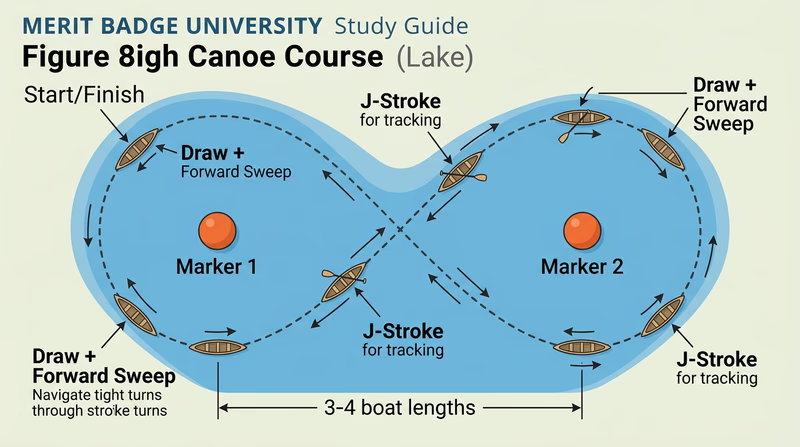
What you do: Complete a figure-eight course around two markers set 3–4 boat lengths apart.
How it works:
- This combines everything — forward strokes for speed, draw strokes and sweeps for turning, and J-strokes for tracking between turns.
- Plan your arcs. Approach each marker with enough room to make a smooth turn. Cutting it too close forces a tight spin that kills your momentum.
- Communicate. The bow and stern need to coordinate their strokes — especially when transitioning from a right turn into a left turn (or vice versa).
- This maneuver demonstrates your overall canoe control — it is the final exam of tandem skills.
Tips for All Maneuvers
Tandem Maneuver Keys
Keep these in mind for every skill
- Paddle in unison: Match your partner’s stroke rate and timing.
- Communicate: Call out strokes and transitions. “Draw.” “Sweep.” “Stop.”
- Stay on opposite sides: Do not switch paddle sides during a maneuver.
- Demonstrate from both positions: Bow and stern, both sides of the canoe.
- Keep the canoe trimmed: Your weight should keep the canoe level bow to stern.
- Stay low: Kneeling gives you more stability during technical maneuvers.
You have mastered the strokes, the maneuvers, and the rescues. You are a canoeist. But there is always more to explore — read on for ways to take your paddling further.