 Getting Started
Introduction & Overview
Everything around you is chemistry. The water you drink, the food you eat, the clothes you wear, the phone in your pocket — all of it exists because of chemical reactions and the properties of matter. The Chemistry merit badge pulls back the curtain on how the world works at the molecular level, and once you start seeing chemistry in everyday life, you will never look at things the same way again.
This guide will walk you through each requirement, giving you the background knowledge, hands-on experiment tips, and real-world connections you need to earn this badge with confidence.
Then and Now
Then — The Age of Alchemy
Long before chemistry was a science, it was a mystery. Ancient alchemists in Egypt, China, and the Middle East spent centuries mixing substances in search of the “philosopher’s stone” — a legendary material they believed could turn lead into gold and grant eternal life. They never found it, but along the way they discovered real things: how to distill liquids, extract metals from ore, and create dyes, inks, and medicines.
- Key figure: Antoine Lavoisier (1743–1794), often called the “Father of Modern Chemistry,” proved that burning was a chemical reaction with oxygen — not a magical substance called “phlogiston.” He also established the law of conservation of mass: matter is never created or destroyed, only rearranged.
- Mindset: Trial and error, secrecy, a blend of science and superstition
Now — Chemistry Everywhere
Today, chemistry is one of the most important sciences on the planet. Chemists develop life-saving medicines, create stronger and lighter materials, design cleaner energy sources, and figure out how to clean up pollution. The COVID-19 vaccines were developed using chemistry and biochemistry. Biodegradable plastics, water purification systems, and even the flavor of your favorite snack — all chemistry.
- Key breakthroughs: mRNA vaccines, biodegradable polymers, lithium-ion batteries, water desalination membranes
- Mindset: Solve real-world problems, from human health to climate change
Get Ready! Chemistry is not just beakers and lab coats — it is the science of everything. By the time you finish this badge, you will have conducted real experiments, learned to read safety documents like a pro, and discovered how chemistry connects to cooking, camping, first aid, and the environment.
Kinds of Chemistry
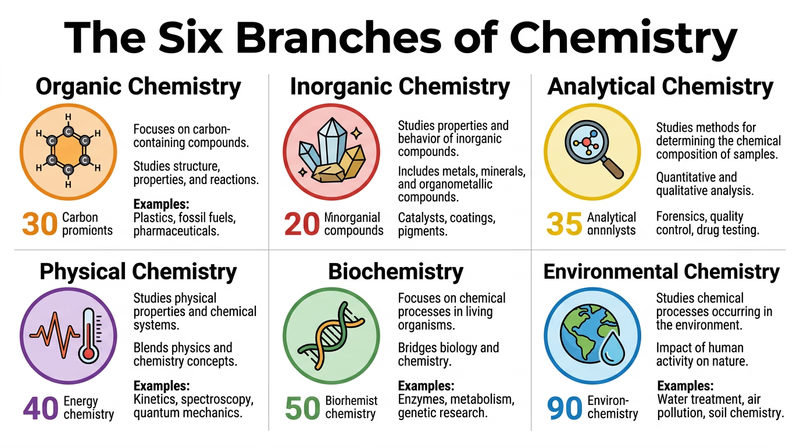
Chemistry is a big field, and scientists have divided it into several branches. Here is a look at the major areas you will encounter as you work through this merit badge.
Organic Chemistry
Organic chemistry studies molecules built around carbon atoms. Carbon is special because it can form long chains and rings, creating an enormous variety of compounds. Everything from the sugar in your cereal to the plastic in your water bottle to the DNA in your cells is organic chemistry.
Inorganic Chemistry
Inorganic chemistry covers everything that is not carbon-based — metals, minerals, salts, and ceramics. The iron in a bridge, the silicon in a computer chip, and the calcium in your bones all fall under inorganic chemistry.
Analytical Chemistry
Analytical chemists are detectives. They figure out what substances are made of and how much of each ingredient is present. When a water treatment plant tests for lead, or a forensic lab analyzes evidence from a crime scene, that is analytical chemistry in action.
Physical Chemistry
Physical chemistry explores why reactions happen and how energy flows during them. Why does ice melt? Why do some reactions release heat while others absorb it? Physical chemists use math and physics to answer these questions.
Biochemistry
Biochemistry is where chemistry meets biology. It studies the chemical processes inside living things — how your body breaks down food for energy, how plants convert sunlight into sugar, and how medicines interact with your cells.
Environmental Chemistry
Environmental chemistry looks at how chemicals move through air, water, and soil — and what happens when pollutants enter those systems. Environmental chemists work on cleaning up contaminated sites, developing greener products, and understanding climate change.
Now that you know what chemistry is all about, it is time to start with the foundation of every safe experiment — understanding chemical hazards and how to protect yourself.