Req 1c — Safety Pictograms
You have probably seen those small diamond-shaped symbols with red borders on cleaning products, paint cans, or laboratory chemicals. Those are GHS pictograms — a universal visual language that tells you about a chemical’s hazards at a glance, even if you cannot read the label’s language.
The Nine GHS Pictograms
The Globally Harmonized System uses nine standard pictograms. Each one warns about a specific type of hazard:
| Pictogram | Name | What It Means |
|---|---|---|
| Flame | Flammable | Can catch fire easily. Includes flammable liquids, gases, and solids. |
| Flame over circle | Oxidizer | Can cause or intensify a fire by providing oxygen. |
| Exploding bomb | Explosive | Can explode under certain conditions (heat, shock, friction). |
| Skull and crossbones | Acute toxicity (severe) | Can cause death or serious harm with a single exposure. |
| Exclamation mark | Irritant / Harmful | Can cause less serious health effects like skin or eye irritation. |
| Health hazard | Serious health hazard | Can cause long-term health problems like cancer, organ damage, or respiratory sensitization. |
| Corrosion | Corrosive | Destroys skin tissue or corrodes metals on contact. |
| Gas cylinder | Gas under pressure | Contains gas stored under pressure. May explode if heated. |
| Environment | Environmental hazard | Toxic to aquatic life or the environment. |
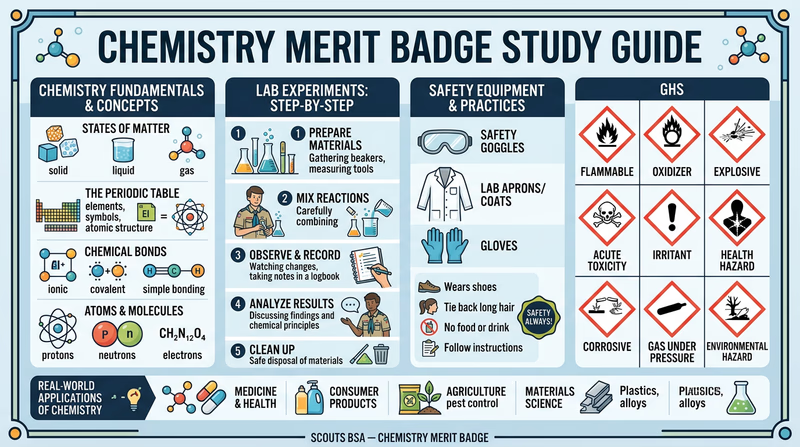
What Pictograms Do Your Three Chemicals Have?
When you look at Section 2 of each SDS, here is what you will typically find:
Sucrose (sugar): Usually no GHS pictograms at all. Sugar is not classified as hazardous under the GHS system. Some SDS documents may note minor dust irritation, but it does not warrant a pictogram.
Isopropyl alcohol: You will likely see two pictograms:
- Flame — It is a flammable liquid (flash point around 12°C / 53°F)
- Exclamation mark — It can cause eye irritation and drowsiness if inhaled
Waterproofing spray: Typically shows three or more pictograms:
- Flame — Extremely flammable aerosol
- Exclamation mark — Irritant to eyes and skin
- Health hazard — May cause respiratory damage if inhaled
- Environment — Some formulas are toxic to aquatic life
Pictograms in Your Community
Once you know what to look for, you will start noticing GHS pictograms everywhere:
- At home — Oven cleaner, drain cleaner, bleach, spray paint, nail polish remover, and lighter fluid all carry pictograms.
- At school — Chemistry labs, art rooms (solvents, glazes), and custodial supply closets all have chemicals with pictograms on the labels.
- In your community — Gas stations (fuel pumps), hardware stores (paints and adhesives), swimming pool supply shops (chlorine), and farms (pesticides and fertilizers) all use GHS-labeled products.
- On the road — Delivery trucks carrying hazardous materials display placards that are closely related to GHS pictograms.
Signal Words
In addition to pictograms, Section 2 of the SDS includes a signal word that tells you how severe the hazard is:
- Danger — Used for more severe hazards. If you see this word, take extra precautions.
- Warning — Used for less severe hazards. Still take it seriously, but the risk is lower.
- No signal word — The chemical is not classified as hazardous (like sucrose).