Req 3b — pH & Indicators
Red cabbage might not look like a chemistry tool, but it contains a natural pigment that changes color depending on whether a solution is acidic, neutral, or basic. In this experiment, you will make your own pH indicator and use it to test common household liquids.
What Is pH?
pH is a scale that measures how acidic or basic (alkaline) a solution is. The scale runs from 0 to 14:
- 0–6: Acidic (the lower the number, the stronger the acid)
- 7: Neutral (pure water)
- 8–14: Basic/alkaline (the higher the number, the stronger the base)
The “p” in pH stands for the German word Potenz (power), and “H” stands for hydrogen. pH actually measures the concentration of hydrogen ions (H⁺) in a solution. More hydrogen ions = more acidic.
Why Red Cabbage Works
Red cabbage gets its purple color from a class of pigments called anthocyanins. These molecules change their chemical structure — and therefore their color — depending on the pH of their environment:
| pH Range | Color | Type |
|---|---|---|
| 1–3 | Red/Pink | Strong acid |
| 4–6 | Purple/Violet | Weak acid |
| 7 | Blue/Violet | Neutral |
| 8–10 | Blue/Green | Weak base |
| 11–14 | Green/Yellow | Strong base |
This range of color changes makes red cabbage one of the best natural pH indicators available.
Making Your Indicator
Indicator Materials
What you will need
- Red cabbage: About one quarter of a head, chopped into small pieces.
- Boiling water: About 2 cups.
- Pot and stove: To boil the cabbage.
- Strainer or cheesecloth: To separate the liquid from the cabbage.
- Clear cups or glasses: At least six (one for each liquid you test, plus extras).
- Household liquids to test: At least five, including water.
- White paper: Place behind the cups to see colors more clearly.
- Labels or tape: To mark each cup.
Step 1: Chop the red cabbage into small pieces and place them in a pot.
Step 2: Pour boiling water over the cabbage and let it steep for 15–20 minutes. The water should turn a deep purple-blue color.
Step 3: Strain out the cabbage pieces. The purple liquid is your pH indicator. Let it cool to room temperature.
Step 4: Pour equal amounts of indicator into each clear cup (about 2–3 tablespoons).
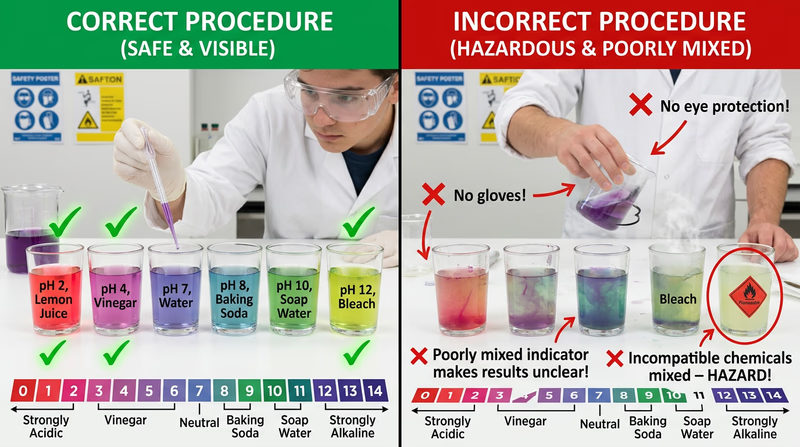
Step 5: Add a small amount of each test liquid to a separate cup and observe the color change.
Suggested Liquids to Test
Here are some common household liquids that give a good range of results:
- Water (pH ~7) — Should stay purple/blue (neutral)
- Lemon juice or white vinegar (pH ~2–3) — Should turn pink/red (acidic)
- Baking soda dissolved in water (pH ~8–9) — Should turn blue/green (basic)
- Milk (pH ~6.5) — Should stay purple with a slight pink tint (slightly acidic)
- Laundry detergent dissolved in water (pH ~10–11) — Should turn green (basic)
Other options: orange juice, soda, soapy water, antacid tablets dissolved in water, or apple juice.
What to Discuss with Your Counselor
When you meet with your counselor, be ready to explain:
- What pH is and how the scale works
- Why red cabbage changes color (anthocyanins change structure with pH)
- Your results — Which liquids were acidic? Basic? Neutral?
- Any surprises — Did any liquid test differently than you expected?
- Real-world applications — Where is pH important? (Swimming pools, aquariums, soil for gardening, human blood, food preservation)
pH in Everyday Life
pH is not just a lab concept — it matters in the real world:
- Swimming pools must maintain a pH of 7.2–7.8 for safety and comfort
- Your blood is kept at a very precise pH of 7.35–7.45; even small changes can be life-threatening
- Soil pH determines which plants can grow; blueberries need acidic soil, while most vegetables prefer slightly acidic to neutral
- Acid rain (pH below 5.6) damages buildings, kills fish, and harms forests
- Your stomach has a pH of 1.5–3.5 — acidic enough to dissolve metal