Req 6 — Five Fields of Chemistry
In the Introduction, we touched on the major branches of chemistry. Now it is time to go deeper. For this requirement, you need to identify five fields, describe what each one does, explain how it connects to your daily life, and discuss how the fields work together.
The Major Fields of Chemistry
1. Organic Chemistry
What it studies: Molecules containing carbon, including the complex molecules that make up living things, fuels, plastics, and medicines.
How it applies to your life: The clothes you wear (polyester, nylon, cotton fibers), the food you eat (carbohydrates, fats, proteins), the medicines you take (aspirin, antibiotics), and the fuel in your family’s car are all products of organic chemistry. Even the soap you used in Requirement 2b is an organic compound.
2. Inorganic Chemistry
What it studies: Compounds that are not carbon-based — metals, minerals, salts, ceramics, and semiconductors.
How it applies to your life: The aluminum in a soda can, the silicon chips in your phone, the iron in a steel bridge, and the titanium dioxide in sunscreen are all inorganic materials. The flame test colors you may have seen in Requirement 4c come from inorganic metal salts.
3. Analytical Chemistry
What it studies: Methods for identifying what substances are made of and measuring how much of each component is present.
How it applies to your life: When your city tests the water supply for lead or bacteria, that is analytical chemistry. When a doctor orders a blood test to check your cholesterol, analytical chemistry is at work. The nutrition labels on food — listing exact amounts of vitamins, minerals, and macronutrients — are the result of analytical chemistry techniques.
4. Physical Chemistry
What it studies: The energy changes that drive chemical reactions, including thermodynamics (heat flow), kinetics (reaction speed), and quantum mechanics (behavior of atoms and electrons).
How it applies to your life: Physical chemistry explains why your hand warmer gets hot (exothermic reaction), why ice melts at 32°F (phase transition energy), and why batteries store energy (electrochemistry). The Maillard reaction you performed in Requirement 3a involves physical chemistry — heat energy drove the chemical change.
5. Biochemistry
What it studies: The chemical processes that occur inside living organisms — how enzymes work, how DNA stores information, how cells produce energy.
How it applies to your life: Biochemistry is behind everything your body does: digesting food, building muscle, fighting infections, and even thinking. The yeast experiment you performed in Requirement 2c demonstrated biochemistry — yeast cells use biochemical pathways to ferment sugar into CO₂ and alcohol.
More Fields Worth Knowing
While you only need five, here are additional fields that show just how broad chemistry is:
- Environmental Chemistry — Studies how chemicals interact with the environment. You explored this in Requirement 5 when you learned about biodegradable plastics and green chemistry.
- Nuclear Chemistry — Studies radioactive elements and nuclear reactions. Powers nuclear energy plants and medical imaging (PET scans, radiation therapy).
- Polymer Chemistry — Studies large molecules made of repeating units. Every plastic item you own is a polymer. Nylon synthesis (Requirement 4d) is polymer chemistry.
- Food Chemistry — Studies the chemical composition and properties of food. The red cabbage indicator (Requirement 3b) is food chemistry in action.
- Forensic Chemistry — Applies chemical analysis to criminal investigations. Drug testing, DNA analysis, and trace evidence analysis all rely on forensic chemistry.
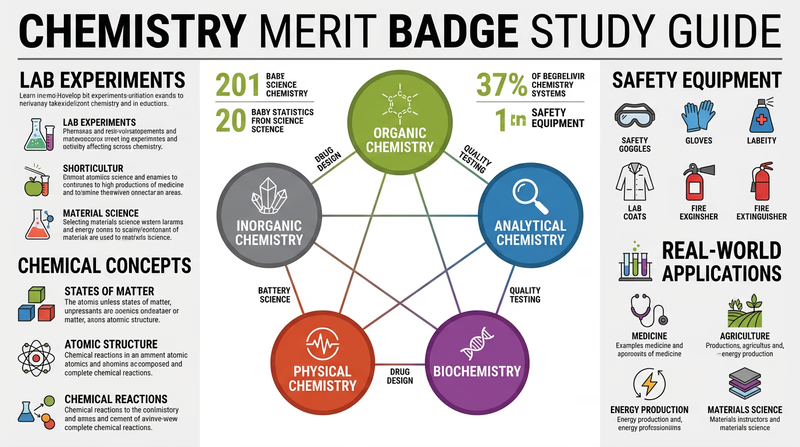
How the Fields Interact
Chemistry fields do not exist in isolation — they constantly overlap and depend on each other:
- Making a new medicine requires organic chemistry (designing the molecule), analytical chemistry (testing its purity), biochemistry (understanding how it interacts with the body), and physical chemistry (determining the best conditions for the reaction).
- Building a better battery combines inorganic chemistry (electrode materials), physical chemistry (energy storage and transfer), and analytical chemistry (measuring performance).
- Developing biodegradable plastic involves organic chemistry (designing the polymer), environmental chemistry (ensuring it breaks down safely), and biochemistry (using bacteria or enzymes in production).