Req 8 — Career Exploration
This is your chance to see chemistry in action beyond the classroom. You will choose one of three options: visiting a research laboratory, touring a chemical plant, or researching a chemistry career. Each option gives you a real-world connection to the science you have been studying.
- Option a: Visit a research laboratory
- Option b: Visit a company or plant that uses chemistry
- Option c: Research chemistry careers
Read through all three options and choose the one that works best for you.
Option A: Visit a Research Laboratory
A research laboratory is where new chemistry happens — where scientists ask questions nobody has answered yet and design experiments to find out. Research labs exist at universities, government agencies, hospitals, and private companies.
Where to find a lab to visit:
- Universities — Most college chemistry departments welcome visitors, especially Scouts working on merit badges. Contact the department office and ask if a professor or graduate student would be willing to give you a tour.
- Government labs — Agencies like the EPA, USDA, and Department of Energy operate research facilities. Some offer public tours or educational programs.
- Hospital labs — Clinical laboratories analyze blood, tissue, and other samples. Ask your family doctor or a local hospital about shadowing opportunities.
Questions to ask the chemist:
- What research are you currently working on?
- What does a typical day look like for you?
- What degree(s) do you have, and where did you study?
- What got you interested in chemistry?
- What is the most surprising discovery you have made?
- What skills beyond chemistry are important in your work?
Option B: Visit a Chemical Company or Plant
Chemistry is the backbone of many industries. Companies that manufacture paints, medicines, plastics, food products, cosmetics, fertilizers, and cleaning supplies all rely on chemical processes every day.
Types of facilities to visit:
- Water treatment plants — Your local municipality treats drinking water and wastewater using chemical processes. Most plants offer free public tours.
- Food manufacturing — Companies that produce beverages, baked goods, or dairy products use chemistry for preservation, flavoring, and quality control.
- Pharmaceutical companies — Drug manufacturers use chemistry at every stage, from drug discovery to quality testing.
- Paint or coatings manufacturers — These companies formulate products using pigments, solvents, resins, and additives.
- Breweries or distilleries — Fermentation is biochemistry in action, and quality control relies on analytical chemistry.
Questions to ask employees:
- What chemical processes does this facility use?
- What safety protocols do you follow? (Connect this to Requirements 1a–1d)
- What products do you make, and who uses them?
- What education or training did you need for your job?
- What is the most interesting part of working here?
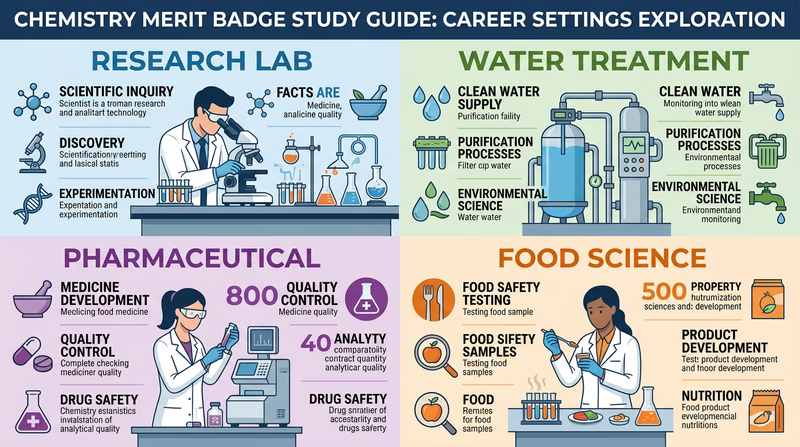
Option C: Research Chemistry Careers
Chemistry opens doors to a wide range of careers. Here are several to consider — but remember, you need to identify at least three and research one in depth.
Career Options in Chemistry
| Career | What They Do | Typical Education |
|---|---|---|
| Chemist | Conducts research, develops new materials, tests substances | Bachelor’s or Master’s in Chemistry |
| Chemical Engineer | Designs large-scale chemical manufacturing processes | Bachelor’s in Chemical Engineering |
| Pharmacist | Dispenses medications, advises patients on drug interactions | Doctor of Pharmacy (PharmD) — 6–8 years |
| Environmental Scientist | Studies pollution, develops cleanup strategies | Bachelor’s in Environmental Science or Chemistry |
| Forensic Scientist | Analyzes crime scene evidence using chemistry | Bachelor’s in Forensic Science or Chemistry |
| Food Scientist | Develops and tests food products for safety and quality | Bachelor’s in Food Science |
| Quality Control Analyst | Tests products to ensure they meet safety and quality standards | Bachelor’s in Chemistry or related field |
| Patent Attorney (Chemistry) | Protects chemical inventions with legal expertise | Chemistry degree + Law degree |
| Science Teacher | Teaches chemistry at middle school, high school, or college | Bachelor’s + teaching certification |
How to Research a Career
For the career you choose, investigate:
- Education requirements — What degrees or certifications are needed? How long does it take?
- Training — Are there internships, residencies, or apprenticeships?
- Costs — What is the cost of the required education? Are scholarships available?
- Employment outlook — Is the field growing? The Bureau of Labor Statistics (BLS) publishes this data.
- Starting salary — What can you expect to earn in your first job?
- Advancement — What does the career ladder look like? Can you move into management, research, or academia?
- Day-to-day work — What does a typical workday look like?