 Getting Started
Introduction & Overview
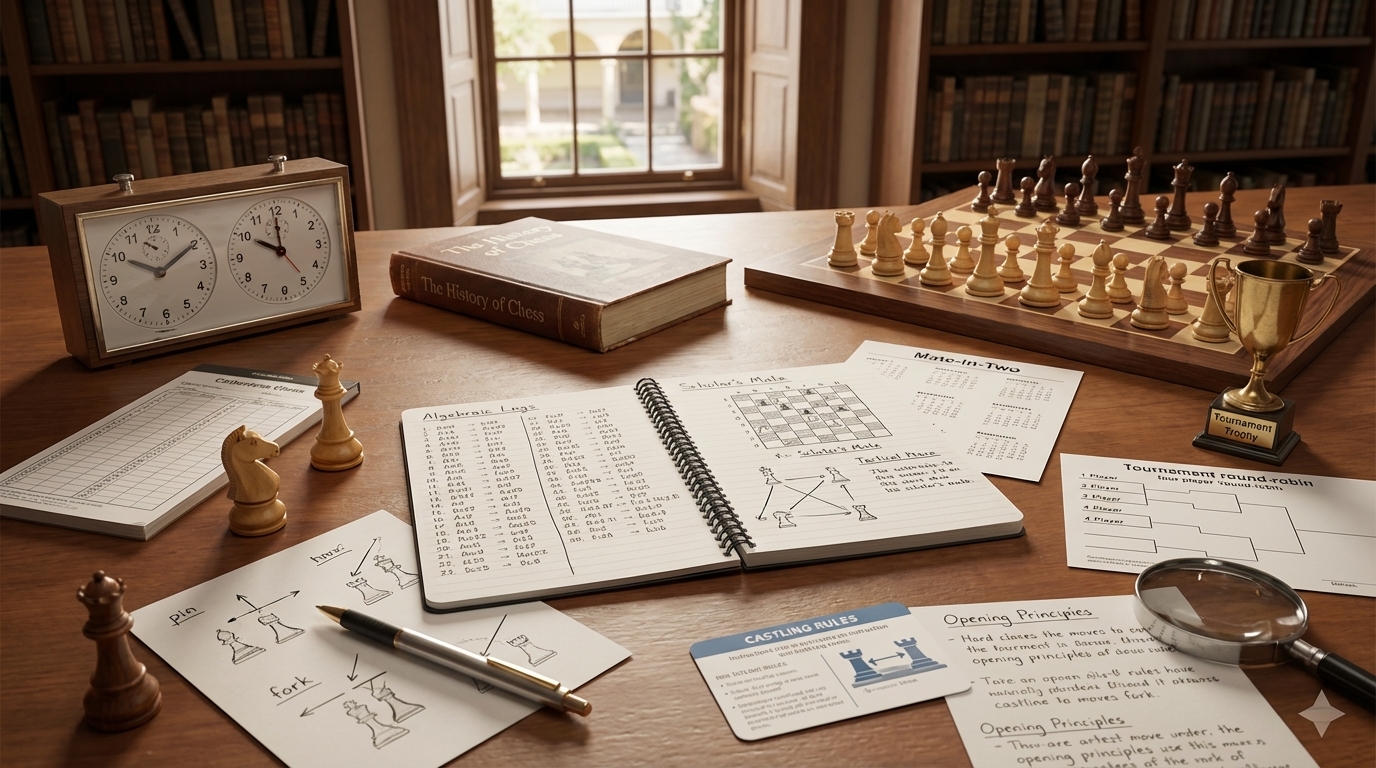
Sixty-four squares. Thirty-two pieces. A game so deep that after just three moves by each side, there are over nine million possible board positions. Chess has captivated generals, scientists, and kids at summer camp for more than a thousand years — and once you learn how to play, you will understand why.
Chess is sometimes called “the game of kings,” but it belongs to everyone. You do not need expensive gear, perfect weather, or a particular playing field. All you need is a board, a set of pieces, and someone willing to sit across from you and think.
Then and Now
Then — From India to the World
Chess was born around the 6th century in India, where it was called Chaturanga — a Sanskrit word meaning “four divisions of the military.” The game featured infantry, cavalry, elephants, and chariots, mirroring the armies of ancient India. Traders and travelers carried Chaturanga westward through Persia, where it became Shatranj, and then across the Islamic world into Europe by the 10th century.
- Tools: Hand-carved ivory or wooden pieces; boards scratched into stone
- Approach: Slow, positional play — the queen was originally the weakest piece, moving only one square diagonally
- Impact: Chess became the training ground for strategic thinking among royalty and military leaders
Now — The Digital Chess Boom
The 21st century transformed chess from a quiet parlor game into a global phenomenon. In 2020, the Netflix series The Queen’s Gambit sparked a massive wave of new players, and online platforms saw registrations surge by hundreds of percent. World Champion Magnus Carlsen became a household name, and chess streamers on Twitch and YouTube turned the game into a spectator sport.
- Tools: Online platforms like Lichess and Chess.com; AI engines like Stockfish and AlphaZero that play at superhuman levels
- Approach: Rapid and blitz formats for fast-paced games; computer analysis to study every move after a game
- Impact: More people play chess today than at any point in history — over 600 million worldwide
Get Ready!
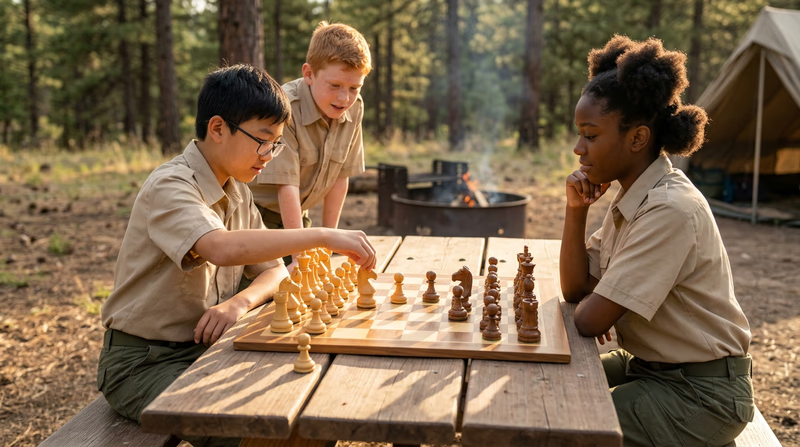
You are about to join a tradition that stretches back fifteen centuries. Whether you end up playing casual games with friends on a camping trip or entering your first tournament, the skills you build with this badge — critical thinking, patience, pattern recognition, and sportsmanship — will serve you in every part of your life.
Kinds of Chess
Classical Chess
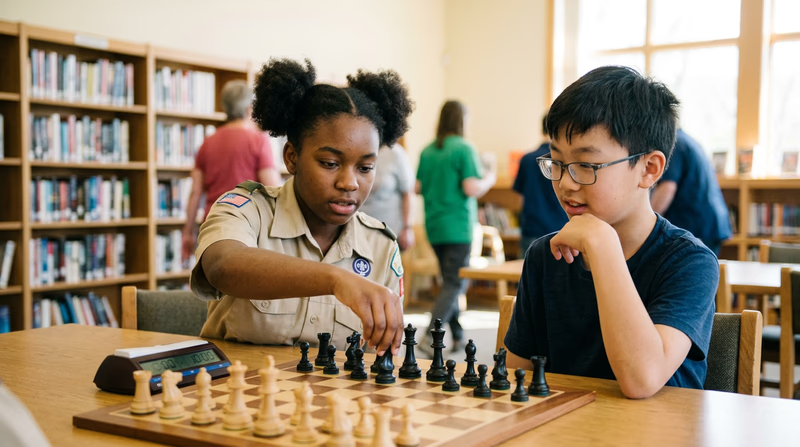
Classical chess is the traditional format — two players, a standard board, and plenty of time to think. Tournament games at the classical level give each player 90 minutes or more, sometimes with additional time added after each move. This is the format used in World Championship matches and is the best way to develop deep analytical skills. When most people picture chess, they picture classical play.
Rapid & Blitz Chess
Not every game needs to last two hours. Rapid chess gives each player 10 to 30 minutes total, while blitz chess shrinks the clock to 3 to 5 minutes per side. The fastest format, bullet chess, allows just 1 to 2 minutes per player for the entire game. These faster time controls test instinct and pattern recognition as much as calculation. They are a great way to practice openings and sharpen your tactical eye.
Online Chess
The internet made chess available to anyone with a phone or computer. Platforms like Lichess (completely free and open-source) and Chess.com offer games against players at every level, puzzles to sharpen your tactics, lessons, and computer analysis of your games. You can play a five-minute blitz game against someone on the other side of the world during a lunch break, then review every move with an engine afterward.
Lichess — Free, Open-Source Chess Play chess for free against players worldwide, solve puzzles, and analyze your games — no ads, no paywalls.Chess Variants
Once you master the standard game, a world of variants awaits. Chess960 (also called Fischer Random), invented by former World Champion Bobby Fischer, randomizes the starting position of the back-rank pieces, forcing players to rely on understanding rather than memorized openings. Bughouse is a team variant where captured pieces can be passed to your partner to place on their board. Three-check and King of the Hill add new win conditions that completely change your strategy.
Ready to make your first move? Let’s start by exploring the rich history of this ancient game and the players who shaped it.