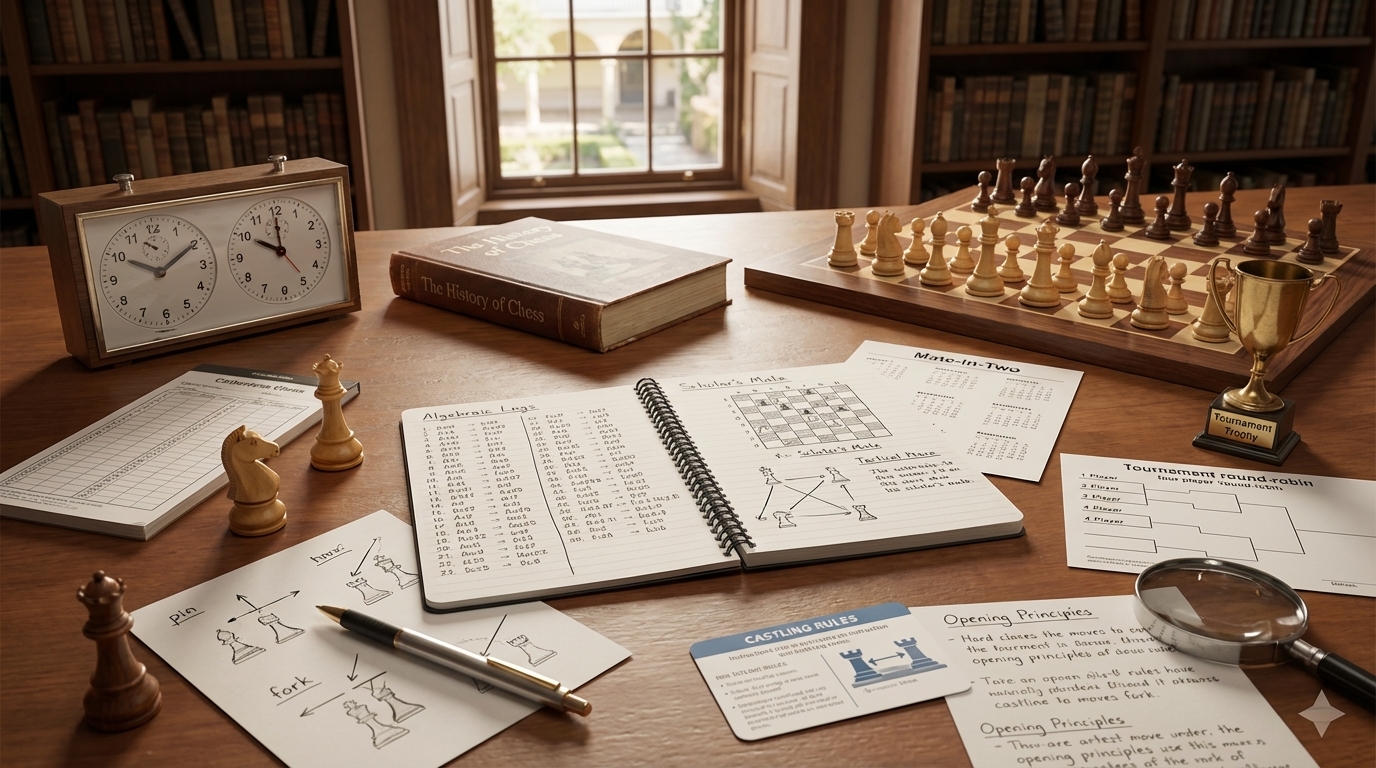
Chess Merit Badge — Complete Digital Resource Guide
https://merit-badge.university/merit-badges/chess/guide/
Introduction & Overview
Sixty-four squares. Thirty-two pieces. A game so deep that after just three moves by each side, there are over nine million possible board positions. Chess has captivated generals, scientists, and kids at summer camp for more than a thousand years — and once you learn how to play, you will understand why.
Chess is sometimes called “the game of kings,” but it belongs to everyone. You do not need expensive gear, perfect weather, or a particular playing field. All you need is a board, a set of pieces, and someone willing to sit across from you and think.
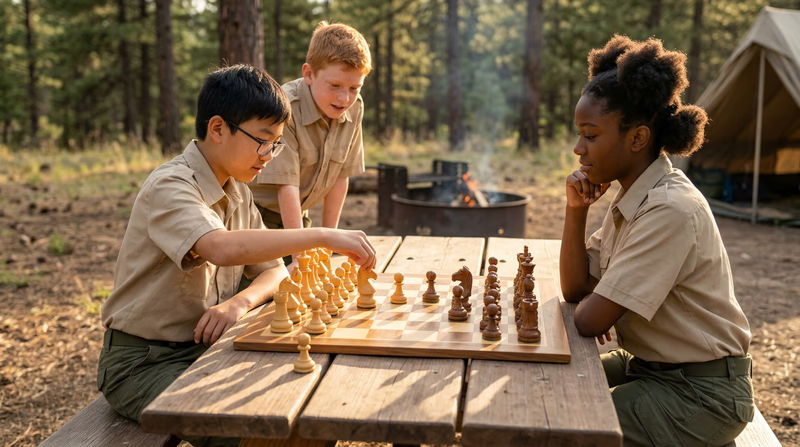
Then and Now
Then — From India to the World
Chess was born around the 6th century in India, where it was called Chaturanga — a Sanskrit word meaning “four divisions of the military.” The game featured infantry, cavalry, elephants, and chariots, mirroring the armies of ancient India. Traders and travelers carried Chaturanga westward through Persia, where it became Shatranj, and then across the Islamic world into Europe by the 10th century.
- Tools: Hand-carved ivory or wooden pieces; boards scratched into stone
- Approach: Slow, positional play — the queen was originally the weakest piece, moving only one square diagonally
- Impact: Chess became the training ground for strategic thinking among royalty and military leaders
Now — The Digital Chess Boom
The 21st century transformed chess from a quiet parlor game into a global phenomenon. In 2020, the Netflix series The Queen’s Gambit sparked a massive wave of new players, and online platforms saw registrations surge by hundreds of percent. World Champion Magnus Carlsen became a household name, and chess streamers on Twitch and YouTube turned the game into a spectator sport.
- Tools: Online platforms like Lichess and Chess.com; AI engines like Stockfish and AlphaZero that play at superhuman levels
- Approach: Rapid and blitz formats for fast-paced games; computer analysis to study every move after a game
- Impact: More people play chess today than at any point in history — over 600 million worldwide
Get Ready!
You are about to join a tradition that stretches back fifteen centuries. Whether you end up playing casual games with friends on a camping trip or entering your first tournament, the skills you build with this badge — critical thinking, patience, pattern recognition, and sportsmanship — will serve you in every part of your life.
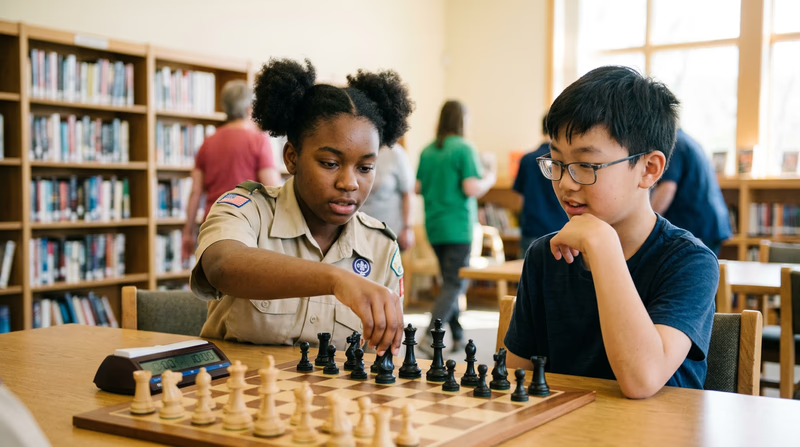
Kinds of Chess
Classical Chess
Classical chess is the traditional format — two players, a standard board, and plenty of time to think. Tournament games at the classical level give each player 90 minutes or more, sometimes with additional time added after each move. This is the format used in World Championship matches and is the best way to develop deep analytical skills. When most people picture chess, they picture classical play.
Rapid & Blitz Chess
Not every game needs to last two hours. Rapid chess gives each player 10 to 30 minutes total, while blitz chess shrinks the clock to 3 to 5 minutes per side. The fastest format, bullet chess, allows just 1 to 2 minutes per player for the entire game. These faster time controls test instinct and pattern recognition as much as calculation. They are a great way to practice openings and sharpen your tactical eye.
Online Chess
The internet made chess available to anyone with a phone or computer. Platforms like Lichess (completely free and open-source) and Chess.com offer games against players at every level, puzzles to sharpen your tactics, lessons, and computer analysis of your games. You can play a five-minute blitz game against someone on the other side of the world during a lunch break, then review every move with an engine afterward.
Lichess — Free, Open-Source Chess Play chess for free against players worldwide, solve puzzles, and analyze your games — no ads, no paywalls. Link: Lichess — Free, Open-Source Chess — https://lichess.orgChess Variants
Once you master the standard game, a world of variants awaits. Chess960 (also called Fischer Random), invented by former World Champion Bobby Fischer, randomizes the starting position of the back-rank pieces, forcing players to rely on understanding rather than memorized openings. Bughouse is a team variant where captured pieces can be passed to your partner to place on their board. Three-check and King of the Hill add new win conditions that completely change your strategy.
Ready to make your first move? Let’s start by exploring the rich history of this ancient game and the players who shaped it.
Req 1a — History of Chess
The story of chess is the story of human civilization itself — a game born in one empire that traveled along trade routes, adapted to new cultures, and evolved into the universal contest of minds we know today.
Ancient Origins: Chaturanga
Chess began as Chaturanga in northern India around the 6th century CE. The name means “four divisions of the military,” and the original game mirrored the Indian army: infantry (which became our pawns), cavalry (knights), elephants (which evolved into bishops), and chariots (rooks). The king and his advisor (the forerunner of the queen) commanded these forces on an 8×8 board called an Ashtāpada.
Chaturanga was the first known game to feature two critical elements that define chess today: different pieces with different powers, and a win condition based on one specific piece (the king).
Westward Through Persia and the Islamic World
When the Sassanid Empire of Persia encountered Chaturanga through trade with India, they adapted it into Shatranj. The Persian contribution was significant — they formalized rules, added the concepts of “Shāh” (king) and “Shāh Māt” (the king is helpless), which gave us the words “check” and “checkmate.”
After the Arab conquest of Persia in the 7th century, Shatranj spread rapidly across the Islamic world. Muslim scholars wrote the first chess books, analyzed positions, and composed chess puzzles called Mansūbāt — some of which survive today and are still challenging to solve. By the 10th century, chess was played from Spain to Central Asia.
Chess Comes to Europe
Chess arrived in Europe through multiple paths — Moorish Spain, Byzantine trade routes, and the Viking networks of Scandinavia. By the 11th century, the game had become a staple of European court life. It was considered one of the essential skills of a knight, alongside riding, swimming, archery, hawking, and poetry.
The biggest transformation came around 1475 in Spain or Italy. The queen — previously the weakest piece, limited to a single diagonal step — was suddenly given the power to move any number of squares in any direction. The bishop gained similar long-range diagonal movement. These changes, sometimes called the “Mad Queen” reform, made chess dramatically faster and more exciting.
The Modern Game Takes Shape
The centuries that followed brought further refinements:
- 1600s–1700s: The Italian and French schools of chess developed competing philosophies. Italians favored bold attacks and sacrifices. The French, led by François-André Philidor, argued that “pawns are the soul of chess” — emphasizing structure and planning.
- 1851: The first international chess tournament was held in London, won by the German player Adolf Anderssen.
- 1886: Wilhelm Steinitz became the first official World Chess Champion, introducing a scientific approach to the game based on positional principles rather than flashy attacks.
- 1924: The Fédération Internationale des Échecs (FIDE) was founded to govern international chess. FIDE remains the world chess organization today.
Chess in the 20th and 21st Centuries
The Cold War turned chess into a proxy battlefield. The 1972 World Championship match between American Bobby Fischer and Soviet Boris Spassky in Reykjavik, Iceland, drew worldwide attention and was dubbed “The Match of the Century.”
In 1997, IBM’s computer Deep Blue defeated World Champion Garry Kasparov — the first time a machine beat a reigning champion under standard tournament conditions. Today, AI engines like Stockfish and Google’s AlphaZero play at levels far beyond any human, and players use these tools to study and improve.
The 2020s brought another explosion. The Netflix series The Queen’s Gambit, chess streamers on Twitch, and the rivalry between Magnus Carlsen and his challengers introduced the game to millions of new players.
Chess History Timeline — Chess.com A detailed interactive timeline of chess history from ancient India to the modern era. Link: Chess History Timeline — Chess.com — https://www.chess.com/article/view/history-of-chessKey Dates to Know
| Year | Event |
|---|---|
| ~600 CE | Chaturanga develops in India |
| ~700 CE | Shatranj spreads through the Islamic world |
| ~1000 CE | Chess reaches Europe |
| ~1475 | “Mad Queen” reform modernizes piece movement |
| 1851 | First international tournament (London) |
| 1886 | First official World Champion (Steinitz) |
| 1924 | FIDE founded |
| 1972 | Fischer vs. Spassky — “The Match of the Century” |
| 1997 | Deep Blue defeats Kasparov |
| 2020 | The Queen’s Gambit sparks global chess boom |
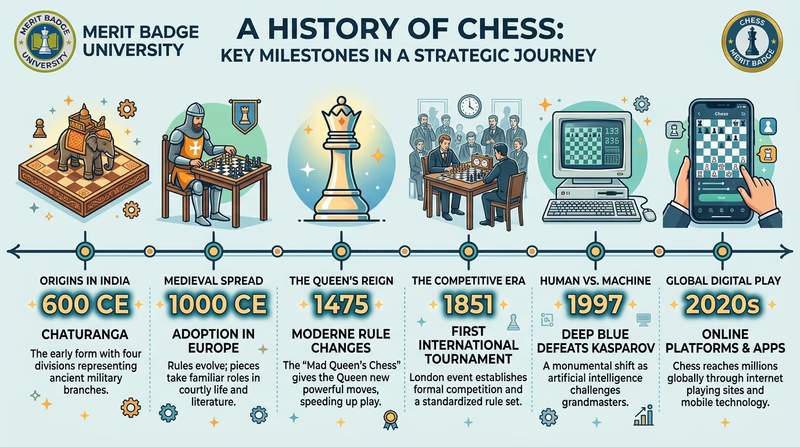
When you discuss chess history with your counselor, think about the big themes: how the game traveled across cultures, how each culture adapted it, and why it has endured for over 1,400 years. Now let’s meet some of the players who made chess history.
Req 1b — Famous Chess Players
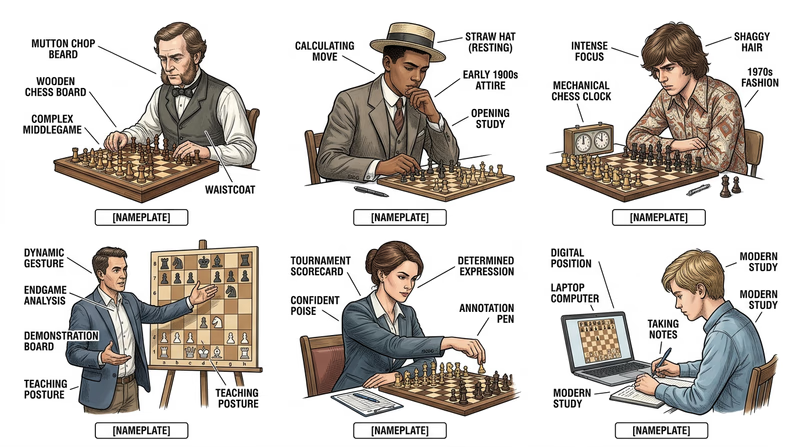
Every generation has produced chess players whose brilliance, personality, or achievements reshaped the game. For this requirement, you will research one player in depth — but first, here is a guide to help you choose. These are some of the most influential players in chess history, along with what made each one stand out.
Players Who Changed the Game
Wilhelm Steinitz (1836–1900)
Steinitz was the first official World Chess Champion (1886–1894). Before him, chess was dominated by wild, sacrificial attacks. Steinitz developed a scientific approach based on accumulating small positional advantages — controlling the center, maintaining a strong pawn structure, and exploiting weaknesses. His ideas were mocked during his lifetime but became the foundation of modern chess.
Key accomplishment: Created the positional school of chess that every serious player studies today.
José Raúl Capablanca (1888–1942)
Known as the “Chess Machine,” the Cuban-born Capablanca was famous for making chess look effortless. He learned the game at age four by watching his father play and went on to become World Champion from 1921 to 1927. His endgame technique is still considered among the finest ever.
Key accomplishment: Lost only 36 serious games in his entire career — a remarkably low number for a top player.
Bobby Fischer (1943–2008)
The American prodigy became the youngest U.S. Champion at age 14 and defeated Boris Spassky in 1972 to become World Champion — breaking decades of Soviet dominance. His 1972 match captivated the world during the Cold War. Fischer also invented Chess960 (Fischer Random Chess) to reduce the influence of opening memorization.
Key accomplishment: Ended Soviet control of world chess and popularized the game in the United States.
Garry Kasparov (1963–present)
Many consider Kasparov the greatest chess player of all time. He became the youngest-ever undisputed World Champion at age 22 in 1985 and held the top ranking for 20 consecutive years — an all-time record. He is also famous for his 1997 match against IBM’s Deep Blue computer, one of the pivotal moments in artificial intelligence history.
Key accomplishment: Dominated chess for two decades and helped launch the era of human-vs-computer competition.
Judit Polgár (1976–present)
The Hungarian grandmaster shattered gender barriers in chess. She became the youngest grandmaster in history at age 15 (breaking Fischer’s record at the time) and competed exclusively in open (non-gender-segregated) tournaments. She defeated multiple World Champions, including Kasparov, Karpov, and Spassky.
Key accomplishment: Proved that women could compete at the absolute highest level in chess, reaching a peak world ranking of #8.
Magnus Carlsen (1990–present)
The Norwegian became World Champion in 2013 and held the title until he chose not to defend it in 2023. Carlsen achieved the highest chess rating in history — 2882 — and is known for his versatility, endgame precision, and ability to win games from seemingly equal positions. He has also been instrumental in popularizing online and rapid chess.
Key accomplishment: Achieved the highest rating ever recorded and dominated all time formats simultaneously.
How to Research Your Player
This requirement asks you to dig into one player’s story. Here is a framework for your research:
Research Framework
Use these questions to guide your research- When and where was the player born?
- How did they learn chess, and at what age?
- What was their playing style? (Aggressive attacker? Patient defender? Universal player?)
- What was their most famous game or match?
- What records or titles did they achieve?
- How did they change chess for future generations?
- What challenges did they overcome?
Where to Find Reliable Information
Chess.com Player Biographies Detailed biographies and game collections of the greatest chess players in history. Link: Chess.com Player Biographies — https://www.chess.com/playersYou can also find famous games by these players on databases like Lichess and Chessgames.com — replaying their games is one of the best ways to understand what made them great.
Now that you have explored the history and legends of chess, it is time to understand why this game has survived for centuries — and how it can sharpen your own thinking.
Req 2 — Strategy, Benefits & Etiquette
This requirement covers three topics you will discuss with your counselor:
- Why chess is a game of planning and strategy (Req 2a)
- The benefits of playing chess for critical thinking, concentration, and decision-making (Req 2b)
- Sportsmanship and chess etiquette (Req 2c)
Why Chess Is a Game of Planning and Strategy
Unlike games that rely on dice rolls or card draws, chess has zero luck. Every piece is visible. Every option is available to both sides. The only advantage you can gain comes from outthinking your opponent.
This makes chess a pure strategy game. But what does “strategy” actually mean on the chessboard?
Strategy is your long-term plan — your goals for the next 10, 20, or 30 moves. Should you attack on the kingside? Trade pieces to simplify into a winning endgame? Keep the center closed and maneuver on the flanks? Strategic thinking is about asking, “Where do I want to be in 15 moves, and what steps get me there?”
Tactics, by contrast, are short-term combinations — specific sequences of 2–5 moves that win material or create checkmate threats. A fork, a pin, a discovered attack: these are tactical tools. Good strategy puts you in a position where tactics become available.
The best chess players combine both. They develop a plan (strategy) and execute it through precise move sequences (tactics). This same planning-then-executing approach applies to everything from planning a backpacking route to preparing for a school project.
Benefits of Playing Chess
Critical Thinking
Chess forces you to evaluate positions, weigh trade-offs, and choose between competing plans. Every move requires answering: “What does my opponent want to do? What are my options? Which move best serves my plan while limiting theirs?” This is critical thinking in its purest form — and research shows it transfers to academic performance, particularly in math and reading comprehension.
Concentration
A single chess game can last an hour or more. During that time, you need sustained focus — one careless move can undo 30 moves of careful play. Chess trains your ability to concentrate deeply over extended periods, a skill that helps with studying, test-taking, and any task that requires sustained attention.
Decision-Making
In chess, you make a decision every single move. Sometimes the choice is clear; often it is not. You learn to make decisions under pressure, with incomplete information (you cannot read your opponent’s mind), and with consequences (a blunder might cost the game). Over time, chess players develop the habit of thinking before acting — considering consequences, weighing risks, and committing to a plan.
Beyond the Board
These skills do not stay on the chessboard. Studies have linked regular chess play to:
- Improved problem-solving ability
- Better memory and pattern recognition
- Greater patience and emotional control (learning to stay calm after making a mistake)
- Enhanced planning and foresight
Sportsmanship and Chess Etiquette
Chess has a strong tradition of mutual respect between opponents. Good sportsmanship is not optional — it is part of the game’s culture. Here are the key etiquette rules every chess player should follow:
Before the Game
- Shake hands with your opponent before the game begins.
- Arrive on time. In tournament play, your clock starts whether you are at the board or not.
- Silence your phone and remove it from the playing area. In tournament chess, having a phone on your person — even powered off — can result in a loss.
During the Game
- Touch move: If you touch a piece, you must move it (if a legal move exists). If you touch an opponent’s piece, you must capture it (if a legal capture exists). This is one of the most important rules in chess etiquette. If you need to adjust a piece on its square without moving it, say “I adjust” or “J’adoube” (the traditional French phrase) before touching it.
- Stay quiet. Do not talk, hum, tap, or make distracting noises.
- Do not offer draw excessively. Repeated draw offers are considered unsportsmanlike.
- Use one hand to move pieces and press the clock.
After the Game
- Shake hands again, regardless of the result.
- Do not make excuses. Instead of blaming bad luck, ask yourself what you could learn from the game.
- Offer to analyze the game with your opponent. Post-game analysis is one of the most valuable learning tools in chess and a sign of mutual respect.
You now understand why chess matters — as a strategy game, a brain trainer, and a social activity built on respect. Time to learn the pieces themselves.
Req 3a — Chess Piece Names
For this requirement, you need to know each piece by name — and then teach those names to someone new using the Scouting EDGE method (Explain, Demonstrate, Guide, Enable). Let’s get to know each member of your chess army.
The Six Chess Pieces
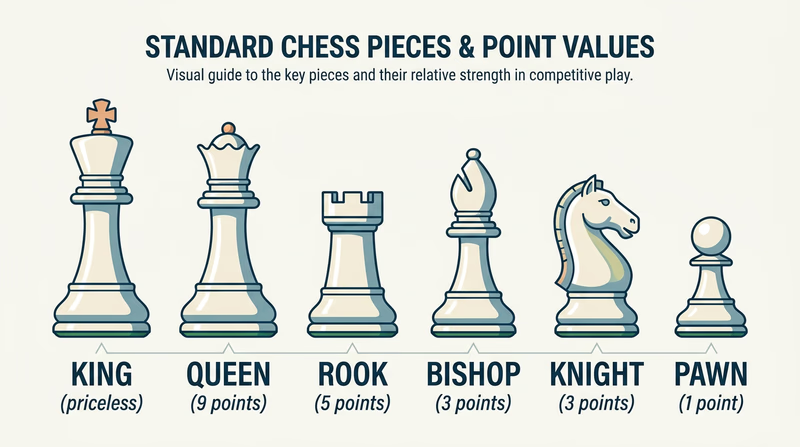
Every chess set contains six different types of pieces. Each player starts with 16 pieces: one king, one queen, two rooks, two bishops, two knights, and eight pawns.
King
The king is the most important piece on the board — the entire game revolves around it. If your king is checkmated, you lose. The king can move one square in any direction: horizontally, vertically, or diagonally. Despite being the most important piece, the king is one of the least powerful in terms of movement.
Notation symbol: K
Queen
The queen is the most powerful piece. She can move any number of squares in any direction — horizontally, vertically, or diagonally — as long as no piece blocks her path. The queen combines the powers of the rook and the bishop, making her a devastating attacking piece.
Notation symbol: Q
Rook
The rook (sometimes mistakenly called a “castle”) moves any number of squares horizontally or vertically. Rooks are strongest on open files (columns with no pawns blocking them) and are critical in the endgame. Each player starts with two rooks.
Notation symbol: R
Bishop
The bishop moves any number of squares diagonally. Because it stays on diagonal lines, a bishop that starts on a light square can never reach a dark square, and vice versa. That is why having both bishops (called a “bishop pair”) is considered an advantage — together they can cover the entire board.
Notation symbol: B
Knight
The knight is the trickiest piece to learn. It moves in an “L” shape: two squares in one direction (horizontally or vertically) and then one square perpendicular to that — or one square first and then two perpendicular. The knight is the only piece that can jump over other pieces, making it especially dangerous in crowded positions.
Notation symbol: N (not K, since K is already used for the king)
Pawn
The pawn is the most numerous piece — each side starts with eight. Pawns move forward one square at a time (or optionally two squares on their very first move). Unlike other pieces, pawns capture differently from how they move: they capture one square diagonally forward. Pawns cannot move backward.
Despite being the weakest individual piece, pawns form the structure of your position. As Philidor said in the 18th century, “Pawns are the soul of chess.”
Notation symbol: (none — pawn moves are written without a letter, e.g., “e4”)
Piece Values
While the king is priceless (losing it means losing the game), the other pieces have approximate point values that help you evaluate trades:
| Piece | Notation | Approximate Value |
|---|---|---|
| Pawn | (none) | 1 point |
| Knight | N | 3 points |
| Bishop | B | 3 points |
| Rook | R | 5 points |
| Queen | Q | 9 points |
| King | K | Infinite (game over if lost) |
These values are guidelines, not absolute rules. A well-placed knight can be worth more than a passive rook. Context matters — but knowing the basic values helps you decide whether a trade is favorable.
Teaching with the EDGE Method
Part of this requirement asks you to teach someone who does not know how to play chess. Use the Scouting EDGE method:
- Explain: Tell them the name of each piece and its role. Use the point values to help them understand relative importance.
- Demonstrate: Hold up each piece, say its name, and show where it starts on the board. Point out distinguishing features (the king has a cross on top, the queen has a crown).
- Guide: Have them pick up each piece and name it. Correct gently if they mix up the bishop and knight (a common confusion).
- Enable: Scramble the pieces and ask them to sort them by name, then set them up on the board.
Now that you know your army, it is time to arrange them for battle.
Req 3b — Setting Up the Board
Setting up the board correctly is the first thing you do in any chess game — and getting it wrong is one of the most common beginner mistakes. Here is how to do it right, every time.
Step 1: Orient the Board
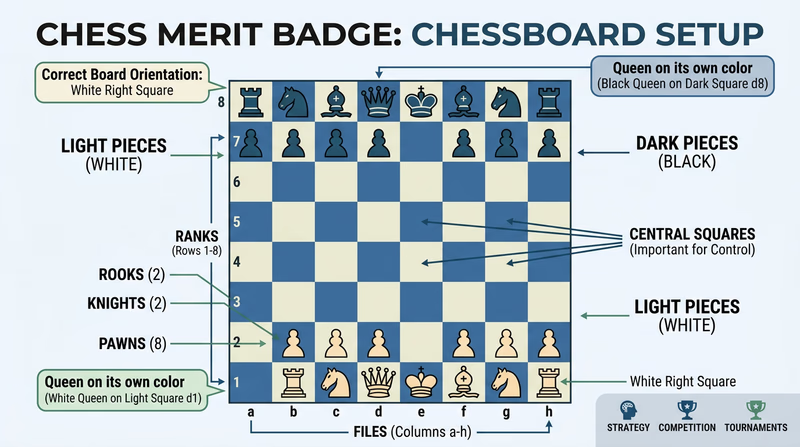
Place the board so that each player has a light-colored square in the bottom-right corner. The easy way to remember: “light on right.” If the dark square is in the bottom-right corner, the board is rotated 90 degrees and needs to be turned.
Step 2: Place the Rooks
Put one rook on each corner square of your back rank (the row closest to you). Rooks always start in the corners.
Step 3: Place the Knights
Place a knight next to each rook — on the second and seventh squares of your back rank.
Step 4: Place the Bishops
Place a bishop next to each knight — on the third and sixth squares.
Step 5: Place the Queen
Here comes the rule that trips up beginners: “Queen on her color.” The White queen goes on the light square (d1). The Black queen goes on the dark square (d8). If you remember nothing else about setup, remember this.
Step 6: Place the King
The king goes on the remaining square next to the queen. White’s king goes on e1 (dark square), Black’s king on e8 (light square).
Step 7: Place the Pawns
Line up all eight pawns on the second rank (the row directly in front of your other pieces).
The Complete Setup
Here is what the board should look like when set up correctly, from White’s perspective:
8  ♜ ♞ ♝ ♛ ♚ ♝ ♞ ♜
7  ♟ ♟ ♟ ♟ ♟ ♟ ♟ ♟
6  · · · · · · · ·
5  · · · · · · · ·
4  · · · · · · · ·
3  · · · · · · · ·
2  ♙ ♙ ♙ ♙ ♙ ♙ ♙ ♙
1  ♖ ♘ ♗ ♕ ♔ ♗ ♘ ♖
   a  b  c  d  e  f  g  h
Setup Verification
Check these before every game- Light square in the bottom-right corner (“light on right”).
- Rooks in the corners.
- Knights next to rooks.
- Bishops next to knights.
- Queen on her own color (“queen on her color”).
- King on the remaining center square.
- All eight pawns on the second rank.
- Both sides mirror each other across the board.
Common Setup Mistakes
Teaching Board Setup with EDGE
When teaching someone to set up the board:
- Explain the two key rules: “light on right” and “queen on her color.”
- Demonstrate by setting up your own side while narrating each step.
- Guide them through setting up the other side, prompting with questions like “What goes in the corner?” and “What color square does the queen go on?”
- Enable them to set up the entire board from scratch while you observe.
With the board set up correctly, you are ready to learn how each piece moves across those 64 squares.
Req 3c — How Pieces Move & Capture
This is one of the most content-heavy requirements in the Chess merit badge. You need to understand how every piece moves, how it captures, and all the special rules that make chess so rich. Let’s work through each one.
Basic Movement and Capture
In Req 3a, you learned the names of the six pieces. Here is exactly how each one moves and captures:
| Piece | Movement | Captures |
|---|---|---|
| King | One square in any direction | Same as movement |
| Queen | Any number of squares horizontally, vertically, or diagonally | Same as movement |
| Rook | Any number of squares horizontally or vertically | Same as movement |
| Bishop | Any number of squares diagonally | Same as movement |
| Knight | “L” shape: 2+1 squares; can jump over pieces | Same as movement |
| Pawn | Forward one square (or two on first move) | One square diagonally forward |
Most pieces capture the same way they move — by landing on a square occupied by an opponent’s piece. The pawn is the exception: it moves straight ahead but captures diagonally.
Special Rules
Castling
Castling is a unique move that involves the king and a rook moving simultaneously. It is the only move in chess where two pieces move at once. Castling helps protect your king and activate your rook.
How it works:
- Kingside castling (O-O): The king moves two squares toward the h-rook, and the rook jumps over the king to the adjacent square. White: Ke1→g1 and Rh1→f1.
- Queenside castling (O-O-O): The king moves two squares toward the a-rook, and the rook jumps over the king. White: Ke1→c1 and Ra1→d1.
The four rules of castling — all four must be true:
- Neither the king nor the chosen rook has moved previously in the game.
- No pieces stand between the king and the rook.
- The king is not in check. You cannot castle out of check.
- The king does not pass through or land on a square attacked by an opponent’s piece.
En Passant
En passant (French for “in passing”) is a special pawn capture that catches many beginners by surprise.
When it happens: If a pawn advances two squares from its starting position and lands beside an opponent’s pawn, the opponent’s pawn can capture it as if it had moved only one square. The capturing pawn moves diagonally forward to the square the advancing pawn passed through, and the advancing pawn is removed.
Critical rule: En passant can only be done on the very next move after the two-square advance. If you do not capture en passant immediately, you lose the right to do so.
Pawn Promotion
When a pawn reaches the opposite end of the board (the 8th rank for White, the 1st rank for Black), it must immediately be promoted to any piece the player chooses: queen, rook, bishop, or knight. The pawn cannot remain a pawn, and it cannot become a king.
Nearly all promotions are to a queen (called “queening”), since the queen is the most powerful piece. However, promoting to a knight — called “underpromotion” — is occasionally the right move when the knight delivers an immediate check or fork that a queen could not.
Check, Getting Out of Check, and Checkmate
Check
A king is in check when it is attacked by an opponent’s piece — meaning the opponent could capture the king on the next move. When your king is in check, you must get out of check on your very next move. You cannot ignore check or make a different move.
Three Ways to Get Out of Check
There are exactly three ways to escape check:
- Move the king to a square that is not attacked.
- Block the check by placing one of your pieces between the attacking piece and your king. (This does not work against knight checks or contact checks — you cannot block an L-shaped attack.)
- Capture the attacking piece. If you can take the piece that is giving check, the threat is eliminated.
If none of these three options is possible, it is checkmate.
Checkmate
Checkmate means the king is in check and there is no legal way to escape. The king cannot move to a safe square, no piece can block the attack, and no piece can capture the attacker. When this happens, the game is over — the side that delivered checkmate wins.
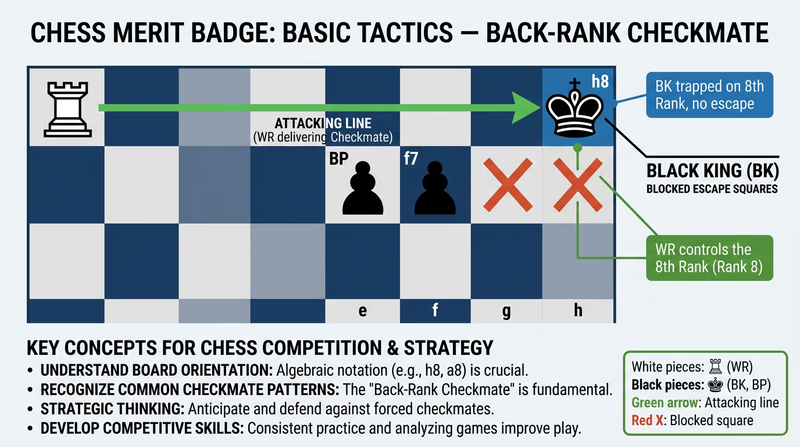
Teaching These Rules with EDGE
This requirement asks you to teach all of this to someone new. This is a lot of material, so break it into sessions:
- Session 1: Basic movement of all six pieces. Let them practice moving each piece on an empty board.
- Session 2: Capturing. Set up practice positions and have them find all possible captures.
- Session 3: Special rules — castling, en passant, pawn promotion. These are the rules that feel “weird” to beginners, so give extra practice time.
- Session 4: Check, escaping check, and checkmate. Set up simple checkmate positions for them to recognize.
With all the rules under your belt, there is one more important topic to cover: how a game can end without anyone winning.
Req 3d — Five Ways to Draw
Not every chess game produces a winner. Sometimes the game ends in a draw — a tie where neither player wins or loses. There are exactly five ways this can happen.
1. Stalemate
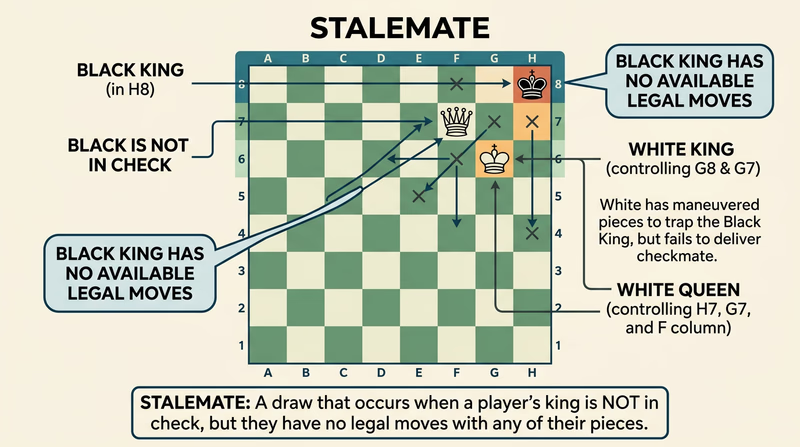
Stalemate occurs when the player whose turn it is has no legal moves and their king is not in check. The game immediately ends in a draw.
This is one of the most frustrating outcomes in chess — a player who is completely winning can accidentally stalemate their opponent and throw away the victory. It is also one of the most important defensive resources. If you are losing badly, look for ways to force a stalemate.
Example: White has a king and queen against Black’s lone king. If White moves the queen so that it covers every square the Black king could move to, but the queen is not actually giving check, Black has no legal moves and it is stalemate — a draw instead of a win for White.
2. Mutual Agreement
Both players can agree to a draw at any time. One player offers the draw (typically by saying “I offer a draw” or writing it on their score sheet), and the opponent can accept or decline.
In tournament play, draw offers follow a specific protocol: you make your move, offer the draw, then press the clock. Your opponent can think about the offer on their own time.
3. Threefold Repetition
If the same exact board position occurs three times during a game — with the same player to move, the same castling rights, and the same en passant possibilities — either player can claim a draw. The positions do not need to happen on consecutive moves.
In practice, threefold repetition often happens when one player checks the opponent’s king back and forth between the same squares (called “perpetual check”). If you are losing, forcing perpetual check is an excellent way to save a half point.
4. Fifty-Move Rule
If fifty consecutive moves pass without a pawn move or a capture, either player can claim a draw. The idea is that if neither side can make progress in 50 moves, the game has reached a dead end.
This rule is most relevant in endgames where one side has a slight material advantage but cannot figure out how to force checkmate. The defending player can try to reach the 50-move threshold.
5. Insufficient Material
The game is an automatic draw when neither player has enough pieces to force checkmate. These material combinations cannot produce checkmate:
- King vs. king — nobody can deliver check, let alone checkmate
- King and bishop vs. king — a single bishop cannot force checkmate
- King and knight vs. king — a single knight cannot force checkmate
- King and bishop vs. king and bishop (same-colored bishops) — neither side can force a win
Summary Table
| Draw Type | How It Happens | Who Claims It? |
|---|---|---|
| Stalemate | No legal moves, king not in check | Automatic |
| Mutual Agreement | Both players agree | Either player offers |
| Threefold Repetition | Same position occurs 3 times | Either player claims |
| Fifty-Move Rule | 50 moves without pawn move or capture | Either player claims |
| Insufficient Material | Neither side can force checkmate | Automatic |
You now know every rule of chess — how the pieces move, the special moves, and all the ways a game can end. Next, you will learn the language of chess: algebraic notation.
Req 4a — Algebraic Notation
Every serious chess game is recorded move by move. Algebraic notation is the universal language for writing down chess moves — once you learn it, you can read games played by grandmasters, record your own games for review, and communicate positions with anyone in the world.
The Coordinate System
Think of the chessboard as a grid. Each square has a unique name made up of a letter (the column, called a “file”) and a number (the row, called a “rank”):
- Files are labeled a through h, from White’s left to right.
- Ranks are labeled 1 through 8, from White’s side to Black’s side.
So the bottom-left square (from White’s perspective) is a1, and the top-right square is h8. White’s king starts on e1; Black’s king starts on e8.
8  ·  ·  ·  ·  ·  ·  ·  ·
7  ·  ·  ·  ·  ·  ·  ·  ·
6  ·  ·  ·  ·  ·  ·  ·  ·
5  ·  ·  ·  ·  ·  ·  ·  ·
4  ·  ·  ·  ·  ·  ·  ·  ·
3  ·  ·  ·  ·  ·  ·  ·  ·
2  ·  ·  ·  ·  ·  ·  ·  ·
1  ·  ·  ·  ·  ·  ·  ·  ·
   a  b  c  d  e  f  g  h
Writing Moves
Each move is written with the piece symbol followed by the destination square.
| Symbol | Piece |
|---|---|
| K | King |
| Q | Queen |
| R | Rook |
| B | Bishop |
| N | Knight |
| (none) | Pawn |
Examples:
- e4 — a pawn moves to e4 (no letter for pawns)
- Nf3 — a knight moves to f3
- Bb5 — a bishop moves to b5
- Qd7 — the queen moves to d7
- O-O — kingside castling
- O-O-O — queenside castling
Captures
Use an x between the piece symbol and the destination square:
- Bxf7 — a bishop captures on f7
- exd5 — a pawn on the e-file captures on d5 (for pawn captures, include the file the pawn came from)
Special Symbols
| Symbol | Meaning |
|---|---|
| x | Capture |
| + | Check |
| # | Checkmate |
| =Q | Pawn promotion to queen (or =R, =B, =N) |
| e.p. | En passant (optional — many players just write the move) |
| ! | Good move |
| ? | Mistake |
| !! | Brilliant move |
| ?? | Blunder |
Recording a Game: The Score Sheet
In tournaments, players are required to record every move on a score sheet. Each move is numbered, with White’s move first and Black’s move second:
1. e4    e5
2. Nf3   Nc6
3. Bb5   a6
4. Ba4   Nf6
5. O-O   Be7
This is the opening of a real game — the Ruy Lopez, one of the oldest and most popular chess openings. You will learn more about it in Req 4c.
Disambiguating Moves
Sometimes two pieces of the same type can move to the same square. In that case, include extra information to clarify which piece moved:
- Rae1 — the rook on the a-file moves to e1 (to distinguish it from the rook on, say, f1)
- N5d4 — the knight on the 5th rank moves to d4 (to distinguish it from a knight on, say, f3)
- Raxd1 — the rook on the a-file captures on d1
Practice Exercise
Here is a short game (Scholar’s Mate — you will study this in Req 4d). Practice reading it move by move:
1. e4    e5
2. Bc4   Nc6
3. Qh5   Nf6??
4. Qxf7#
Read it aloud: “One, pawn to e4, pawn to e5. Two, bishop to c4, knight to c6. Three, queen to h5, knight to f6 — blunder. Four, queen takes f7, checkmate.”
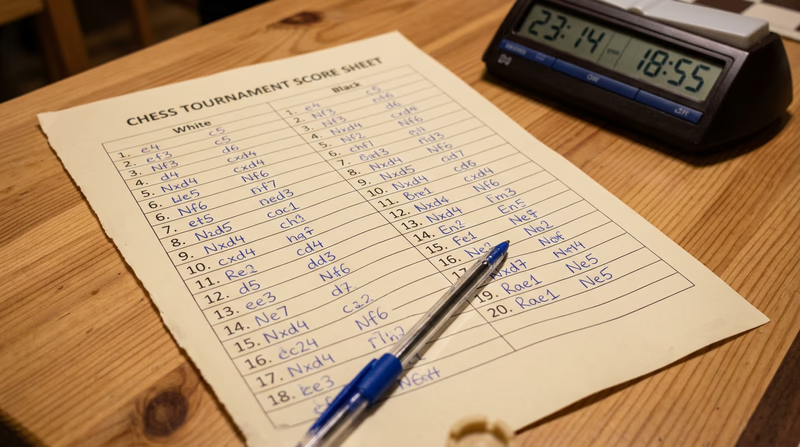
Notation Skills to Demonstrate
Your counselor will want to see you can do all of these- Name any square on the board by its coordinates.
- Write moves using correct piece symbols and destination squares.
- Record captures with the “x” symbol.
- Note check (+) and checkmate (#) correctly.
- Record castling as O-O or O-O-O.
- Record at least one complete game on a score sheet.
Now that you can read and write the language of chess, let’s explore the three phases that every game passes through.
Req 4b — Opening, Middle & Endgame
Every chess game passes through three distinct phases, each with its own goals, strategies, and character. Understanding what to focus on in each phase is one of the biggest jumps in chess skill.
The Opening (Moves 1–10, roughly)
The opening is the deployment phase — both players are mobilizing their forces from the starting position. Think of it like setting up camp: you are not hiking yet, but how well you set up determines whether the rest of the trip goes smoothly.
Goals of the Opening
- Control the center. The four central squares (d4, d5, e4, e5) are the most important real estate on the board. Pieces placed in or near the center control more squares and can shift to either side of the board quickly.
- Develop your pieces. Move your knights and bishops off the back rank and into active positions. Each move should bring a new piece into play.
- Castle your king. Get your king to safety behind a wall of pawns, and simultaneously connect your rooks (bring them to the center files where they can work together).
- Do not waste time. Avoid moving the same piece twice in the opening unless there is a good reason. Do not go pawn-hunting with your queen early — she will get chased around by your opponent’s developing pieces.
The Middle Game (Moves 10–30, roughly)
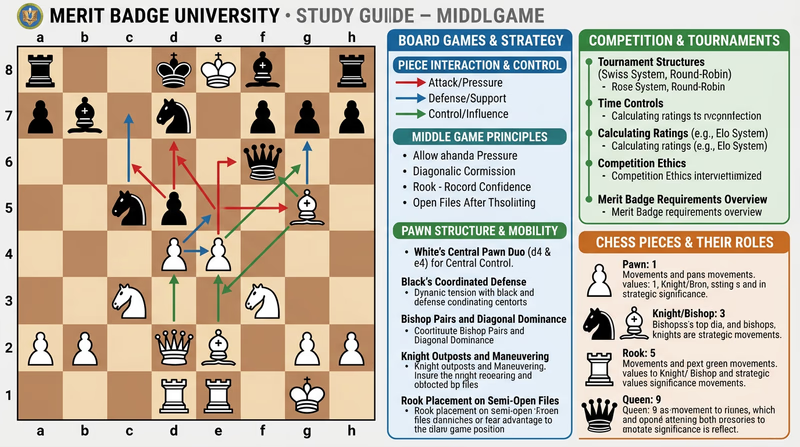
The middle game is where chess becomes truly complex. Most pieces are developed, pawns have defined the structure, and both players are executing their plans. This is the battle phase — the part of the game where strategy and tactics collide.
Goals of the Middle Game
- Create and follow a plan. Look at the pawn structure to determine where you should attack. If your pawns point toward the kingside, that is usually where your pieces should go.
- Coordinate your pieces. A lone rook does little. A rook backed by a queen on an open file, with a knight ready to jump to a key square, creates devastating threats.
- Look for tactical opportunities. Forks, pins, skewers, and discovered attacks (you will learn these in Req 5b) are most common in the middle game, when many pieces are on the board and tensions are high.
- Trade strategically. Do not trade pieces randomly. Trade when it improves your position (e.g., swapping your passive bishop for your opponent’s active knight) or when you have a material advantage and want to simplify.
Middle Game vs. Opening
The transition from opening to middle game is not a fixed line. Generally, once both sides have completed their development and castled, the middle game has begun. The key difference: in the opening, you follow principles. In the middle game, you create your own plan based on the specific position.
The Endgame (Few pieces remaining)
The endgame begins when most pieces have been traded off and the kings become active fighting units rather than hiding behind their pawns. With fewer pieces on the board, the character of the game changes dramatically.
Goals of the Endgame
- Activate your king. In the opening and middle game, the king hides. In the endgame, the king marches toward the center and becomes a powerful piece. A king in the center can support pawn advances and attack enemy pawns.
- Push passed pawns. A “passed pawn” — one with no enemy pawn blocking or guarding its path to the promotion square — becomes the most important feature of many endgames. Escort it to the 8th rank to promote to a queen.
- Use zugzwang. This German word means “compulsion to move.” In some endgame positions, whoever has to move is at a disadvantage because any move worsens their position. Understanding zugzwang is critical in king-and-pawn endgames (you will practice this in Req 5d).
- Know your theoretical endgames. Certain endgame positions have been analyzed to a definitive result. For example, king and queen vs. king is always a win if you know the technique. King and rook vs. king is also a forced win. Knowing these fundamentals saves you from throwing away a winning position.
Comparing the Three Phases
| Opening | Middle Game | Endgame | |
|---|---|---|---|
| Priority | Development & king safety | Plans & tactics | King activity & promotion |
| King role | Hide (castle) | Stay safe | Fight (march to center) |
| Pawns | Establish center structure | Define attack directions | Race to promote |
| Pieces | Get them off the back rank | Coordinate attacks | Few remain; each is critical |
| Thinking | Follow principles | Create custom plans | Calculate precisely |
Ready to go deeper into opening play? Next, you will learn four core principles and the first moves of four famous openings.
Req 4c — Opening Principles & Openings
In Req 4b, you learned that the opening is about development, center control, and king safety. Now let’s get specific: four principles to guide your opening play, and four of the most important openings in chess history.
Four Opening Principles
1. Control the Center
The four central squares — d4, d5, e4, e5 — are the battlefield’s high ground. A piece in the center controls more squares than the same piece on the edge. Place pawns and pieces in or toward the center early, and resist the temptation to play on the flanks before you have established central presence.
2. Develop Your Pieces
Every move should ideally bring a new piece into action. Knights and bishops should leave the back rank within the first several moves. Avoid moving the same piece twice unless forced (e.g., when attacked). A common guideline: develop knights before bishops, since knights have fewer ideal squares and their best spots (f3/c3 for White, f6/c6 for Black) are almost always correct.
3. Castle Early
Castling accomplishes two things at once: it tucks your king behind a wall of pawns for safety, and it brings a rook toward the center where it can control open files. Aim to castle within the first 8–10 moves. Delaying castling leaves your king exposed to tactical attacks.
4. Do Not Bring the Queen Out Early
The queen is the most powerful piece, but she is also the most vulnerable to harassment early in the game. If you move your queen to an active square on move 3, your opponent can chase her with developing moves — gaining time while you retreat. Keep the queen back until your minor pieces (knights and bishops) are developed.
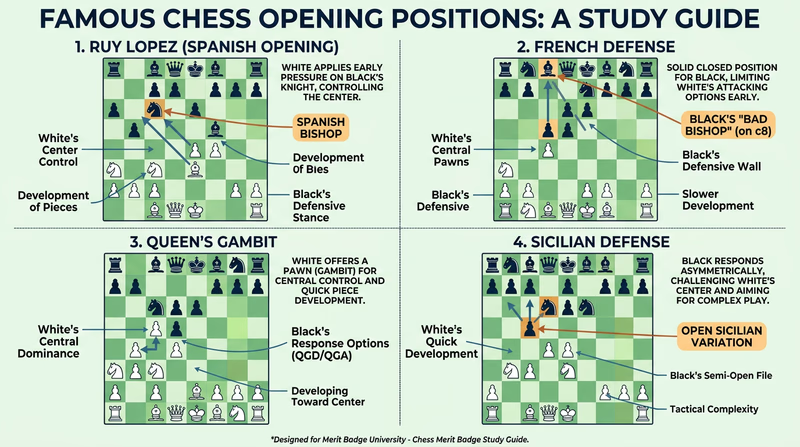
Four Famous Openings
You need to demonstrate the first five moves of each opening. Here they are, with the ideas behind them.
Ruy Lopez (1. e4 e5 2. Nf3 Nc6 3. Bb5)
Named after a 16th-century Spanish priest, the Ruy Lopez is one of the oldest and most deeply studied openings in chess. It has been a weapon of World Champions from Steinitz to Carlsen.
1. e4    e5       White and Black both stake a claim to the center.
2. Nf3   Nc6      White attacks the e5 pawn; Black defends it.
3. Bb5   a6       White pins pressure on the knight defending e5;
4. Ba4   Nf6        Black chases the bishop and develops.
5. O-O   Be7      White castles early; Black prepares to castle.
Key idea: White builds pressure on Black’s center (the e5 pawn) while developing harmoniously. The Ruy Lopez leads to rich strategic positions with chances for both sides.
French Defense (1. e4 e6)
The French Defense is a solid, counter-punching opening. Black lets White build a big center with pawns on e4 and d4, then immediately challenges it. It was a favorite of Mikhail Botvinnik, the “Patriarch of Soviet Chess.”
1. e4    e6       Black prepares to challenge the center with ...d5.
2. d4    d5       Black strikes at White's e4 pawn.
3. Nc3   Nf6      Both sides develop knights.
4. Bg5   Be7      White pins the knight; Black breaks the pin.
5. e5    Nfd7     White advances; Black's knight retreats to regroup.
Key idea: Black accepts a slightly cramped position but gets a solid pawn structure and clear plans for counter-attack on the queenside. The French is an excellent choice for players who prefer strategic, long-term games.
Queen’s Gambit Declined (1. d4 d5 2. c4 e6)
The Queen’s Gambit is not actually a true sacrifice — White offers a pawn (c4) that Black should not take permanently because White will win it back with advantage. When Black “declines” by playing …e6 instead of taking on c4, the result is one of the most classical openings in chess.
1. d4    d5       Both players open with their d-pawns.
2. c4    e6       White offers the "gambit"; Black declines solidly.
3. Nc3   Nf6      Both sides develop knights toward the center.
4. Bg5   Be7      White pins Black's knight; Black prepares to castle.
5. e3    O-O      White supports the center; Black castles to safety.
Key idea: White gets a spatial advantage in the center while Black maintains a solid, hard-to-crack position. This opening has been played at the highest levels for over 150 years and was featured prominently in The Queen’s Gambit TV series.
Sicilian Defense (1. e4 c5)
The Sicilian Defense is Black’s most popular response to 1. e4 and the most common opening in master-level chess. It leads to sharp, unbalanced positions where both sides have winning chances — making it a favorite of aggressive players like Garry Kasparov and Bobby Fischer.
1. e4    c5       Black fights for the center from the flank.
2. Nf3   d6       White develops; Black solidifies.
3. d4    cxd4     White pushes for a big center; Black trades to open the c-file.
4. Nxd4  Nf6      White recaptures; Black develops and attacks e4.
5. Nc3   a6       White develops; Black prepares queenside expansion.
Key idea: Black trades a flank pawn (c5) for White’s center pawn (d4), creating an asymmetric position. Black gets the semi-open c-file for counterplay, while White typically attacks on the kingside. These imbalances lead to exciting, dynamic games.
Preparing for Your Counselor
Opening Demonstration Checklist
Be ready to show your counselor all of these- Explain each of the four opening principles in your own words.
- Set up a board and play through the first five moves of the Ruy Lopez for both sides.
- Play through the first five moves of the French Defense.
- Play through the first five moves of the Queen’s Gambit Declined.
- Play through the first five moves of the Sicilian Defense.
- For each opening, explain the basic idea behind it in one or two sentences.
Now it is time for some fun: famous checkmate patterns and deadly traps that have been catching opponents off guard for centuries.
Req 4d — Famous Checkmates & Traps
These five patterns are some of the most famous sequences in chess history. Each one teaches an important lesson about tactics, traps, and what happens when you violate opening principles. Set up a board and follow along.
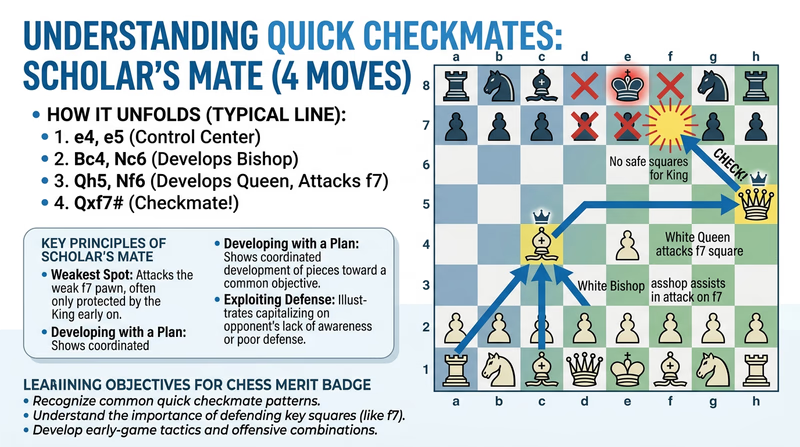
Scholar’s Mate
Result: Checkmate in 4 moves (White wins)
1. e4    e5
2. Bc4   Nc6
3. Qh5   Nf6??
4. Qxf7#
White aims the bishop and queen at the f7 square — the weakest point in Black’s position (defended only by the king). Black’s mistake is playing 3…Nf6, which attacks the queen but does not defend f7. The queen captures on f7 with checkmate, supported by the bishop on c4.
Lesson: The f7 (and f2 for White) square is vulnerable early in the game because only the king defends it. Always be aware of attacks aimed at this square.
Fool’s Mate
Result: Checkmate in 2 moves (Black wins)
1. f3?   e5
2. g4??  Qh4#
The fastest possible checkmate in chess. White weakens the kingside catastrophically by pushing both the f- and g-pawns, and Black’s queen delivers checkmate on h4. The White king has no escape — the pawn moves have blocked all retreat squares.
Lesson: The f2/f7 pawn protects the king’s diagonal. Moving it early — especially combined with g2/g7 — creates fatal weaknesses. Never play f3 and g4 in the opening.
Légal Mate
Result: White sacrifices the queen and checkmates with minor pieces
1. e4    e5
2. Nf3   d6
3. Bc4   Bg4
4. Nc3   g6?
5. Nxe5! Bxd1??
6. Bxf7+ Ke7
7. Nd5#
This brilliant pattern is named after the French player Sire de Légal, who played it in the 18th century. White deliberately leaves the queen hanging (5. Nxe5, allowing …Bxd1). If Black greedily captures the queen, White delivers checkmate with the bishop and two knights. The key is that after 6. Bxf7+ Ke7, the knight on d5 delivers checkmate because the king is completely surrounded.
Lesson: Do not automatically capture a piece just because it is “free.” Always check for hidden threats, especially when your opponent seems to be giving away material.
Fried Liver Attack
Result: A devastating attack after a knight sacrifice
1. e4    e5
2. Nf3   Nc6
3. Bc4   Nf6
4. Ng5   d5
5. exd5  Nxd5?
6. Nxf7! Kxf7
7. Qf3+  Ke6
8. Nc3   ...
The Fried Liver Attack (also called the Fegatello Attack — Italian for “dead as a piece of liver”) is one of the most aggressive openings in chess. White sacrifices a knight on f7, forcing the Black king to capture. The king is then dragged into the center of the board, where it faces a vicious attack from White’s queen and pieces.
After 7. Qf3+ Ke6, Black’s king is on e6 — in the middle of the board in the opening! White has a powerful attack, and the position is extremely difficult for Black to survive.
Lesson: This is why king safety matters. If you can force your opponent’s king into the open early, even a material sacrifice can be worthwhile. As Black, the best defense against the Fried Liver is 5…Na5 (the Traxler Counterattack) or 4…d5 5. exd5 b5 (the Ulvestad Variation).
Noah’s Ark Trap
Result: Black traps and wins White’s bishop
1. e4    e5
2. Nf3   Nc6
3. Bb5   a6
4. Ba4   d6
5. d4    b5
6. Bb3   Na5!
7. dxe5  Nxb3
8. axb3  dxe5
Unlike the other patterns, Noah’s Ark Trap does not end in checkmate — it wins material. Arising from the Ruy Lopez (which you learned in Req 4c), Black uses pawn advances (…a6, …b5) and a knight maneuver (…Na5) to trap White’s bishop on b3. The bishop has no escape squares, and White loses a piece.
This trap has been catching inattentive players since at least the 1620s — which is supposedly why it is called “Noah’s Ark” (it is that old).
Lesson: Always check whether your pieces have retreat squares. A piece that advances deep into enemy territory without an escape route can become trapped.
Demonstration Summary
| Pattern | Key Theme | Moves to Mate/Win |
|---|---|---|
| Scholar’s Mate | f7 weakness | 4 (checkmate) |
| Fool’s Mate | Kingside pawn weakness | 2 (checkmate) |
| Légal Mate | Queen sacrifice + coordination | 7 (checkmate) |
| Fried Liver Attack | Knight sacrifice + king hunt | Ongoing attack |
| Noah’s Ark Trap | Piece trapping | 7 (wins bishop) |
You have now mastered the fundamentals and some famous patterns. Time to go deeper into the strategic and tactical elements that separate beginners from intermediate players.
Req 5a — Chess Strategy
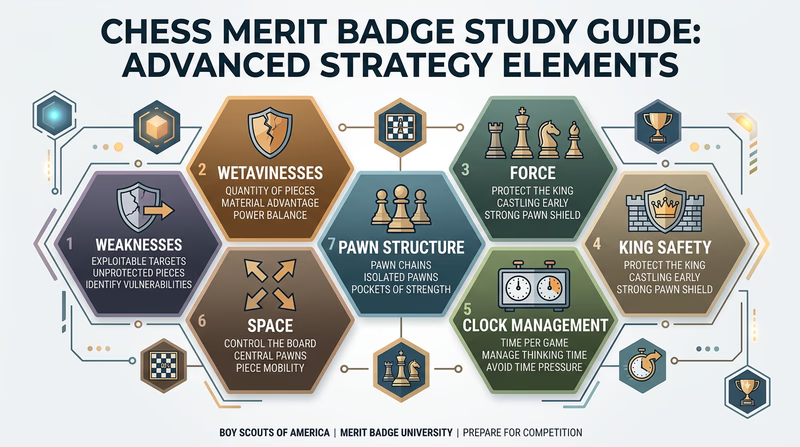
Strategy is your long-term plan — the “big picture” that guides your moves across 10, 20, or 30 turns. In Req 2, you learned that strategy and tactics work together. Now let’s dive deeper into the seven strategic elements you need to understand. You will explain four of these to your counselor, but learning all seven will make you a stronger player.
Exploiting Weaknesses
A weakness in chess is any feature of your opponent’s position that is difficult to defend. The most common weaknesses are:
- Weak squares: Squares that can no longer be defended by pawns (because the pawns have advanced past them). A knight planted on a weak square deep in enemy territory can dominate a game.
- Weak pawns: Isolated pawns (no friendly pawns on adjacent files), doubled pawns (two pawns of the same color on the same file), and backward pawns (behind their neighbors and unable to advance safely) are all targets.
- Weak king position: A king with few or no pawn cover is a strategic liability, even if no immediate tactical threat exists.
The art of strategy is identifying these weaknesses, maneuvering your pieces to attack them, and forcing your opponent to make uncomfortable choices.
Force
Force refers to your material advantage — having more or better pieces than your opponent. The simplest strategic principle is: if you have more material, trade pieces. Each trade brings you closer to a position where your extra material decides the game.
Force also includes temporary material imbalances. Sacrificing a knight to destroy your opponent’s pawn cover might lose material in the short term but create a winning attack. Understanding when material advantage matters more than position — and when it does not — is a key strategic skill.
King Safety
Your king’s safety is a strategic priority throughout the game. In the opening and middle game, the king is a liability — a target to be protected. Strategic decisions about king safety include:
- When to castle (and which side)
- Whether to keep pawns in front of your king (advancing them weakens the king’s cover)
- Recognizing when your opponent’s king is vulnerable — sometimes the best plan is to attack a weakened king position rather than playing for a positional advantage
A well-timed pawn storm (advancing your pawns toward the opponent’s castled king) can crack open the position for a decisive attack — but only if your own king is safe first.
Pawn Structure
Pawns cannot move backward. Every pawn move is permanent, which makes pawn structure one of the most important strategic factors. Common pawn structures include:
- Open center (few center pawns): Pieces are active, the game is dynamic, bishops tend to be strong.
- Closed center (locked pawns): Maneuvering is key, knights are often better than bishops, play tends to shift to the flanks.
- Pawn chains: Diagonal lines of pawns (like d4–e5 or d5–e6) point toward one side of the board. Attack on the side your pawns point to.
Space
Space refers to how much of the board your pieces control. A player with a space advantage has more room to maneuver — their pieces can shift between the kingside and queenside easily, while the opponent’s pieces are cramped and tripping over each other.
You gain space primarily by advancing pawns. A pawn on e5 (for White) controls more territory than a pawn on e2. But space comes with a cost: advanced pawns can become targets, and overextension (pushing too far without support) can leave weaknesses behind.
Tempo
A tempo is a unit of time in chess — essentially, one move. Gaining a tempo means achieving your goal in fewer moves than your opponent. Losing a tempo means wasting a move.
Examples of tempo:
- Developing a piece with an attack (e.g., playing Bb5 to develop the bishop while threatening the knight on c6) gains tempo because your opponent must respond.
- Moving the same piece twice in the opening (without a forcing reason) loses tempo because you used two moves for what should take one.
- In the openings from Req 4c, the Ruy Lopez (3. Bb5) gains tempo by forcing Black to spend a move on …a6.
Clock Management
In tournament chess, time is a real resource — not just a metaphor. Each player has a limited amount of thinking time. Clock management means allocating your time wisely:
- Spend time on critical decisions: A move that determines the game’s direction (e.g., choosing between two plans in the middle game) deserves more thought than a move with only one reasonable option.
- Do not spend time in the opening: If you know the opening well, play the first 10–15 moves quickly and save time for the complex middle game.
- Watch your opponent’s clock: If your opponent is low on time, avoid creating complicated positions that require long calculation — or deliberately create them if you want to increase time pressure.
Strategy gives you the plan. But you also need the tools to execute it — and those tools are called tactics.
Req 5b — Chess Tactics
Tactics are short, concrete sequences of moves that achieve a specific goal — winning material, delivering checkmate, or gaining a decisive advantage. While strategy is your long-term plan (as you learned in Req 5a), tactics are the weapons you use to execute that plan. Let’s walk through each tactic on the list.
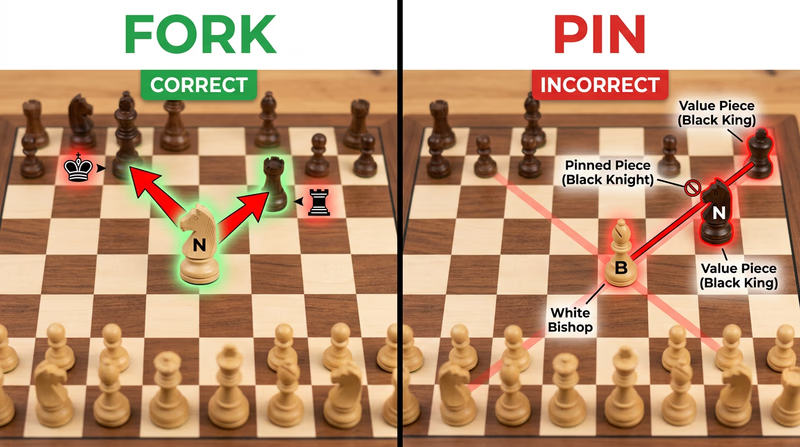
Fork
A fork is a single move that attacks two (or more) enemy pieces at the same time. The opponent can only save one, so you win the other. Knights are the most common forking pieces because of their unusual movement pattern, but any piece — including pawns — can deliver a fork.
Example: A knight on c7 might attack both the king on e8 and the rook on a8. The king must move out of check, and the rook is lost.
Pin
A pin occurs when a piece attacks an enemy piece that cannot move (or should not move) because doing so would expose a more valuable piece behind it. There are two types:
- Absolute pin: The pinned piece cannot legally move because moving it would expose the king to check. (A bishop pinning a knight to the king.)
- Relative pin: The pinned piece can legally move but doing so would lose a more valuable piece. (A rook pinning a bishop to the queen.)
Pins are devastating because the pinned piece becomes effectively paralyzed.
Skewer
A skewer is the reverse of a pin. The more valuable piece is attacked first and must move, exposing the less valuable piece behind it to capture. A classic example: a bishop attacks a king along a diagonal, the king moves, and the bishop captures the rook behind it.
Discovered Attack
A discovered attack occurs when you move one piece and reveal an attack from a different piece behind it. The piece that moves may also create its own threat, resulting in two simultaneous attacks. Discovered attacks are powerful because the opponent faces two threats at once.
Double Check
A double check is a special kind of discovered attack where both the moving piece and the piece behind it give check simultaneously. Double check is the most forcing move in chess because the only way to escape is to move the king — you cannot block two checks at once, and you cannot capture two pieces at once.
Double Attack
A double attack is any move that creates two threats at once. A fork is one type of double attack, but the term is broader — it includes any situation where a single move attacks two targets (not necessarily with the same piece). For instance, a queen move that threatens checkmate on one square and attacks an undefended rook on another is a double attack.
Clearance Sacrifice
A clearance sacrifice gives up a piece to clear a square or line for another piece to use. You sacrifice material not to win it back directly, but to create a path for a more powerful follow-up move — often a checkmate or a winning combination.
Decoy
A decoy lures an enemy piece to a specific square where it becomes vulnerable. You sacrifice material to force your opponent’s piece onto a square where you can then fork, pin, or otherwise exploit it. Think of it as “baiting the trap.”
Remove the Defender
This tactic eliminates a piece that is protecting a key square or another piece. Once the defender is gone, the thing it was defending becomes vulnerable. You might capture, exchange, or chase away the defending piece.
Interposing
Interposing means placing a piece between an attacker and its target (usually the king) to block the attack. This is one of the three ways to escape check (you learned this in Req 3c). As a tactic, an interposing move can sometimes block an attack while simultaneously creating a counter-threat.
Overloading
Overloading occurs when a single piece is given too many defensive responsibilities. If a rook is defending both a back-rank checkmate and a pawn on the other side of the board, you can exploit this by attacking one of the things it is defending — forcing it to abandon the other.
Overprotecting
Overprotecting is a strategic technique (coined by Aron Nimzowitsch) of placing extra defenders on a key square — more than seem strictly necessary. The idea is that a heavily protected central square or piece cannot be undermined, and the overprotecting pieces gain flexibility because they are centralized.
Zwischenzug
Zwischenzug (German for “in-between move”) is an unexpected move inserted into a sequence of forced moves. Instead of making the “obvious” recapture or response, you play a surprising intermediate move — often a check or a threat — that forces your opponent to deal with the new problem first, improving your position before you complete the expected sequence.
Zugzwang
Zugzwang (German for “compulsion to move”) is a situation where every possible move makes the position worse. The player would prefer to pass but the rules require them to move. Zugzwang most commonly occurs in endgames and is a key weapon in king-and-pawn endings (which you will study in Req 5d).
Now let’s put your knowledge to work on the board. Time to learn how to force checkmate with major pieces.
Req 5c — Checkmate with Major Pieces
This requirement tests three essential endgame checkmates. Each position has White forcing checkmate against a lone Black king. These are fundamental skills — if you reach an endgame with a queen or rooks, you must know how to finish the job.
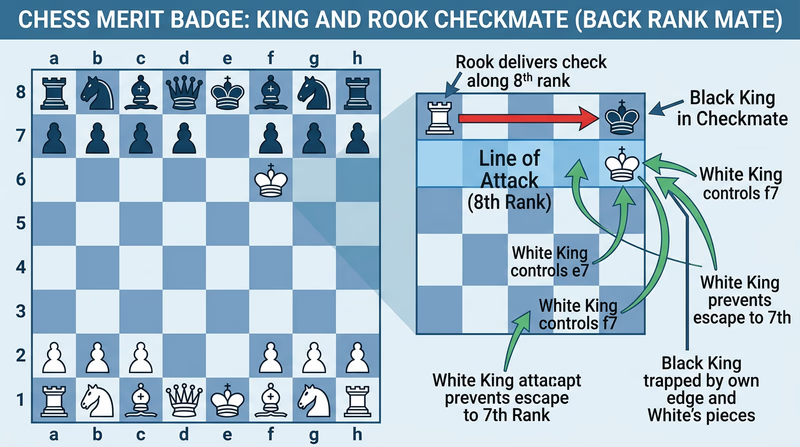
Position 1: Two Rooks vs. King
Setup: White King e1, White Rooks a1 and h1, Black King e5.
The Technique: The Staircase (Lawnmower)
With two rooks, you use a pattern called the staircase or lawnmower. The rooks take turns cutting off ranks, pushing the enemy king toward the edge of the board.
How it works:
- One rook controls a rank, preventing the king from crossing back.
- The other rook checks the king on the next rank, driving it further toward the edge.
- They alternate, “mowing” the king to the 8th (or 1st) rank.
- Once the king is on the edge, one rook delivers checkmate while the other covers the escape squares.
Key principle: The two rooks work together without needing help from the White king. Each rook controls an entire rank. The Black king is progressively confined to a smaller and smaller area until checkmate is delivered on the edge.
Position 2: Queen vs. King
Setup: White King e1, White Queen d1, Black King e5.
The Technique: Box and Approach
The queen is powerful enough to confine the enemy king alone, but she cannot deliver checkmate without the king’s help. The technique has two steps:
Step 1 — Build the box. Use the queen to restrict the Black king to a smaller and smaller area of the board. The queen can control an entire rank, file, or diagonal, so she can single-handedly push the king toward the edge.
Step 2 — Bring up the king. Once the enemy king is near the edge, march your own king toward it. You need your king to support the queen in delivering the final checkmate.
Step 3 — Deliver checkmate. With the enemy king on the edge and your king nearby, the queen delivers checkmate on the rank or file next to the enemy king, supported by your own king.
Position 3: Rook vs. King
Setup: White King e1, White Rook a1, Black King e5.
The Technique: Opposition and Edge
This is the most challenging of the three, because a single rook cannot confine the king as easily as two rooks or a queen. Your king must actively participate throughout.
Step 1 — Use opposition. The White king must march toward the Black king and achieve opposition — placing the two kings directly across from each other with one square between them. When kings are in opposition, the player who must move is at a disadvantage (a form of zugzwang from Req 5b).
Step 2 — Cut off the king. Use the rook to control a file or rank that prevents the Black king from escaping toward the center. The rook acts as a wall while the White king pushes the Black king toward the edge.
Step 3 — Drive to the edge. Alternate between gaining opposition with your king and using the rook to check or cut off the enemy king. Gradually force it to the edge of the board.
Step 4 — Deliver checkmate. With the enemy king on the edge and your king controlling escape squares, the rook delivers checkmate along the edge rank or file.
Practice Tips
Checkmate Practice
Master these endgames on a real board- Practice each position at least five times until the technique feels automatic.
- Time yourself: two-rook mate should take under 15 moves, queen mate under 10, rook mate under 20.
- Practice against a friend who tries to make it as difficult as possible for you (moving the king toward the center, avoiding the edges).
- Try the Lichess endgame practice tool (linked below) which plays the losing side perfectly and counts your moves.
Now let’s study a more subtle endgame skill: king and pawn endings where promotion and opposition decide everything.
Req 5d — King & Pawn Endgames
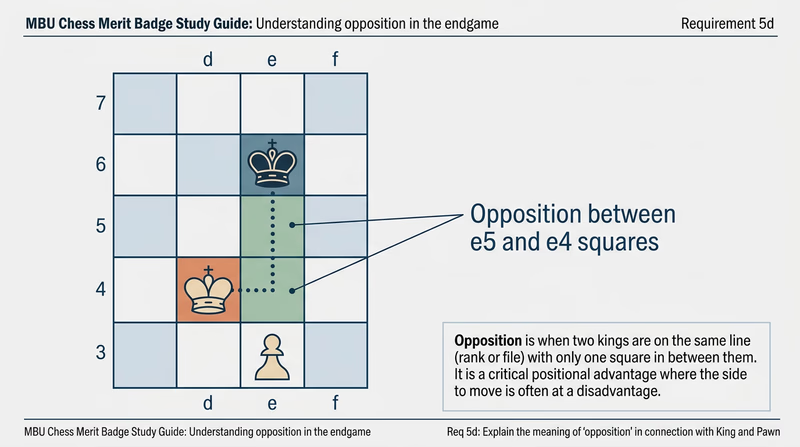
This requirement teaches you the most important concept in king-and-pawn endgames: opposition. The same starting position produces completely different results depending on who moves first — a perfect demonstration of zugzwang.
The Setup
8  · · · · · · · ·
7  · · · · · · · ·
6  · · · · ♚ · · ·
5  · · · · · · · ·
4  · · · ♔ · · · ·
3  · · · · ♙ · · ·
2  · · · · · · · ·
1  · · · · · · · ·
   a b c d e f g h
White King on d4, White Pawn on e3, Black King on e6.
What Is Opposition?
When two kings stand on the same file or rank with exactly one square between them, they are in opposition. The player whose turn it is to move is at a disadvantage — they must step aside, allowing the other king to advance.
In this position, with one square separating the kings on the d- and e-files, opposition determines everything.
Position 1: White to Move — White Wins
When White moves first, White can outmaneuver Black and escort the pawn to promotion.
The Technique
The key is for the White king to advance in front of the pawn, gaining opposition and pushing the Black king back.
- Ke4 — White advances the king. Now the kings are on the same rank, separated by one square on the e-file. It is Black’s turn, so Black has the opposition disadvantage.
- Black must move aside (e.g., …Kd6 or …Kf6). Either way, the White king gains ground.
- White continues advancing the king in front of the pawn, maintaining opposition whenever possible.
- Once the White king reaches the 6th rank in front of the pawn, promotion is guaranteed. The Black king cannot stop the pawn from queening.
Key principle: The king leads, the pawn follows. If the White king can reach the 6th rank in front of its pawn, the pawn promotes regardless of what Black does.
Position 2: Black to Move — Black Draws
When Black moves first from the same position, Black can hold a draw by maintaining opposition.
The Technique
- …Ke5! — Black takes opposition directly. Now the kings face each other on the e-file with one square between them, and it is White’s turn — so White is at the zugzwang disadvantage.
- White must step aside. If White plays Kd3, Black plays …Kd5, maintaining direct opposition. If White plays Ke4, the kings are on the same rank and Black mirrors with …Ke6.
- White eventually advances the pawn (e.g., e4), but Black keeps the opposition and blocks the White king from reaching the 6th rank in front of the pawn.
- The game results in stalemate or the Black king blockading the pawn — a draw.
Key principle: The defender draws by maintaining opposition. As long as the Black king stands directly in front of the White king when it is White’s turn to move, White cannot make progress.
Why It Works: Zugzwang in Action
Both positions demonstrate zugzwang — the compulsion to move that puts you at a disadvantage. In the starting position:
- When White moves first, White can advance (Ke4), and Black is forced to step aside, giving White’s king access to critical squares.
- When Black moves first, Black takes opposition (Ke5), and White is forced to step aside or push the pawn prematurely, allowing Black to maintain the blockade.
The same position, the same pieces — but who moves first determines the result. This is what makes king-and-pawn endgames so fascinating.
Practice
King & Pawn Endgame Practice
Drill these positions until they are automatic- Set up the position and practice White winning (White moves first) at least three times.
- Set up the same position and practice Black drawing (Black moves first) at least three times.
- Try variations: what if Black does NOT take opposition? Show that White wins even more easily.
- Practice with the pawn on different files (not just e3) — the principles are the same.
One more endgame skill to go: solving direct-mate puzzles that test your ability to find forcing sequences.
Req 5e — Solving Mate Problems
A direct-mate problem gives you a position and says: “White to move and checkmate in X moves.” Your job is to find the exact sequence of moves that forces checkmate, no matter how the opponent responds. This is one of the best ways to develop calculation skills and tactical vision.
What Is a Direct-Mate Problem?
Direct-mate (or “mate-in-X”) problems are chess puzzles where:
- You are given a specific board position
- You must find the move (or sequence of moves) that forces checkmate in a set number of moves
- The solution must work against any defensive move by the opponent
Problems range from mate-in-1 (find the one move that delivers immediate checkmate) to mate-in-2, mate-in-3, and beyond. Your counselor will provide five problems for you to solve.
How to Solve Mate Problems
Step 1: Assess the Position
Before calculating, take 30 seconds to scan the board:
- Where is the enemy king? What squares can it move to?
- Which of your pieces are near the king? What lines do they control?
- Are there any checks available? (Checks drastically narrow the possibilities.)
- Is the king already confined, or does it have escape routes you need to cut off?
Step 2: Look for Checks First
In mate-in-1 problems, the answer is always a check that is also checkmate. In longer problems, the solution often (but not always) starts with a check. Checks force the opponent’s response, which reduces the number of variations you need to consider.
Step 3: Consider Surprising Moves
Many mate problems are designed to have a surprising or counterintuitive solution. The “obvious” move is often wrong. Look for:
- Quiet moves — non-checking moves that limit the king’s escape squares
- Sacrifices — giving up material to force the king into a mating net
- Interference — placing a piece on a square that blocks the defender
Step 4: Verify Your Solution
Once you think you have found the answer, check every possible response by the defender. A valid solution must work against all replies, not just one. For a mate-in-2:
- You make your first move
- Consider each possible reply by the opponent
- For each reply, find your mating move
- If any reply does not lead to checkmate in the required moves, your solution is wrong
Practice Strategies
Solving on a Physical Board
Your counselor will likely present problems on a real chessboard. When working through the solution:
- Do NOT move the pieces until you have found the answer in your head (or at least think you have).
- Announce your solution move by move, including the opponent’s responses.
- If you get stuck, ask your counselor for a hint — they might tell you which piece delivers the final checkmate.
Building Your Skills Before the Meeting
The best preparation is to solve many puzzles on your own before meeting with your counselor. Start with mate-in-1 problems to build pattern recognition, then advance to mate-in-2.
Where to Practice
Lichess Puzzles — Mate-in-1 Hundreds of mate-in-1 puzzles to build your checkmate pattern recognition. Free, unlimited, and sorted by difficulty. Link: Lichess Puzzles — Mate-in-1 — https://lichess.org/training/mateIn1 Lichess Puzzles — Mate-in-2 Mate-in-2 puzzles that challenge you to think two moves ahead. A great next step after mastering mate-in-1. Link: Lichess Puzzles — Mate-in-2 — https://lichess.org/training/mateIn2Common Checkmate Patterns to Know
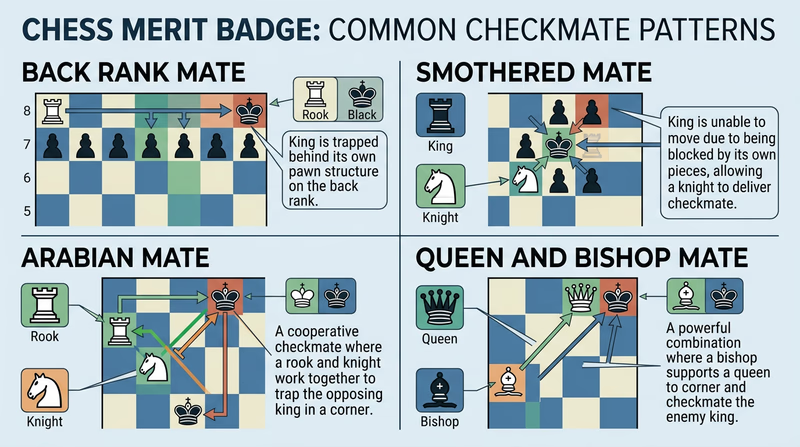
Recognizing these recurring checkmate patterns will help you solve problems faster:
| Pattern | Description |
|---|---|
| Back-rank mate | A rook or queen delivers checkmate on the 1st or 8th rank because the king is blocked by its own pawns |
| Smothered mate | A knight delivers checkmate because the king is surrounded by its own pieces |
| Arabian mate | A rook and knight work together — the rook on the edge, the knight covering escape squares |
| Anastasia’s mate | A rook and knight combine on the edge of the board, with the king trapped by a pawn |
| Epaulette mate | The queen checkmates a king that is flanked by its own pieces on both sides |
You have now worked through the entire strategy-and-tactics section of the badge. Next: how competitive chess is organized, from local club tournaments to international championships.
Req 6 — Chess Tournaments
Understanding how tournaments work is essential whether you plan to enter one for Req 7b or organize one for Req 7c. Let’s break down each element.
Tournament Formats
Swiss System
The Swiss system is the most common format for large tournaments (20+ players). Here is how it works:
- All players play the same number of rounds (typically 4–7, depending on the tournament).
- In Round 1, players are paired based on their rating — top-rated players face middle-rated ones (not each other). Colors (White or Black) are assigned to balance fairness.
- In subsequent rounds, players with the same score are paired against each other. If you have 2 wins and 1 loss (2/3 points), you play someone else with the same score.
- No rematches — you never play the same opponent twice.
- Color balance — the tournament director alternates colors so each player gets a roughly equal number of White and Black games.
The Swiss system is efficient because not everyone plays everyone. A 64-player Swiss tournament can produce a clear winner in just 6 rounds, while a round robin with 64 players would require 63 rounds.
Round Robin
In a round robin tournament, every player plays every other player exactly once. With n players, there are n - 1 rounds, and each player plays n - 1 games.
Round robin tournaments are used when:
- The number of players is small (typically 6–14)
- Maximum fairness is desired (everyone faces everyone)
- The tournament has enough time to complete all rounds
Double round robin tournaments have each pair of players meet twice — once as White and once as Black. World Championship Candidates tournaments use this format.
| Feature | Swiss System | Round Robin |
|---|---|---|
| Best for | Large fields (20+) | Small fields (6–14) |
| Games per player | Fixed (4–7 rounds) | n - 1 games |
| Fairness | Good (similar-scored opponents) | Maximum (everyone plays everyone) |
| Time needed | Moderate | Long |
Pairings
Pairings determine who plays whom in each round. In Swiss tournaments, pairings are generated by computer software (or manually by a tournament director) following specific rules:
- Players with the same score are paired against each other.
- Within a score group, the top-rated player plays the lowest-rated player (the “top half vs. bottom half” method).
- Colors alternate as fairly as possible.
- No player faces the same opponent twice.
In round robin tournaments, pairings follow a fixed rotation schedule (often called a “Berger table”) that ensures each player meets every other player and colors are balanced.
Time Controls
Every tournament game uses a chess clock — a device with two timers that count down. When you complete your move, you press the clock to start your opponent’s timer.
Common time controls:
| Format | Time per Player | Character |
|---|---|---|
| Classical | 90 minutes + 30 seconds per move | Deep, careful play |
| Rapid | 15–30 minutes total | Faster; less time to calculate |
| Blitz | 3–5 minutes total | Very fast; instinct and pattern recognition |
| Bullet | 1–2 minutes total | Extremely fast; nearly instant decisions |
Many tournaments use a “time increment” — an extra 2–30 seconds added to your clock after each move. This prevents players from losing purely on time in a complex position.
Touch Move
Touch move is one of the most important rules in tournament chess, and you covered it in Req 2. To recap:
- If you touch a piece, you must move it (if a legal move exists).
- If you touch an opponent’s piece, you must capture it (if a legal capture exists).
- Say “I adjust” or “j’adoube” before touching a piece if you only want to center it on its square.
Touch move is strictly enforced in tournaments. If you accidentally brush a piece, your opponent can call the tournament director.
Scoring
Chess uses a simple scoring system:
| Result | Points |
|---|---|
| Win | 1 |
| Draw | ½ |
| Loss | 0 |
Your tournament score is the total of all your game results. If you play 5 rounds and win 3, draw 1, and lose 1, your score is 3½ out of 5 (written as 3.5/5).
Tiebreaks: When players finish with the same score, tiebreak methods determine final standings. Common tiebreaks include:
- Buchholz (sum of opponents’ scores — playing against stronger opponents helps)
- Sonneborn-Berger (sum of scores of opponents you beat, plus half the scores of opponents you drew)
- Head-to-head (the result between the tied players)
Chess Ratings
A chess rating is a number that estimates your playing strength. The higher the number, the stronger the player. The most common rating systems are:
- USCF ratings (US Chess Federation): Used for American tournaments. Beginners start around 100–400; club players are 1200–1800; experts are 2000–2199; masters are 2200+; grandmasters are typically 2500+.
- FIDE ratings (international): Similar scale but awarded by the World Chess Federation. FIDE titles include:
- Candidate Master (CM): 2200+
- FIDE Master (FM): 2300+
- International Master (IM): 2400+
- Grandmaster (GM): 2500+
Ratings change after each tournament game using a mathematical formula called the Elo system (named after physicist Arpad Elo). If you beat a higher-rated player, your rating goes up significantly. If you lose to a lower-rated player, it drops more.
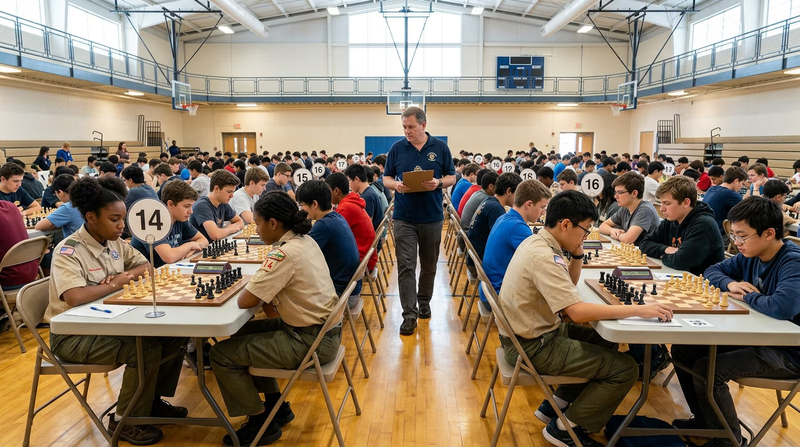
You are almost at the finish line. The final requirement asks you to put everything together and actually play.
Req 7 — Play & Review Games
This is the capstone requirement — where you take everything you have learned and put it into practice. You choose one of three options:
- Option A: Play at least three games, record them, and review with your counselor
- Option B: Play in a scholastic tournament and review your games
- Option C: Organize and run a tournament yourself
Option A: Play Three Games
This is the most accessible option. You play at least three recorded games and then analyze them with your counselor.
How to Prepare
- Practice your notation (Req 4a) so you can record every move during the game.
- Use a chess clock if available — even an informal time control (like 15 minutes per side) adds tournament-like discipline.
- Play serious games — no takebacks, touch-move rules apply. These games should challenge you.
After the Games
Replay each game move by move from your score sheet on a real board. For each game, identify:
- The opening: What opening did you play? Did you follow the principles from Req 4c?
- The critical moment: Where did the game change direction? Can you pinpoint the move that decided the outcome?
- Mistakes: What did you do wrong? What would you do differently?
- Good moves: What did you do right? Which moves are you proud of?
Option B: Play in a Tournament
This option takes things to the next level. A real tournament gives you the experience of tournament pairings, time controls, and the atmosphere of competitive play — all concepts you studied in Req 6.
Finding a Tournament
- US Chess Federation: Search for scholastic events on the USCF website. Many areas have regular scholastic tournaments, especially on weekends during the school year.
- Chess clubs: Local chess clubs often host informal or rated events.
- School chess programs: Many schools and after-school programs organize tournaments.
Tournament Day Tips
Tournament Preparation
Be ready for your first tournament- Bring your own chess set and clock (many tournaments require this).
- Bring score sheets and a pen — at least two pens in case one dies.
- Arrive early to check in, find your board, and settle in.
- Eat a good meal beforehand — tournaments can be long, and mental energy requires fuel.
- Bring water and a quiet snack for between rounds.
- Review the tournament rules (time control, number of rounds) before Round 1.
Option C: Organize a Tournament
This option develops leadership and organizational skills. You are not just a player — you are the tournament director.
Planning Your Tournament
Step 1: Choose a format. With 4–5 players, a round robin works perfectly — everyone plays everyone. With more players, consider a Swiss system with 3–4 rounds (see Req 6 for details on both formats).
Step 2: Set the time control. For a casual tournament, G/15 (15 minutes per player) or G/30 (30 minutes per player) works well. Shorter is better for keeping things moving; longer gives more time for recorded games.
Step 3: Gather equipment. You need at least enough boards and sets for half the players to play simultaneously. Chess clocks are ideal but not strictly required for casual events.
Step 4: Create a schedule. For a 5-player round robin, you need 4 rounds with 2 games each round (one player gets a bye each round). Write out the pairings in advance using a Berger table.
Step 5: Prepare score sheets. Print or create simple score sheets for recording moves (even if recording is optional).
Running the Tournament
Tournament Director Duties
What the TD does each round- Post pairings and color assignments for the round.
- Start all clocks simultaneously (or call “begin” if no clocks).
- Enforce touch-move and time rules if disputes arise.
- Record results after each game (win, loss, or draw for each player).
- Calculate and post updated standings after each round.
- Award prizes or recognition at the end.
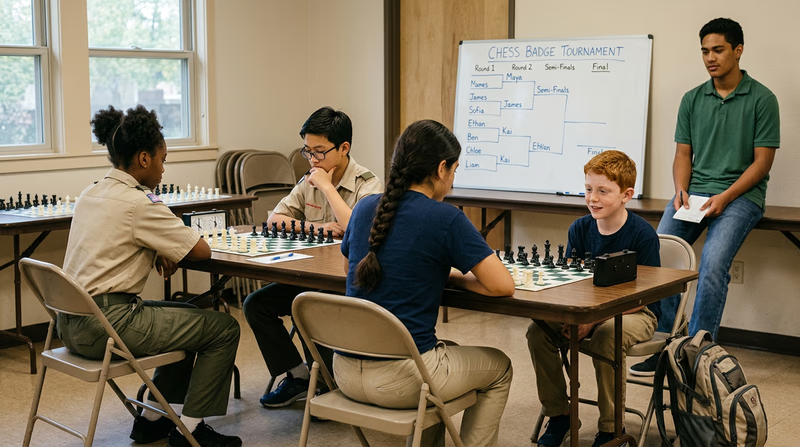
Sample 5-Player Round Robin Schedule
| Round | Board 1 | Board 2 | Bye |
|---|---|---|---|
| 1 | Player 1 vs. Player 5 | Player 2 vs. Player 4 | Player 3 |
| 2 | Player 5 vs. Player 3 | Player 4 vs. Player 1 | Player 2 |
| 3 | Player 2 vs. Player 5 | Player 3 vs. Player 4 | Player 1 |
| 4 | Player 5 vs. Player 4 | Player 1 vs. Player 3 | Player 2 |
| 5 | Player 3 vs. Player 2 | Player 4 vs. Player 5 | Player 1 |
Game Review: The Most Important Step
Whichever option you choose, the review with your counselor is where the deepest learning happens. Do not just replay the moves — tell the story of each game:
- What was your plan?
- Where did things go right or wrong?
- What opening principles or tactical patterns from this guide showed up in your games?
- What would you do differently next time?
Congratulations — you have covered every requirement for the Chess merit badge. But the game does not stop here.
Extended Learning
A. Congratulations, Chess Player
You have earned the Chess merit badge — and that means you now know more about the game than most people ever will. You understand the history, the rules, the strategy, the tactics, and what it takes to compete. But here is the best part: you are just getting started. Chess is a game you can play for the rest of your life, and there is always more to discover.
B. How to Study Chess Like a Serious Player
The difference between a casual player and an improving one comes down to structured practice. Here is a framework used by players from club level to grandmaster.
Tactical Training
Solving puzzles is the single most effective way to improve at chess. Grandmaster Simon Williams recommends solving at least 10–15 puzzles per day, focusing on accuracy over speed. Start with puzzles at your current skill level and gradually increase difficulty.
The key is to calculate the full solution before moving any pieces. Guessing and checking teaches your brain to be sloppy. Taking 2–3 minutes on a hard puzzle and getting it right trains the deep pattern recognition that strong players rely on.
On Lichess, the puzzle rating system adjusts to your level automatically. Track your puzzle rating over time — it is one of the best indicators of tactical improvement.
Game Analysis
Every tournament game (and every serious practice game) deserves a post-game review. The ideal process:
- Play through the game without an engine first. Write down what you were thinking at key moments. Where did you feel uncertain? Where did you change plans?
- Turn on the computer analysis (Lichess and Chess.com both offer this for free). The engine will flag your mistakes and blunders.
- Focus on your biggest mistakes. For each one, understand why the move was bad and what you should have played instead. Do not just note “the engine says Nf5” — understand the logic.
- Look for patterns. If you keep falling for back-rank mates or missing knight forks, you know what to practice.
Opening Repertoire
At the beginner level, principles matter more than specific openings (as covered in Req 4c). But as you improve, building a repertoire — a set of openings you know well — gives you a consistent starting plan.
Pick one opening as White (e.g., the Italian Game or the London System) and one defense against 1. e4 and one against 1. d4. Study the main ideas (not just memorize moves) and play them consistently. Over time, you will build deep understanding of the positions that arise.
Endgame Study
Beyond the basic checkmates from Req 5c, there is a world of endgame theory to explore. Key endgames to study next:
- Lucena position (rook and pawn vs. rook — the winning technique)
- Philidor position (rook and pawn vs. rook — the drawing technique)
- Bishop and pawn endings (good vs. bad bishop, opposite-colored bishops)
- Knight vs. bishop (when each piece is superior)
Mark Dvoretsky’s Endgame Manual is considered the bible of endgame study, but free resources on Lichess cover the essentials for intermediate players.
C. Chess and Technology
Computer Engines
Modern chess engines like Stockfish (free, open-source) and Leela Chess Zero (a neural network engine) play at levels far beyond any human — rated above 3500, compared to the human record of 2882. These engines are invaluable for:
- Analysis: Finding mistakes in your games and suggesting improvements
- Preparation: Testing new opening ideas to see if they hold up under engine scrutiny
- Training: Playing practice games against the engine at reduced strength
However, relying too heavily on engines can hurt your development. The engine tells you what to play but does not always explain why. Developing your own understanding through study and practice is irreplaceable.
Online Chess Culture
Chess has exploded online in the 2020s. Platforms like Lichess and Chess.com host millions of games daily. YouTube channels and Twitch streams have created a new generation of chess fans who watch grandmaster commentary, follow tournament drama, and participate in community events.
Notable chess content creators include GothamChess (Levy Rozman), Hikaru Nakamura’s speed chess streams, and Daniel Naroditsky’s educational “speed run” series, where he plays games at various levels while explaining his thought process in real time.
D. The Psychology of Chess
Chess is as much a mental challenge as an intellectual one. Understanding the psychological side of competition can make you a more resilient player.
Dealing with Tilt
“Tilt” is a term (borrowed from poker) for the emotional spiral that happens after a bad loss or blunder. You make one mistake, get frustrated, and then play worse — which leads to more frustration. The best players recognize tilt and have strategies for managing it:
- Take a walk between games. Physical movement helps reset your emotional state.
- Focus on the process, not the result. Instead of “I need to win this game,” think “I will play the best move I can find in every position.”
- Accept mistakes as part of learning. Even Magnus Carlsen blunders. The question is not whether you will make mistakes but how quickly you recover.
Concentration and Stamina
A tournament day might involve 4–5 hours of intense mental effort. Mental stamina is a trainable skill:
- Sleep well the night before a tournament. Cognitive performance drops sharply with poor sleep.
- Eat balanced meals — your brain consumes about 20% of your body’s energy, and it needs fuel during long games.
- Practice sustained focus by playing longer time-control games rather than only blitz.
Sportsmanship Under Pressure
The sportsmanship principles from Req 2 become truly tested when the stakes feel high. Maintaining composure, showing respect to your opponent, and handling both victory and defeat with grace are skills that chess develops and that carry over into every area of life.