Req 1a — History of Chess
The story of chess is the story of human civilization itself — a game born in one empire that traveled along trade routes, adapted to new cultures, and evolved into the universal contest of minds we know today.
Ancient Origins: Chaturanga
Chess began as Chaturanga in northern India around the 6th century CE. The name means “four divisions of the military,” and the original game mirrored the Indian army: infantry (which became our pawns), cavalry (knights), elephants (which evolved into bishops), and chariots (rooks). The king and his advisor (the forerunner of the queen) commanded these forces on an 8×8 board called an Ashtāpada.
Chaturanga was the first known game to feature two critical elements that define chess today: different pieces with different powers, and a win condition based on one specific piece (the king).
Westward Through Persia and the Islamic World
When the Sassanid Empire of Persia encountered Chaturanga through trade with India, they adapted it into Shatranj. The Persian contribution was significant — they formalized rules, added the concepts of “Shāh” (king) and “Shāh Māt” (the king is helpless), which gave us the words “check” and “checkmate.”
After the Arab conquest of Persia in the 7th century, Shatranj spread rapidly across the Islamic world. Muslim scholars wrote the first chess books, analyzed positions, and composed chess puzzles called Mansūbāt — some of which survive today and are still challenging to solve. By the 10th century, chess was played from Spain to Central Asia.
Chess Comes to Europe
Chess arrived in Europe through multiple paths — Moorish Spain, Byzantine trade routes, and the Viking networks of Scandinavia. By the 11th century, the game had become a staple of European court life. It was considered one of the essential skills of a knight, alongside riding, swimming, archery, hawking, and poetry.
The biggest transformation came around 1475 in Spain or Italy. The queen — previously the weakest piece, limited to a single diagonal step — was suddenly given the power to move any number of squares in any direction. The bishop gained similar long-range diagonal movement. These changes, sometimes called the “Mad Queen” reform, made chess dramatically faster and more exciting.
The Modern Game Takes Shape
The centuries that followed brought further refinements:
- 1600s–1700s: The Italian and French schools of chess developed competing philosophies. Italians favored bold attacks and sacrifices. The French, led by François-André Philidor, argued that “pawns are the soul of chess” — emphasizing structure and planning.
- 1851: The first international chess tournament was held in London, won by the German player Adolf Anderssen.
- 1886: Wilhelm Steinitz became the first official World Chess Champion, introducing a scientific approach to the game based on positional principles rather than flashy attacks.
- 1924: The Fédération Internationale des Échecs (FIDE) was founded to govern international chess. FIDE remains the world chess organization today.
Chess in the 20th and 21st Centuries
The Cold War turned chess into a proxy battlefield. The 1972 World Championship match between American Bobby Fischer and Soviet Boris Spassky in Reykjavik, Iceland, drew worldwide attention and was dubbed “The Match of the Century.”
In 1997, IBM’s computer Deep Blue defeated World Champion Garry Kasparov — the first time a machine beat a reigning champion under standard tournament conditions. Today, AI engines like Stockfish and Google’s AlphaZero play at levels far beyond any human, and players use these tools to study and improve.
The 2020s brought another explosion. The Netflix series The Queen’s Gambit, chess streamers on Twitch, and the rivalry between Magnus Carlsen and his challengers introduced the game to millions of new players.
Chess History Timeline — Chess.com A detailed interactive timeline of chess history from ancient India to the modern era.Key Dates to Know
| Year | Event |
|---|---|
| ~600 CE | Chaturanga develops in India |
| ~700 CE | Shatranj spreads through the Islamic world |
| ~1000 CE | Chess reaches Europe |
| ~1475 | “Mad Queen” reform modernizes piece movement |
| 1851 | First international tournament (London) |
| 1886 | First official World Champion (Steinitz) |
| 1924 | FIDE founded |
| 1972 | Fischer vs. Spassky — “The Match of the Century” |
| 1997 | Deep Blue defeats Kasparov |
| 2020 | The Queen’s Gambit sparks global chess boom |
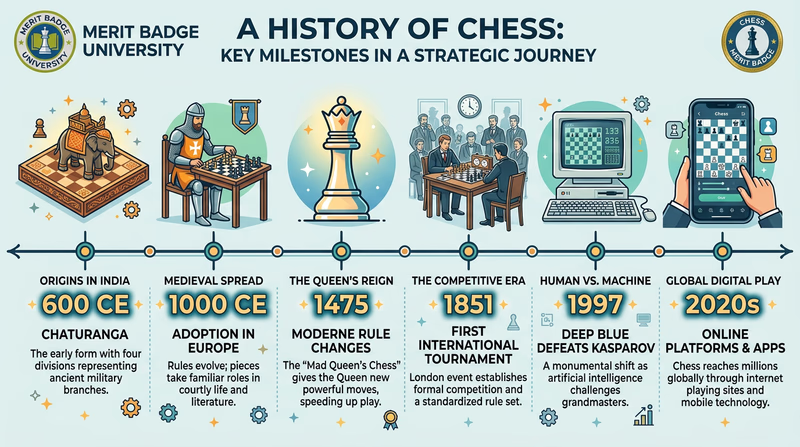
When you discuss chess history with your counselor, think about the big themes: how the game traveled across cultures, how each culture adapted it, and why it has endured for over 1,400 years. Now let’s meet some of the players who made chess history.