Req 2 — Strategy, Benefits & Etiquette
This requirement covers three topics you will discuss with your counselor:
- Why chess is a game of planning and strategy (Req 2a)
- The benefits of playing chess for critical thinking, concentration, and decision-making (Req 2b)
- Sportsmanship and chess etiquette (Req 2c)
Why Chess Is a Game of Planning and Strategy
Unlike games that rely on dice rolls or card draws, chess has zero luck. Every piece is visible. Every option is available to both sides. The only advantage you can gain comes from outthinking your opponent.
This makes chess a pure strategy game. But what does “strategy” actually mean on the chessboard?
Strategy is your long-term plan — your goals for the next 10, 20, or 30 moves. Should you attack on the kingside? Trade pieces to simplify into a winning endgame? Keep the center closed and maneuver on the flanks? Strategic thinking is about asking, “Where do I want to be in 15 moves, and what steps get me there?”
Tactics, by contrast, are short-term combinations — specific sequences of 2–5 moves that win material or create checkmate threats. A fork, a pin, a discovered attack: these are tactical tools. Good strategy puts you in a position where tactics become available.
The best chess players combine both. They develop a plan (strategy) and execute it through precise move sequences (tactics). This same planning-then-executing approach applies to everything from planning a backpacking route to preparing for a school project.
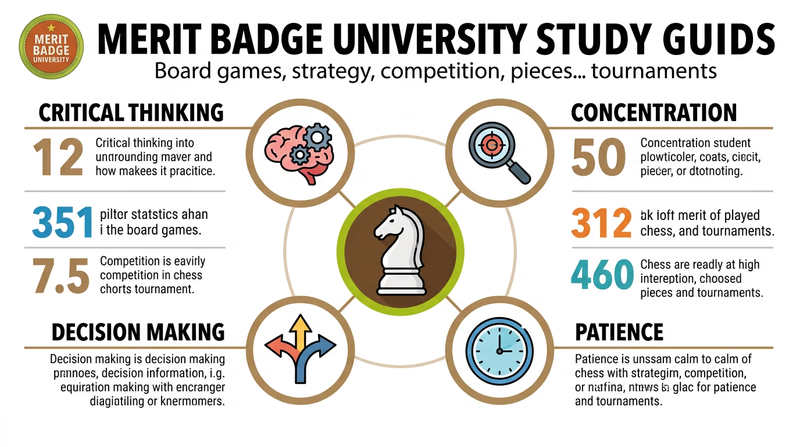
Benefits of Playing Chess
Critical Thinking
Chess forces you to evaluate positions, weigh trade-offs, and choose between competing plans. Every move requires answering: “What does my opponent want to do? What are my options? Which move best serves my plan while limiting theirs?” This is critical thinking in its purest form — and research shows it transfers to academic performance, particularly in math and reading comprehension.
Concentration
A single chess game can last an hour or more. During that time, you need sustained focus — one careless move can undo 30 moves of careful play. Chess trains your ability to concentrate deeply over extended periods, a skill that helps with studying, test-taking, and any task that requires sustained attention.
Decision-Making
In chess, you make a decision every single move. Sometimes the choice is clear; often it is not. You learn to make decisions under pressure, with incomplete information (you cannot read your opponent’s mind), and with consequences (a blunder might cost the game). Over time, chess players develop the habit of thinking before acting — considering consequences, weighing risks, and committing to a plan.
Beyond the Board
These skills do not stay on the chessboard. Studies have linked regular chess play to:
- Improved problem-solving ability
- Better memory and pattern recognition
- Greater patience and emotional control (learning to stay calm after making a mistake)
- Enhanced planning and foresight
Sportsmanship and Chess Etiquette
Chess has a strong tradition of mutual respect between opponents. Good sportsmanship is not optional — it is part of the game’s culture. Here are the key etiquette rules every chess player should follow:
Before the Game
- Shake hands with your opponent before the game begins.
- Arrive on time. In tournament play, your clock starts whether you are at the board or not.
- Silence your phone and remove it from the playing area. In tournament chess, having a phone on your person — even powered off — can result in a loss.
During the Game
- Touch move: If you touch a piece, you must move it (if a legal move exists). If you touch an opponent’s piece, you must capture it (if a legal capture exists). This is one of the most important rules in chess etiquette. If you need to adjust a piece on its square without moving it, say “I adjust” or “J’adoube” (the traditional French phrase) before touching it.
- Stay quiet. Do not talk, hum, tap, or make distracting noises.
- Do not offer draw excessively. Repeated draw offers are considered unsportsmanlike.
- Use one hand to move pieces and press the clock.
After the Game
- Shake hands again, regardless of the result.
- Do not make excuses. Instead of blaming bad luck, ask yourself what you could learn from the game.
- Offer to analyze the game with your opponent. Post-game analysis is one of the most valuable learning tools in chess and a sign of mutual respect.
You now understand why chess matters — as a strategy game, a brain trainer, and a social activity built on respect. Time to learn the pieces themselves.