Req 3a — Chess Piece Names
For this requirement, you need to know each piece by name — and then teach those names to someone new using the Scouting EDGE method (Explain, Demonstrate, Guide, Enable). Let’s get to know each member of your chess army.
The Six Chess Pieces
Every chess set contains six different types of pieces. Each player starts with 16 pieces: one king, one queen, two rooks, two bishops, two knights, and eight pawns.
King
The king is the most important piece on the board — the entire game revolves around it. If your king is checkmated, you lose. The king can move one square in any direction: horizontally, vertically, or diagonally. Despite being the most important piece, the king is one of the least powerful in terms of movement.
Notation symbol: K
Queen
The queen is the most powerful piece. She can move any number of squares in any direction — horizontally, vertically, or diagonally — as long as no piece blocks her path. The queen combines the powers of the rook and the bishop, making her a devastating attacking piece.
Notation symbol: Q
Rook
The rook (sometimes mistakenly called a “castle”) moves any number of squares horizontally or vertically. Rooks are strongest on open files (columns with no pawns blocking them) and are critical in the endgame. Each player starts with two rooks.
Notation symbol: R
Bishop
The bishop moves any number of squares diagonally. Because it stays on diagonal lines, a bishop that starts on a light square can never reach a dark square, and vice versa. That is why having both bishops (called a “bishop pair”) is considered an advantage — together they can cover the entire board.
Notation symbol: B
Knight
The knight is the trickiest piece to learn. It moves in an “L” shape: two squares in one direction (horizontally or vertically) and then one square perpendicular to that — or one square first and then two perpendicular. The knight is the only piece that can jump over other pieces, making it especially dangerous in crowded positions.
Notation symbol: N (not K, since K is already used for the king)
Pawn
The pawn is the most numerous piece — each side starts with eight. Pawns move forward one square at a time (or optionally two squares on their very first move). Unlike other pieces, pawns capture differently from how they move: they capture one square diagonally forward. Pawns cannot move backward.
Despite being the weakest individual piece, pawns form the structure of your position. As Philidor said in the 18th century, “Pawns are the soul of chess.”
Notation symbol: (none — pawn moves are written without a letter, e.g., “e4”)
Piece Values
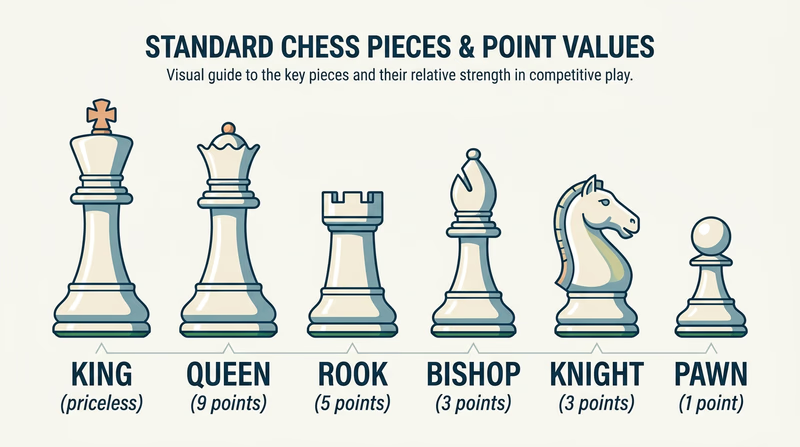
While the king is priceless (losing it means losing the game), the other pieces have approximate point values that help you evaluate trades:
| Piece | Notation | Approximate Value |
|---|---|---|
| Pawn | (none) | 1 point |
| Knight | N | 3 points |
| Bishop | B | 3 points |
| Rook | R | 5 points |
| Queen | Q | 9 points |
| King | K | Infinite (game over if lost) |
These values are guidelines, not absolute rules. A well-placed knight can be worth more than a passive rook. Context matters — but knowing the basic values helps you decide whether a trade is favorable.
Teaching with the EDGE Method
Part of this requirement asks you to teach someone who does not know how to play chess. Use the Scouting EDGE method:
- Explain: Tell them the name of each piece and its role. Use the point values to help them understand relative importance.
- Demonstrate: Hold up each piece, say its name, and show where it starts on the board. Point out distinguishing features (the king has a cross on top, the queen has a crown).
- Guide: Have them pick up each piece and name it. Correct gently if they mix up the bishop and knight (a common confusion).
- Enable: Scramble the pieces and ask them to sort them by name, then set them up on the board.
Now that you know your army, it is time to arrange them for battle.