Req 3c — How Pieces Move & Capture
This is one of the most content-heavy requirements in the Chess merit badge. You need to understand how every piece moves, how it captures, and all the special rules that make chess so rich. Let’s work through each one.
Basic Movement and Capture
In Req 3a, you learned the names of the six pieces. Here is exactly how each one moves and captures:
| Piece | Movement | Captures |
|---|---|---|
| King | One square in any direction | Same as movement |
| Queen | Any number of squares horizontally, vertically, or diagonally | Same as movement |
| Rook | Any number of squares horizontally or vertically | Same as movement |
| Bishop | Any number of squares diagonally | Same as movement |
| Knight | “L” shape: 2+1 squares; can jump over pieces | Same as movement |
| Pawn | Forward one square (or two on first move) | One square diagonally forward |
Most pieces capture the same way they move — by landing on a square occupied by an opponent’s piece. The pawn is the exception: it moves straight ahead but captures diagonally.
Special Rules
Castling
Castling is a unique move that involves the king and a rook moving simultaneously. It is the only move in chess where two pieces move at once. Castling helps protect your king and activate your rook.
How it works:
- Kingside castling (O-O): The king moves two squares toward the h-rook, and the rook jumps over the king to the adjacent square. White: Ke1→g1 and Rh1→f1.
- Queenside castling (O-O-O): The king moves two squares toward the a-rook, and the rook jumps over the king. White: Ke1→c1 and Ra1→d1.
The four rules of castling — all four must be true:
- Neither the king nor the chosen rook has moved previously in the game.
- No pieces stand between the king and the rook.
- The king is not in check. You cannot castle out of check.
- The king does not pass through or land on a square attacked by an opponent’s piece.
En Passant
En passant (French for “in passing”) is a special pawn capture that catches many beginners by surprise.
When it happens: If a pawn advances two squares from its starting position and lands beside an opponent’s pawn, the opponent’s pawn can capture it as if it had moved only one square. The capturing pawn moves diagonally forward to the square the advancing pawn passed through, and the advancing pawn is removed.
Critical rule: En passant can only be done on the very next move after the two-square advance. If you do not capture en passant immediately, you lose the right to do so.
Pawn Promotion
When a pawn reaches the opposite end of the board (the 8th rank for White, the 1st rank for Black), it must immediately be promoted to any piece the player chooses: queen, rook, bishop, or knight. The pawn cannot remain a pawn, and it cannot become a king.
Nearly all promotions are to a queen (called “queening”), since the queen is the most powerful piece. However, promoting to a knight — called “underpromotion” — is occasionally the right move when the knight delivers an immediate check or fork that a queen could not.
Check, Getting Out of Check, and Checkmate
Check
A king is in check when it is attacked by an opponent’s piece — meaning the opponent could capture the king on the next move. When your king is in check, you must get out of check on your very next move. You cannot ignore check or make a different move.
Three Ways to Get Out of Check
There are exactly three ways to escape check:
- Move the king to a square that is not attacked.
- Block the check by placing one of your pieces between the attacking piece and your king. (This does not work against knight checks or contact checks — you cannot block an L-shaped attack.)
- Capture the attacking piece. If you can take the piece that is giving check, the threat is eliminated.
If none of these three options is possible, it is checkmate.
Checkmate
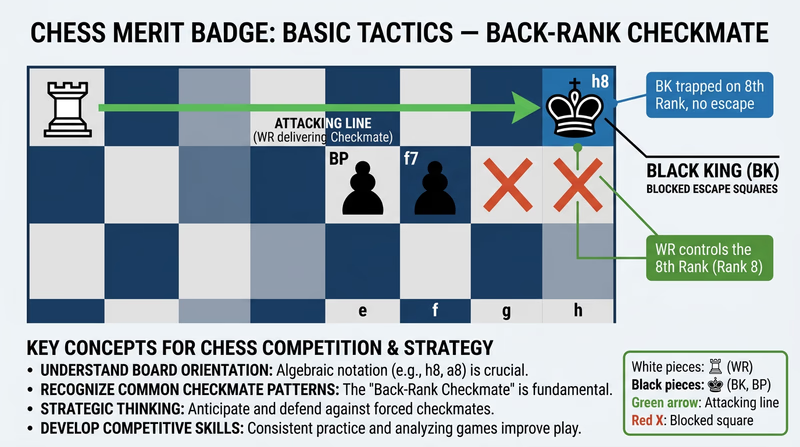
Checkmate means the king is in check and there is no legal way to escape. The king cannot move to a safe square, no piece can block the attack, and no piece can capture the attacker. When this happens, the game is over — the side that delivered checkmate wins.
Teaching These Rules with EDGE
This requirement asks you to teach all of this to someone new. This is a lot of material, so break it into sessions:
- Session 1: Basic movement of all six pieces. Let them practice moving each piece on an empty board.
- Session 2: Capturing. Set up practice positions and have them find all possible captures.
- Session 3: Special rules — castling, en passant, pawn promotion. These are the rules that feel “weird” to beginners, so give extra practice time.
- Session 4: Check, escaping check, and checkmate. Set up simple checkmate positions for them to recognize.
With all the rules under your belt, there is one more important topic to cover: how a game can end without anyone winning.