Req 3d — Five Ways to Draw
Not every chess game produces a winner. Sometimes the game ends in a draw — a tie where neither player wins or loses. There are exactly five ways this can happen.
1. Stalemate
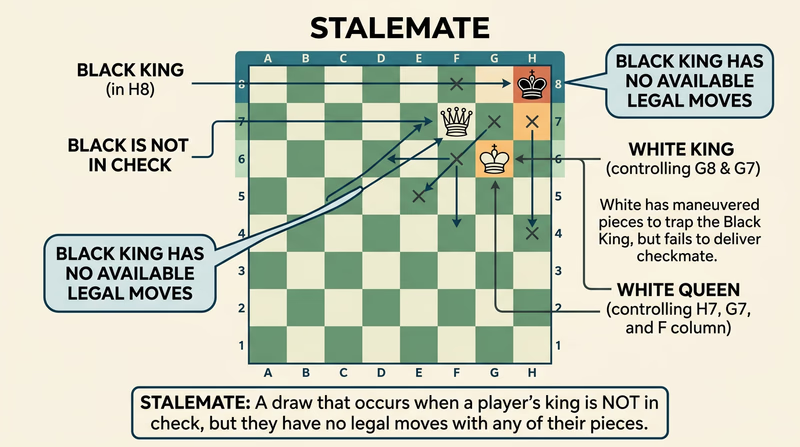
Stalemate occurs when the player whose turn it is has no legal moves and their king is not in check. The game immediately ends in a draw.
This is one of the most frustrating outcomes in chess — a player who is completely winning can accidentally stalemate their opponent and throw away the victory. It is also one of the most important defensive resources. If you are losing badly, look for ways to force a stalemate.
Example: White has a king and queen against Black’s lone king. If White moves the queen so that it covers every square the Black king could move to, but the queen is not actually giving check, Black has no legal moves and it is stalemate — a draw instead of a win for White.
2. Mutual Agreement
Both players can agree to a draw at any time. One player offers the draw (typically by saying “I offer a draw” or writing it on their score sheet), and the opponent can accept or decline.
In tournament play, draw offers follow a specific protocol: you make your move, offer the draw, then press the clock. Your opponent can think about the offer on their own time.
3. Threefold Repetition
If the same exact board position occurs three times during a game — with the same player to move, the same castling rights, and the same en passant possibilities — either player can claim a draw. The positions do not need to happen on consecutive moves.
In practice, threefold repetition often happens when one player checks the opponent’s king back and forth between the same squares (called “perpetual check”). If you are losing, forcing perpetual check is an excellent way to save a half point.
4. Fifty-Move Rule
If fifty consecutive moves pass without a pawn move or a capture, either player can claim a draw. The idea is that if neither side can make progress in 50 moves, the game has reached a dead end.
This rule is most relevant in endgames where one side has a slight material advantage but cannot figure out how to force checkmate. The defending player can try to reach the 50-move threshold.
5. Insufficient Material
The game is an automatic draw when neither player has enough pieces to force checkmate. These material combinations cannot produce checkmate:
- King vs. king — nobody can deliver check, let alone checkmate
- King and bishop vs. king — a single bishop cannot force checkmate
- King and knight vs. king — a single knight cannot force checkmate
- King and bishop vs. king and bishop (same-colored bishops) — neither side can force a win
Summary Table
| Draw Type | How It Happens | Who Claims It? |
|---|---|---|
| Stalemate | No legal moves, king not in check | Automatic |
| Mutual Agreement | Both players agree | Either player offers |
| Threefold Repetition | Same position occurs 3 times | Either player claims |
| Fifty-Move Rule | 50 moves without pawn move or capture | Either player claims |
| Insufficient Material | Neither side can force checkmate | Automatic |
You now know every rule of chess — how the pieces move, the special moves, and all the ways a game can end. Next, you will learn the language of chess: algebraic notation.