Req 4a — Algebraic Notation
Every serious chess game is recorded move by move. Algebraic notation is the universal language for writing down chess moves — once you learn it, you can read games played by grandmasters, record your own games for review, and communicate positions with anyone in the world.
The Coordinate System
Think of the chessboard as a grid. Each square has a unique name made up of a letter (the column, called a “file”) and a number (the row, called a “rank”):
- Files are labeled a through h, from White’s left to right.
- Ranks are labeled 1 through 8, from White’s side to Black’s side.
So the bottom-left square (from White’s perspective) is a1, and the top-right square is h8. White’s king starts on e1; Black’s king starts on e8.
8  ·  ·  ·  ·  ·  ·  ·  ·
7  ·  ·  ·  ·  ·  ·  ·  ·
6  ·  ·  ·  ·  ·  ·  ·  ·
5  ·  ·  ·  ·  ·  ·  ·  ·
4  ·  ·  ·  ·  ·  ·  ·  ·
3  ·  ·  ·  ·  ·  ·  ·  ·
2  ·  ·  ·  ·  ·  ·  ·  ·
1  ·  ·  ·  ·  ·  ·  ·  ·
   a  b  c  d  e  f  g  h
Writing Moves
Each move is written with the piece symbol followed by the destination square.
| Symbol | Piece |
|---|---|
| K | King |
| Q | Queen |
| R | Rook |
| B | Bishop |
| N | Knight |
| (none) | Pawn |
Examples:
- e4 — a pawn moves to e4 (no letter for pawns)
- Nf3 — a knight moves to f3
- Bb5 — a bishop moves to b5
- Qd7 — the queen moves to d7
- O-O — kingside castling
- O-O-O — queenside castling
Captures
Use an x between the piece symbol and the destination square:
- Bxf7 — a bishop captures on f7
- exd5 — a pawn on the e-file captures on d5 (for pawn captures, include the file the pawn came from)
Special Symbols
| Symbol | Meaning |
|---|---|
| x | Capture |
| + | Check |
| # | Checkmate |
| =Q | Pawn promotion to queen (or =R, =B, =N) |
| e.p. | En passant (optional — many players just write the move) |
| ! | Good move |
| ? | Mistake |
| !! | Brilliant move |
| ?? | Blunder |
Recording a Game: The Score Sheet
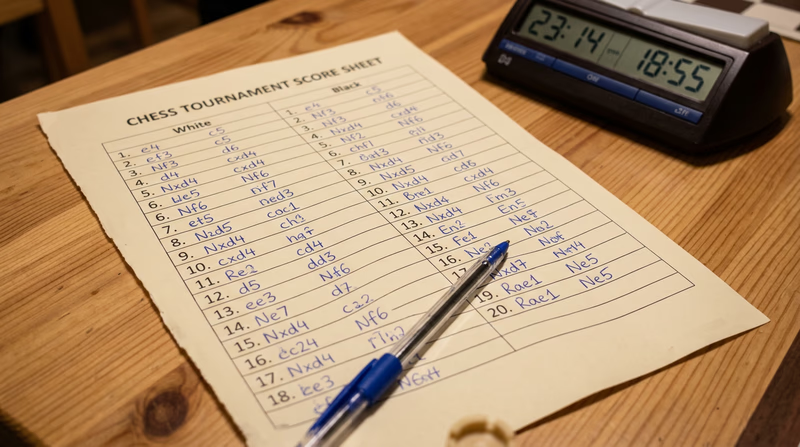
In tournaments, players are required to record every move on a score sheet. Each move is numbered, with White’s move first and Black’s move second:
1. e4    e5
2. Nf3   Nc6
3. Bb5   a6
4. Ba4   Nf6
5. O-O   Be7
This is the opening of a real game — the Ruy Lopez, one of the oldest and most popular chess openings. You will learn more about it in Req 4c.
Disambiguating Moves
Sometimes two pieces of the same type can move to the same square. In that case, include extra information to clarify which piece moved:
- Rae1 — the rook on the a-file moves to e1 (to distinguish it from the rook on, say, f1)
- N5d4 — the knight on the 5th rank moves to d4 (to distinguish it from a knight on, say, f3)
- Raxd1 — the rook on the a-file captures on d1
Practice Exercise
Here is a short game (Scholar’s Mate — you will study this in Req 4d). Practice reading it move by move:
1. e4    e5
2. Bc4   Nc6
3. Qh5   Nf6??
4. Qxf7#
Read it aloud: “One, pawn to e4, pawn to e5. Two, bishop to c4, knight to c6. Three, queen to h5, knight to f6 — blunder. Four, queen takes f7, checkmate.”
Notation Skills to Demonstrate
Your counselor will want to see you can do all of these
- Name any square on the board by its coordinates.
- Write moves using correct piece symbols and destination squares.
- Record captures with the “x” symbol.
- Note check (+) and checkmate (#) correctly.
- Record castling as O-O or O-O-O.
- Record at least one complete game on a score sheet.
Now that you can read and write the language of chess, let’s explore the three phases that every game passes through.