Req 4b — Opening, Middle & Endgame
Every chess game passes through three distinct phases, each with its own goals, strategies, and character. Understanding what to focus on in each phase is one of the biggest jumps in chess skill.
The Opening (Moves 1–10, roughly)
The opening is the deployment phase — both players are mobilizing their forces from the starting position. Think of it like setting up camp: you are not hiking yet, but how well you set up determines whether the rest of the trip goes smoothly.
Goals of the Opening
- Control the center. The four central squares (d4, d5, e4, e5) are the most important real estate on the board. Pieces placed in or near the center control more squares and can shift to either side of the board quickly.
- Develop your pieces. Move your knights and bishops off the back rank and into active positions. Each move should bring a new piece into play.
- Castle your king. Get your king to safety behind a wall of pawns, and simultaneously connect your rooks (bring them to the center files where they can work together).
- Do not waste time. Avoid moving the same piece twice in the opening unless there is a good reason. Do not go pawn-hunting with your queen early — she will get chased around by your opponent’s developing pieces.
The Middle Game (Moves 10–30, roughly)
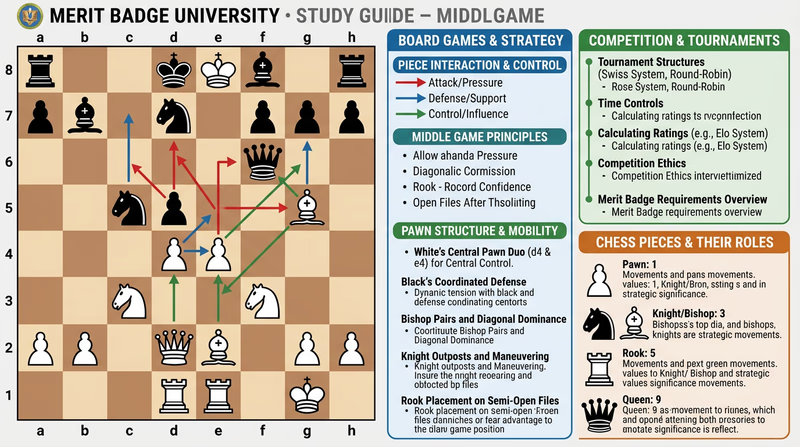
The middle game is where chess becomes truly complex. Most pieces are developed, pawns have defined the structure, and both players are executing their plans. This is the battle phase — the part of the game where strategy and tactics collide.
Goals of the Middle Game
- Create and follow a plan. Look at the pawn structure to determine where you should attack. If your pawns point toward the kingside, that is usually where your pieces should go.
- Coordinate your pieces. A lone rook does little. A rook backed by a queen on an open file, with a knight ready to jump to a key square, creates devastating threats.
- Look for tactical opportunities. Forks, pins, skewers, and discovered attacks (you will learn these in Req 5b) are most common in the middle game, when many pieces are on the board and tensions are high.
- Trade strategically. Do not trade pieces randomly. Trade when it improves your position (e.g., swapping your passive bishop for your opponent’s active knight) or when you have a material advantage and want to simplify.
Middle Game vs. Opening
The transition from opening to middle game is not a fixed line. Generally, once both sides have completed their development and castled, the middle game has begun. The key difference: in the opening, you follow principles. In the middle game, you create your own plan based on the specific position.
The Endgame (Few pieces remaining)
The endgame begins when most pieces have been traded off and the kings become active fighting units rather than hiding behind their pawns. With fewer pieces on the board, the character of the game changes dramatically.
Goals of the Endgame
- Activate your king. In the opening and middle game, the king hides. In the endgame, the king marches toward the center and becomes a powerful piece. A king in the center can support pawn advances and attack enemy pawns.
- Push passed pawns. A “passed pawn” — one with no enemy pawn blocking or guarding its path to the promotion square — becomes the most important feature of many endgames. Escort it to the 8th rank to promote to a queen.
- Use zugzwang. This German word means “compulsion to move.” In some endgame positions, whoever has to move is at a disadvantage because any move worsens their position. Understanding zugzwang is critical in king-and-pawn endgames (you will practice this in Req 5d).
- Know your theoretical endgames. Certain endgame positions have been analyzed to a definitive result. For example, king and queen vs. king is always a win if you know the technique. King and rook vs. king is also a forced win. Knowing these fundamentals saves you from throwing away a winning position.
Comparing the Three Phases
| Opening | Middle Game | Endgame | |
|---|---|---|---|
| Priority | Development & king safety | Plans & tactics | King activity & promotion |
| King role | Hide (castle) | Stay safe | Fight (march to center) |
| Pawns | Establish center structure | Define attack directions | Race to promote |
| Pieces | Get them off the back rank | Coordinate attacks | Few remain; each is critical |
| Thinking | Follow principles | Create custom plans | Calculate precisely |
Ready to go deeper into opening play? Next, you will learn four core principles and the first moves of four famous openings.