Req 4c — Opening Principles & Openings
In Req 4b, you learned that the opening is about development, center control, and king safety. Now let’s get specific: four principles to guide your opening play, and four of the most important openings in chess history.
Four Opening Principles
1. Control the Center
The four central squares — d4, d5, e4, e5 — are the battlefield’s high ground. A piece in the center controls more squares than the same piece on the edge. Place pawns and pieces in or toward the center early, and resist the temptation to play on the flanks before you have established central presence.
2. Develop Your Pieces
Every move should ideally bring a new piece into action. Knights and bishops should leave the back rank within the first several moves. Avoid moving the same piece twice unless forced (e.g., when attacked). A common guideline: develop knights before bishops, since knights have fewer ideal squares and their best spots (f3/c3 for White, f6/c6 for Black) are almost always correct.
3. Castle Early
Castling accomplishes two things at once: it tucks your king behind a wall of pawns for safety, and it brings a rook toward the center where it can control open files. Aim to castle within the first 8–10 moves. Delaying castling leaves your king exposed to tactical attacks.
4. Do Not Bring the Queen Out Early
The queen is the most powerful piece, but she is also the most vulnerable to harassment early in the game. If you move your queen to an active square on move 3, your opponent can chase her with developing moves — gaining time while you retreat. Keep the queen back until your minor pieces (knights and bishops) are developed.
Four Famous Openings
You need to demonstrate the first five moves of each opening. Here they are, with the ideas behind them.
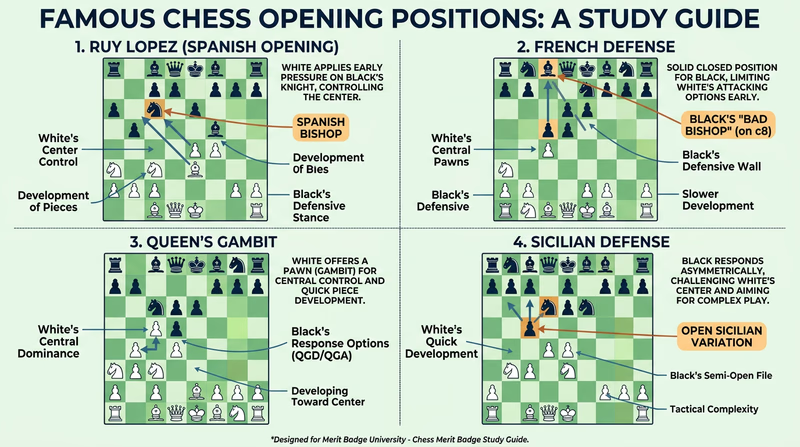
Ruy Lopez (1. e4 e5 2. Nf3 Nc6 3. Bb5)
Named after a 16th-century Spanish priest, the Ruy Lopez is one of the oldest and most deeply studied openings in chess. It has been a weapon of World Champions from Steinitz to Carlsen.
1. e4    e5       White and Black both stake a claim to the center.
2. Nf3   Nc6      White attacks the e5 pawn; Black defends it.
3. Bb5   a6       White pins pressure on the knight defending e5;
4. Ba4   Nf6        Black chases the bishop and develops.
5. O-O   Be7      White castles early; Black prepares to castle.
Key idea: White builds pressure on Black’s center (the e5 pawn) while developing harmoniously. The Ruy Lopez leads to rich strategic positions with chances for both sides.
French Defense (1. e4 e6)
The French Defense is a solid, counter-punching opening. Black lets White build a big center with pawns on e4 and d4, then immediately challenges it. It was a favorite of Mikhail Botvinnik, the “Patriarch of Soviet Chess.”
1. e4    e6       Black prepares to challenge the center with ...d5.
2. d4    d5       Black strikes at White's e4 pawn.
3. Nc3   Nf6      Both sides develop knights.
4. Bg5   Be7      White pins the knight; Black breaks the pin.
5. e5    Nfd7     White advances; Black's knight retreats to regroup.
Key idea: Black accepts a slightly cramped position but gets a solid pawn structure and clear plans for counter-attack on the queenside. The French is an excellent choice for players who prefer strategic, long-term games.
Queen’s Gambit Declined (1. d4 d5 2. c4 e6)
The Queen’s Gambit is not actually a true sacrifice — White offers a pawn (c4) that Black should not take permanently because White will win it back with advantage. When Black “declines” by playing …e6 instead of taking on c4, the result is one of the most classical openings in chess.
1. d4    d5       Both players open with their d-pawns.
2. c4    e6       White offers the "gambit"; Black declines solidly.
3. Nc3   Nf6      Both sides develop knights toward the center.
4. Bg5   Be7      White pins Black's knight; Black prepares to castle.
5. e3    O-O      White supports the center; Black castles to safety.
Key idea: White gets a spatial advantage in the center while Black maintains a solid, hard-to-crack position. This opening has been played at the highest levels for over 150 years and was featured prominently in The Queen’s Gambit TV series.
Sicilian Defense (1. e4 c5)
The Sicilian Defense is Black’s most popular response to 1. e4 and the most common opening in master-level chess. It leads to sharp, unbalanced positions where both sides have winning chances — making it a favorite of aggressive players like Garry Kasparov and Bobby Fischer.
1. e4    c5       Black fights for the center from the flank.
2. Nf3   d6       White develops; Black solidifies.
3. d4    cxd4     White pushes for a big center; Black trades to open the c-file.
4. Nxd4  Nf6      White recaptures; Black develops and attacks e4.
5. Nc3   a6       White develops; Black prepares queenside expansion.
Key idea: Black trades a flank pawn (c5) for White’s center pawn (d4), creating an asymmetric position. Black gets the semi-open c-file for counterplay, while White typically attacks on the kingside. These imbalances lead to exciting, dynamic games.
Preparing for Your Counselor
Opening Demonstration Checklist
Be ready to show your counselor all of these
- Explain each of the four opening principles in your own words.
- Set up a board and play through the first five moves of the Ruy Lopez for both sides.
- Play through the first five moves of the French Defense.
- Play through the first five moves of the Queen’s Gambit Declined.
- Play through the first five moves of the Sicilian Defense.
- For each opening, explain the basic idea behind it in one or two sentences.
Now it is time for some fun: famous checkmate patterns and deadly traps that have been catching opponents off guard for centuries.