Req 4d — Famous Checkmates & Traps
These five patterns are some of the most famous sequences in chess history. Each one teaches an important lesson about tactics, traps, and what happens when you violate opening principles. Set up a board and follow along.
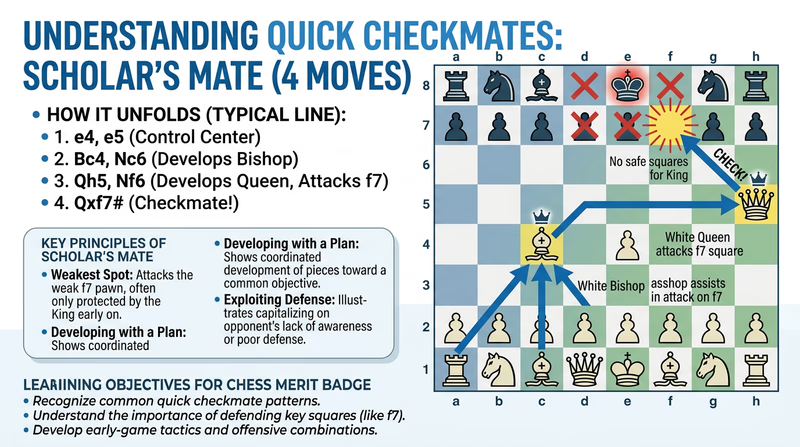
Scholar’s Mate
Result: Checkmate in 4 moves (White wins)
1. e4    e5
2. Bc4   Nc6
3. Qh5   Nf6??
4. Qxf7#
White aims the bishop and queen at the f7 square — the weakest point in Black’s position (defended only by the king). Black’s mistake is playing 3…Nf6, which attacks the queen but does not defend f7. The queen captures on f7 with checkmate, supported by the bishop on c4.
Lesson: The f7 (and f2 for White) square is vulnerable early in the game because only the king defends it. Always be aware of attacks aimed at this square.
Fool’s Mate
Result: Checkmate in 2 moves (Black wins)
1. f3?   e5
2. g4??  Qh4#
The fastest possible checkmate in chess. White weakens the kingside catastrophically by pushing both the f- and g-pawns, and Black’s queen delivers checkmate on h4. The White king has no escape — the pawn moves have blocked all retreat squares.
Lesson: The f2/f7 pawn protects the king’s diagonal. Moving it early — especially combined with g2/g7 — creates fatal weaknesses. Never play f3 and g4 in the opening.
Légal Mate
Result: White sacrifices the queen and checkmates with minor pieces
1. e4    e5
2. Nf3   d6
3. Bc4   Bg4
4. Nc3   g6?
5. Nxe5! Bxd1??
6. Bxf7+ Ke7
7. Nd5#
This brilliant pattern is named after the French player Sire de Légal, who played it in the 18th century. White deliberately leaves the queen hanging (5. Nxe5, allowing …Bxd1). If Black greedily captures the queen, White delivers checkmate with the bishop and two knights. The key is that after 6. Bxf7+ Ke7, the knight on d5 delivers checkmate because the king is completely surrounded.
Lesson: Do not automatically capture a piece just because it is “free.” Always check for hidden threats, especially when your opponent seems to be giving away material.
Fried Liver Attack
Result: A devastating attack after a knight sacrifice
1. e4    e5
2. Nf3   Nc6
3. Bc4   Nf6
4. Ng5   d5
5. exd5  Nxd5?
6. Nxf7! Kxf7
7. Qf3+  Ke6
8. Nc3   ...
The Fried Liver Attack (also called the Fegatello Attack — Italian for “dead as a piece of liver”) is one of the most aggressive openings in chess. White sacrifices a knight on f7, forcing the Black king to capture. The king is then dragged into the center of the board, where it faces a vicious attack from White’s queen and pieces.
After 7. Qf3+ Ke6, Black’s king is on e6 — in the middle of the board in the opening! White has a powerful attack, and the position is extremely difficult for Black to survive.
Lesson: This is why king safety matters. If you can force your opponent’s king into the open early, even a material sacrifice can be worthwhile. As Black, the best defense against the Fried Liver is 5…Na5 (the Traxler Counterattack) or 4…d5 5. exd5 b5 (the Ulvestad Variation).
Noah’s Ark Trap
Result: Black traps and wins White’s bishop
1. e4    e5
2. Nf3   Nc6
3. Bb5   a6
4. Ba4   d6
5. d4    b5
6. Bb3   Na5!
7. dxe5  Nxb3
8. axb3  dxe5
Unlike the other patterns, Noah’s Ark Trap does not end in checkmate — it wins material. Arising from the Ruy Lopez (which you learned in Req 4c), Black uses pawn advances (…a6, …b5) and a knight maneuver (…Na5) to trap White’s bishop on b3. The bishop has no escape squares, and White loses a piece.
This trap has been catching inattentive players since at least the 1620s — which is supposedly why it is called “Noah’s Ark” (it is that old).
Lesson: Always check whether your pieces have retreat squares. A piece that advances deep into enemy territory without an escape route can become trapped.
Demonstration Summary
| Pattern | Key Theme | Moves to Mate/Win |
|---|---|---|
| Scholar’s Mate | f7 weakness | 4 (checkmate) |
| Fool’s Mate | Kingside pawn weakness | 2 (checkmate) |
| Légal Mate | Queen sacrifice + coordination | 7 (checkmate) |
| Fried Liver Attack | Knight sacrifice + king hunt | Ongoing attack |
| Noah’s Ark Trap | Piece trapping | 7 (wins bishop) |
You have now mastered the fundamentals and some famous patterns. Time to go deeper into the strategic and tactical elements that separate beginners from intermediate players.