Req 5a — Chess Strategy
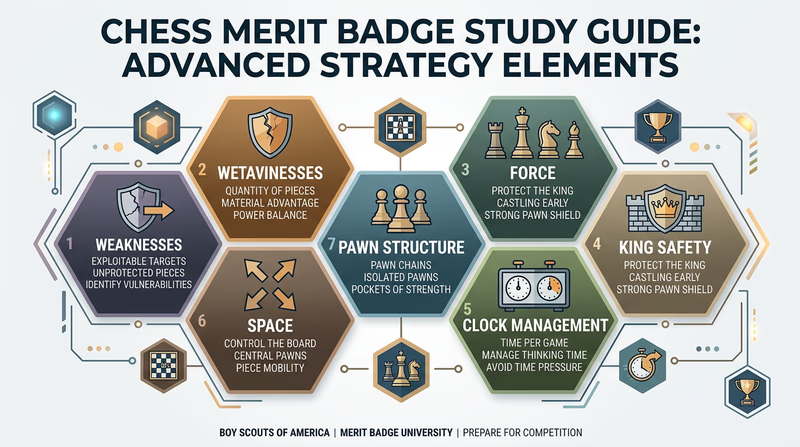
Strategy is your long-term plan — the “big picture” that guides your moves across 10, 20, or 30 turns. In Req 2, you learned that strategy and tactics work together. Now let’s dive deeper into the seven strategic elements you need to understand. You will explain four of these to your counselor, but learning all seven will make you a stronger player.
Exploiting Weaknesses
A weakness in chess is any feature of your opponent’s position that is difficult to defend. The most common weaknesses are:
- Weak squares: Squares that can no longer be defended by pawns (because the pawns have advanced past them). A knight planted on a weak square deep in enemy territory can dominate a game.
- Weak pawns: Isolated pawns (no friendly pawns on adjacent files), doubled pawns (two pawns of the same color on the same file), and backward pawns (behind their neighbors and unable to advance safely) are all targets.
- Weak king position: A king with few or no pawn cover is a strategic liability, even if no immediate tactical threat exists.
The art of strategy is identifying these weaknesses, maneuvering your pieces to attack them, and forcing your opponent to make uncomfortable choices.
Force
Force refers to your material advantage — having more or better pieces than your opponent. The simplest strategic principle is: if you have more material, trade pieces. Each trade brings you closer to a position where your extra material decides the game.
Force also includes temporary material imbalances. Sacrificing a knight to destroy your opponent’s pawn cover might lose material in the short term but create a winning attack. Understanding when material advantage matters more than position — and when it does not — is a key strategic skill.
King Safety
Your king’s safety is a strategic priority throughout the game. In the opening and middle game, the king is a liability — a target to be protected. Strategic decisions about king safety include:
- When to castle (and which side)
- Whether to keep pawns in front of your king (advancing them weakens the king’s cover)
- Recognizing when your opponent’s king is vulnerable — sometimes the best plan is to attack a weakened king position rather than playing for a positional advantage
A well-timed pawn storm (advancing your pawns toward the opponent’s castled king) can crack open the position for a decisive attack — but only if your own king is safe first.
Pawn Structure
Pawns cannot move backward. Every pawn move is permanent, which makes pawn structure one of the most important strategic factors. Common pawn structures include:
- Open center (few center pawns): Pieces are active, the game is dynamic, bishops tend to be strong.
- Closed center (locked pawns): Maneuvering is key, knights are often better than bishops, play tends to shift to the flanks.
- Pawn chains: Diagonal lines of pawns (like d4–e5 or d5–e6) point toward one side of the board. Attack on the side your pawns point to.
Space
Space refers to how much of the board your pieces control. A player with a space advantage has more room to maneuver — their pieces can shift between the kingside and queenside easily, while the opponent’s pieces are cramped and tripping over each other.
You gain space primarily by advancing pawns. A pawn on e5 (for White) controls more territory than a pawn on e2. But space comes with a cost: advanced pawns can become targets, and overextension (pushing too far without support) can leave weaknesses behind.
Tempo
A tempo is a unit of time in chess — essentially, one move. Gaining a tempo means achieving your goal in fewer moves than your opponent. Losing a tempo means wasting a move.
Examples of tempo:
- Developing a piece with an attack (e.g., playing Bb5 to develop the bishop while threatening the knight on c6) gains tempo because your opponent must respond.
- Moving the same piece twice in the opening (without a forcing reason) loses tempo because you used two moves for what should take one.
- In the openings from Req 4c, the Ruy Lopez (3. Bb5) gains tempo by forcing Black to spend a move on …a6.
Clock Management
In tournament chess, time is a real resource — not just a metaphor. Each player has a limited amount of thinking time. Clock management means allocating your time wisely:
- Spend time on critical decisions: A move that determines the game’s direction (e.g., choosing between two plans in the middle game) deserves more thought than a move with only one reasonable option.
- Do not spend time in the opening: If you know the opening well, play the first 10–15 moves quickly and save time for the complex middle game.
- Watch your opponent’s clock: If your opponent is low on time, avoid creating complicated positions that require long calculation — or deliberately create them if you want to increase time pressure.
Strategy gives you the plan. But you also need the tools to execute it — and those tools are called tactics.