Req 5b — Chess Tactics
Tactics are short, concrete sequences of moves that achieve a specific goal — winning material, delivering checkmate, or gaining a decisive advantage. While strategy is your long-term plan (as you learned in Req 5a), tactics are the weapons you use to execute that plan. Let’s walk through each tactic on the list.
Fork
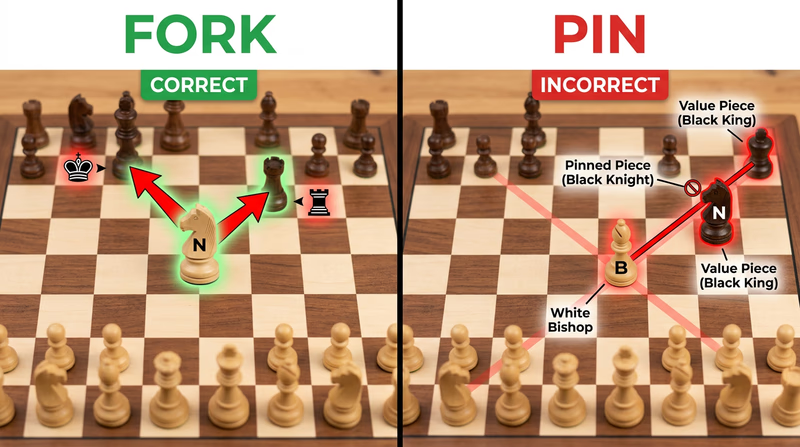
A fork is a single move that attacks two (or more) enemy pieces at the same time. The opponent can only save one, so you win the other. Knights are the most common forking pieces because of their unusual movement pattern, but any piece — including pawns — can deliver a fork.
Example: A knight on c7 might attack both the king on e8 and the rook on a8. The king must move out of check, and the rook is lost.
Pin
A pin occurs when a piece attacks an enemy piece that cannot move (or should not move) because doing so would expose a more valuable piece behind it. There are two types:
- Absolute pin: The pinned piece cannot legally move because moving it would expose the king to check. (A bishop pinning a knight to the king.)
- Relative pin: The pinned piece can legally move but doing so would lose a more valuable piece. (A rook pinning a bishop to the queen.)
Pins are devastating because the pinned piece becomes effectively paralyzed.
Skewer
A skewer is the reverse of a pin. The more valuable piece is attacked first and must move, exposing the less valuable piece behind it to capture. A classic example: a bishop attacks a king along a diagonal, the king moves, and the bishop captures the rook behind it.
Discovered Attack
A discovered attack occurs when you move one piece and reveal an attack from a different piece behind it. The piece that moves may also create its own threat, resulting in two simultaneous attacks. Discovered attacks are powerful because the opponent faces two threats at once.
Double Check
A double check is a special kind of discovered attack where both the moving piece and the piece behind it give check simultaneously. Double check is the most forcing move in chess because the only way to escape is to move the king — you cannot block two checks at once, and you cannot capture two pieces at once.
Double Attack
A double attack is any move that creates two threats at once. A fork is one type of double attack, but the term is broader — it includes any situation where a single move attacks two targets (not necessarily with the same piece). For instance, a queen move that threatens checkmate on one square and attacks an undefended rook on another is a double attack.
Clearance Sacrifice
A clearance sacrifice gives up a piece to clear a square or line for another piece to use. You sacrifice material not to win it back directly, but to create a path for a more powerful follow-up move — often a checkmate or a winning combination.
Decoy
A decoy lures an enemy piece to a specific square where it becomes vulnerable. You sacrifice material to force your opponent’s piece onto a square where you can then fork, pin, or otherwise exploit it. Think of it as “baiting the trap.”
Remove the Defender
This tactic eliminates a piece that is protecting a key square or another piece. Once the defender is gone, the thing it was defending becomes vulnerable. You might capture, exchange, or chase away the defending piece.
Interposing
Interposing means placing a piece between an attacker and its target (usually the king) to block the attack. This is one of the three ways to escape check (you learned this in Req 3c). As a tactic, an interposing move can sometimes block an attack while simultaneously creating a counter-threat.
Overloading
Overloading occurs when a single piece is given too many defensive responsibilities. If a rook is defending both a back-rank checkmate and a pawn on the other side of the board, you can exploit this by attacking one of the things it is defending — forcing it to abandon the other.
Overprotecting
Overprotecting is a strategic technique (coined by Aron Nimzowitsch) of placing extra defenders on a key square — more than seem strictly necessary. The idea is that a heavily protected central square or piece cannot be undermined, and the overprotecting pieces gain flexibility because they are centralized.
Zwischenzug
Zwischenzug (German for “in-between move”) is an unexpected move inserted into a sequence of forced moves. Instead of making the “obvious” recapture or response, you play a surprising intermediate move — often a check or a threat — that forces your opponent to deal with the new problem first, improving your position before you complete the expected sequence.
Zugzwang
Zugzwang (German for “compulsion to move”) is a situation where every possible move makes the position worse. The player would prefer to pass but the rules require them to move. Zugzwang most commonly occurs in endgames and is a key weapon in king-and-pawn endings (which you will study in Req 5d).
Now let’s put your knowledge to work on the board. Time to learn how to force checkmate with major pieces.