Req 5d — King & Pawn Endgames
This requirement teaches you the most important concept in king-and-pawn endgames: opposition. The same starting position produces completely different results depending on who moves first — a perfect demonstration of zugzwang.
The Setup
8  · · · · · · · ·
7  · · · · · · · ·
6  · · · · ♚ · · ·
5  · · · · · · · ·
4  · · · ♔ · · · ·
3  · · · · ♙ · · ·
2  · · · · · · · ·
1  · · · · · · · ·
   a b c d e f g h
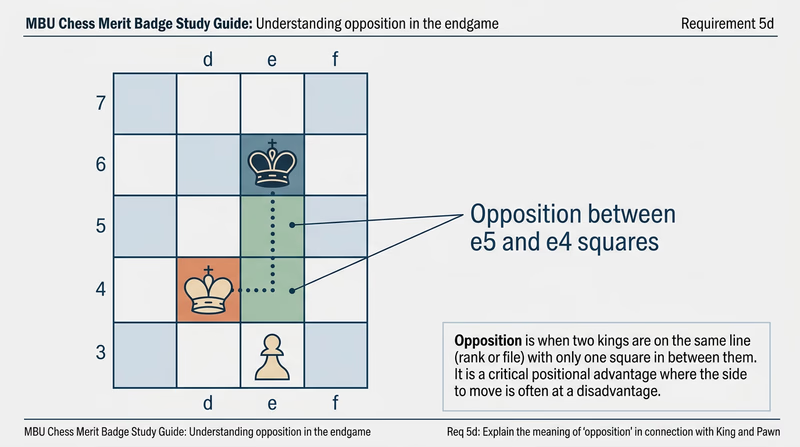
White King on d4, White Pawn on e3, Black King on e6.
What Is Opposition?
When two kings stand on the same file or rank with exactly one square between them, they are in opposition. The player whose turn it is to move is at a disadvantage — they must step aside, allowing the other king to advance.
In this position, with one square separating the kings on the d- and e-files, opposition determines everything.
Position 1: White to Move — White Wins
When White moves first, White can outmaneuver Black and escort the pawn to promotion.
The Technique
The key is for the White king to advance in front of the pawn, gaining opposition and pushing the Black king back.
- Ke4 — White advances the king. Now the kings are on the same rank, separated by one square on the e-file. It is Black’s turn, so Black has the opposition disadvantage.
- Black must move aside (e.g., …Kd6 or …Kf6). Either way, the White king gains ground.
- White continues advancing the king in front of the pawn, maintaining opposition whenever possible.
- Once the White king reaches the 6th rank in front of the pawn, promotion is guaranteed. The Black king cannot stop the pawn from queening.
Key principle: The king leads, the pawn follows. If the White king can reach the 6th rank in front of its pawn, the pawn promotes regardless of what Black does.
Position 2: Black to Move — Black Draws
When Black moves first from the same position, Black can hold a draw by maintaining opposition.
The Technique
- …Ke5! — Black takes opposition directly. Now the kings face each other on the e-file with one square between them, and it is White’s turn — so White is at the zugzwang disadvantage.
- White must step aside. If White plays Kd3, Black plays …Kd5, maintaining direct opposition. If White plays Ke4, the kings are on the same rank and Black mirrors with …Ke6.
- White eventually advances the pawn (e.g., e4), but Black keeps the opposition and blocks the White king from reaching the 6th rank in front of the pawn.
- The game results in stalemate or the Black king blockading the pawn — a draw.
Key principle: The defender draws by maintaining opposition. As long as the Black king stands directly in front of the White king when it is White’s turn to move, White cannot make progress.
Why It Works: Zugzwang in Action
Both positions demonstrate zugzwang — the compulsion to move that puts you at a disadvantage. In the starting position:
- When White moves first, White can advance (Ke4), and Black is forced to step aside, giving White’s king access to critical squares.
- When Black moves first, Black takes opposition (Ke5), and White is forced to step aside or push the pawn prematurely, allowing Black to maintain the blockade.
The same position, the same pieces — but who moves first determines the result. This is what makes king-and-pawn endgames so fascinating.
Practice
King & Pawn Endgame Practice
Drill these positions until they are automatic
- Set up the position and practice White winning (White moves first) at least three times.
- Set up the same position and practice Black drawing (Black moves first) at least three times.
- Try variations: what if Black does NOT take opposition? Show that White wins even more easily.
- Practice with the pawn on different files (not just e3) — the principles are the same.
One more endgame skill to go: solving direct-mate puzzles that test your ability to find forcing sequences.