Req 5e — Solving Mate Problems
A direct-mate problem gives you a position and says: “White to move and checkmate in X moves.” Your job is to find the exact sequence of moves that forces checkmate, no matter how the opponent responds. This is one of the best ways to develop calculation skills and tactical vision.
What Is a Direct-Mate Problem?
Direct-mate (or “mate-in-X”) problems are chess puzzles where:
- You are given a specific board position
- You must find the move (or sequence of moves) that forces checkmate in a set number of moves
- The solution must work against any defensive move by the opponent
Problems range from mate-in-1 (find the one move that delivers immediate checkmate) to mate-in-2, mate-in-3, and beyond. Your counselor will provide five problems for you to solve.
How to Solve Mate Problems
Step 1: Assess the Position
Before calculating, take 30 seconds to scan the board:
- Where is the enemy king? What squares can it move to?
- Which of your pieces are near the king? What lines do they control?
- Are there any checks available? (Checks drastically narrow the possibilities.)
- Is the king already confined, or does it have escape routes you need to cut off?
Step 2: Look for Checks First
In mate-in-1 problems, the answer is always a check that is also checkmate. In longer problems, the solution often (but not always) starts with a check. Checks force the opponent’s response, which reduces the number of variations you need to consider.
Step 3: Consider Surprising Moves
Many mate problems are designed to have a surprising or counterintuitive solution. The “obvious” move is often wrong. Look for:
- Quiet moves — non-checking moves that limit the king’s escape squares
- Sacrifices — giving up material to force the king into a mating net
- Interference — placing a piece on a square that blocks the defender
Step 4: Verify Your Solution
Once you think you have found the answer, check every possible response by the defender. A valid solution must work against all replies, not just one. For a mate-in-2:
- You make your first move
- Consider each possible reply by the opponent
- For each reply, find your mating move
- If any reply does not lead to checkmate in the required moves, your solution is wrong
Practice Strategies
Solving on a Physical Board
Your counselor will likely present problems on a real chessboard. When working through the solution:
- Do NOT move the pieces until you have found the answer in your head (or at least think you have).
- Announce your solution move by move, including the opponent’s responses.
- If you get stuck, ask your counselor for a hint — they might tell you which piece delivers the final checkmate.
Building Your Skills Before the Meeting
The best preparation is to solve many puzzles on your own before meeting with your counselor. Start with mate-in-1 problems to build pattern recognition, then advance to mate-in-2.
Where to Practice
Lichess Puzzles — Mate-in-1 Hundreds of mate-in-1 puzzles to build your checkmate pattern recognition. Free, unlimited, and sorted by difficulty. Lichess Puzzles — Mate-in-2 Mate-in-2 puzzles that challenge you to think two moves ahead. A great next step after mastering mate-in-1.Common Checkmate Patterns to Know
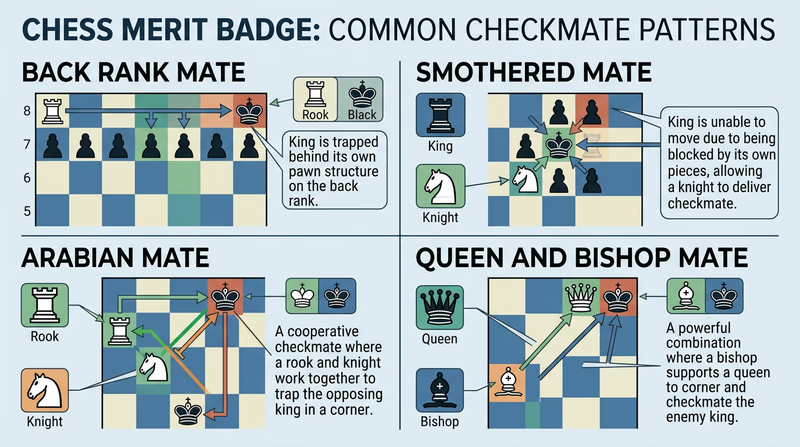
Recognizing these recurring checkmate patterns will help you solve problems faster:
| Pattern | Description |
|---|---|
| Back-rank mate | A rook or queen delivers checkmate on the 1st or 8th rank because the king is blocked by its own pawns |
| Smothered mate | A knight delivers checkmate because the king is surrounded by its own pieces |
| Arabian mate | A rook and knight work together — the rook on the edge, the knight covering escape squares |
| Anastasia’s mate | A rook and knight combine on the edge of the board, with the king trapped by a pawn |
| Epaulette mate | The queen checkmates a king that is flanked by its own pieces on both sides |
You have now worked through the entire strategy-and-tactics section of the badge. Next: how competitive chess is organized, from local club tournaments to international championships.