Req 6 — Chess Tournaments
Understanding how tournaments work is essential whether you plan to enter one for Req 7b or organize one for Req 7c. Let’s break down each element.
Tournament Formats
Swiss System
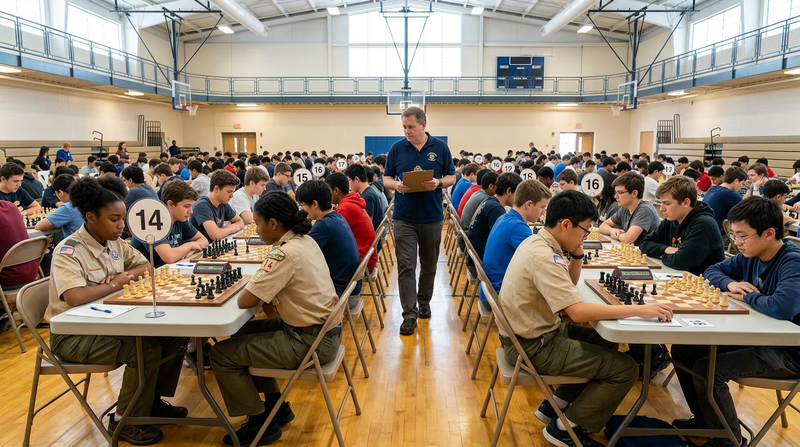
The Swiss system is the most common format for large tournaments (20+ players). Here is how it works:
- All players play the same number of rounds (typically 4–7, depending on the tournament).
- In Round 1, players are paired based on their rating — top-rated players face middle-rated ones (not each other). Colors (White or Black) are assigned to balance fairness.
- In subsequent rounds, players with the same score are paired against each other. If you have 2 wins and 1 loss (2/3 points), you play someone else with the same score.
- No rematches — you never play the same opponent twice.
- Color balance — the tournament director alternates colors so each player gets a roughly equal number of White and Black games.
The Swiss system is efficient because not everyone plays everyone. A 64-player Swiss tournament can produce a clear winner in just 6 rounds, while a round robin with 64 players would require 63 rounds.
Round Robin
In a round robin tournament, every player plays every other player exactly once. With n players, there are n - 1 rounds, and each player plays n - 1 games.
Round robin tournaments are used when:
- The number of players is small (typically 6–14)
- Maximum fairness is desired (everyone faces everyone)
- The tournament has enough time to complete all rounds
Double round robin tournaments have each pair of players meet twice — once as White and once as Black. World Championship Candidates tournaments use this format.
| Feature | Swiss System | Round Robin |
|---|---|---|
| Best for | Large fields (20+) | Small fields (6–14) |
| Games per player | Fixed (4–7 rounds) | n - 1 games |
| Fairness | Good (similar-scored opponents) | Maximum (everyone plays everyone) |
| Time needed | Moderate | Long |
Pairings
Pairings determine who plays whom in each round. In Swiss tournaments, pairings are generated by computer software (or manually by a tournament director) following specific rules:
- Players with the same score are paired against each other.
- Within a score group, the top-rated player plays the lowest-rated player (the “top half vs. bottom half” method).
- Colors alternate as fairly as possible.
- No player faces the same opponent twice.
In round robin tournaments, pairings follow a fixed rotation schedule (often called a “Berger table”) that ensures each player meets every other player and colors are balanced.
Time Controls
Every tournament game uses a chess clock — a device with two timers that count down. When you complete your move, you press the clock to start your opponent’s timer.
Common time controls:
| Format | Time per Player | Character |
|---|---|---|
| Classical | 90 minutes + 30 seconds per move | Deep, careful play |
| Rapid | 15–30 minutes total | Faster; less time to calculate |
| Blitz | 3–5 minutes total | Very fast; instinct and pattern recognition |
| Bullet | 1–2 minutes total | Extremely fast; nearly instant decisions |
Many tournaments use a “time increment” — an extra 2–30 seconds added to your clock after each move. This prevents players from losing purely on time in a complex position.
Touch Move
Touch move is one of the most important rules in tournament chess, and you covered it in Req 2. To recap:
- If you touch a piece, you must move it (if a legal move exists).
- If you touch an opponent’s piece, you must capture it (if a legal capture exists).
- Say “I adjust” or “j’adoube” before touching a piece if you only want to center it on its square.
Touch move is strictly enforced in tournaments. If you accidentally brush a piece, your opponent can call the tournament director.
Scoring
Chess uses a simple scoring system:
| Result | Points |
|---|---|
| Win | 1 |
| Draw | ½ |
| Loss | 0 |
Your tournament score is the total of all your game results. If you play 5 rounds and win 3, draw 1, and lose 1, your score is 3½ out of 5 (written as 3.5/5).
Tiebreaks: When players finish with the same score, tiebreak methods determine final standings. Common tiebreaks include:
- Buchholz (sum of opponents’ scores — playing against stronger opponents helps)
- Sonneborn-Berger (sum of scores of opponents you beat, plus half the scores of opponents you drew)
- Head-to-head (the result between the tied players)
Chess Ratings
A chess rating is a number that estimates your playing strength. The higher the number, the stronger the player. The most common rating systems are:
- USCF ratings (US Chess Federation): Used for American tournaments. Beginners start around 100–400; club players are 1200–1800; experts are 2000–2199; masters are 2200+; grandmasters are typically 2500+.
- FIDE ratings (international): Similar scale but awarded by the World Chess Federation. FIDE titles include:
- Candidate Master (CM): 2200+
- FIDE Master (FM): 2300+
- International Master (IM): 2400+
- Grandmaster (GM): 2500+
Ratings change after each tournament game using a mathematical formula called the Elo system (named after physicist Arpad Elo). If you beat a higher-rated player, your rating goes up significantly. If you lose to a lower-rated player, it drops more.
You are almost at the finish line. The final requirement asks you to put everything together and actually play.