Req 7 — Play & Review Games
This is the capstone requirement — where you take everything you have learned and put it into practice. You choose one of three options:
- Option A: Play at least three games, record them, and review with your counselor
- Option B: Play in a scholastic tournament and review your games
- Option C: Organize and run a tournament yourself
Option A: Play Three Games
This is the most accessible option. You play at least three recorded games and then analyze them with your counselor.
How to Prepare
- Practice your notation (Req 4a) so you can record every move during the game.
- Use a chess clock if available — even an informal time control (like 15 minutes per side) adds tournament-like discipline.
- Play serious games — no takebacks, touch-move rules apply. These games should challenge you.
After the Games
Replay each game move by move from your score sheet on a real board. For each game, identify:
- The opening: What opening did you play? Did you follow the principles from Req 4c?
- The critical moment: Where did the game change direction? Can you pinpoint the move that decided the outcome?
- Mistakes: What did you do wrong? What would you do differently?
- Good moves: What did you do right? Which moves are you proud of?
Option B: Play in a Tournament
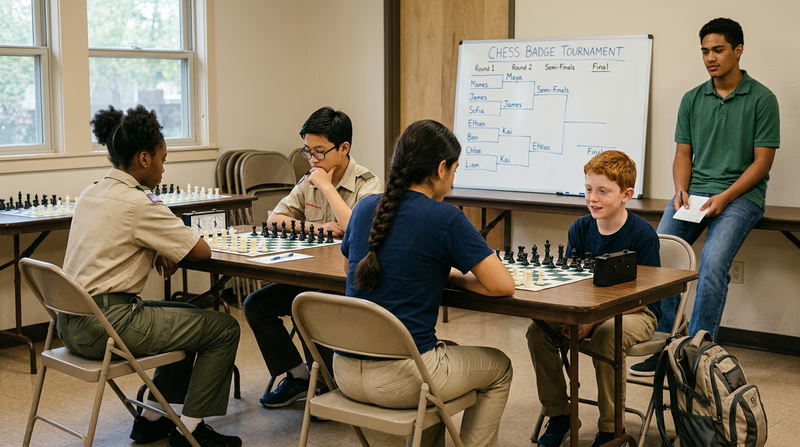
This option takes things to the next level. A real tournament gives you the experience of tournament pairings, time controls, and the atmosphere of competitive play — all concepts you studied in Req 6.
Finding a Tournament
- US Chess Federation: Search for scholastic events on the USCF website. Many areas have regular scholastic tournaments, especially on weekends during the school year.
- Chess clubs: Local chess clubs often host informal or rated events.
- School chess programs: Many schools and after-school programs organize tournaments.
Tournament Day Tips
Tournament Preparation
Be ready for your first tournament
- Bring your own chess set and clock (many tournaments require this).
- Bring score sheets and a pen — at least two pens in case one dies.
- Arrive early to check in, find your board, and settle in.
- Eat a good meal beforehand — tournaments can be long, and mental energy requires fuel.
- Bring water and a quiet snack for between rounds.
- Review the tournament rules (time control, number of rounds) before Round 1.
Option C: Organize a Tournament
This option develops leadership and organizational skills. You are not just a player — you are the tournament director.
Planning Your Tournament
Step 1: Choose a format. With 4–5 players, a round robin works perfectly — everyone plays everyone. With more players, consider a Swiss system with 3–4 rounds (see Req 6 for details on both formats).
Step 2: Set the time control. For a casual tournament, G/15 (15 minutes per player) or G/30 (30 minutes per player) works well. Shorter is better for keeping things moving; longer gives more time for recorded games.
Step 3: Gather equipment. You need at least enough boards and sets for half the players to play simultaneously. Chess clocks are ideal but not strictly required for casual events.
Step 4: Create a schedule. For a 5-player round robin, you need 4 rounds with 2 games each round (one player gets a bye each round). Write out the pairings in advance using a Berger table.
Step 5: Prepare score sheets. Print or create simple score sheets for recording moves (even if recording is optional).
Running the Tournament
Tournament Director Duties
What the TD does each round
- Post pairings and color assignments for the round.
- Start all clocks simultaneously (or call “begin” if no clocks).
- Enforce touch-move and time rules if disputes arise.
- Record results after each game (win, loss, or draw for each player).
- Calculate and post updated standings after each round.
- Award prizes or recognition at the end.
Sample 5-Player Round Robin Schedule
| Round | Board 1 | Board 2 | Bye |
|---|---|---|---|
| 1 | Player 1 vs. Player 5 | Player 2 vs. Player 4 | Player 3 |
| 2 | Player 5 vs. Player 3 | Player 4 vs. Player 1 | Player 2 |
| 3 | Player 2 vs. Player 5 | Player 3 vs. Player 4 | Player 1 |
| 4 | Player 5 vs. Player 4 | Player 1 vs. Player 3 | Player 2 |
| 5 | Player 3 vs. Player 2 | Player 4 vs. Player 5 | Player 1 |
Game Review: The Most Important Step
Whichever option you choose, the review with your counselor is where the deepest learning happens. Do not just replay the moves — tell the story of each game:
- What was your plan?
- Where did things go right or wrong?
- What opening principles or tactical patterns from this guide showed up in your games?
- What would you do differently next time?
Congratulations — you have covered every requirement for the Chess merit badge. But the game does not stop here.