Req 1 — Key Terms
This requirement is your foundation. Before you dive into the rest of the badge, you need to understand the language — the key terms that will come up again and again. These are not just vocabulary words for a test. They are ideas that shape how people treat each other every single day.
Take your time with each term. Think about what it means in your own life, and especially think about how it connects to the Scout Oath and Scout Law. Your counselor wants to hear your understanding, not a dictionary definition.
Identities
Your identity is the collection of traits, beliefs, and characteristics that make you you. Some parts of your identity you were born with — your race, your ethnicity, where you grew up. Other parts you choose — your hobbies, your values, your goals. And some parts, like your religious beliefs or cultural traditions, may be shaped by your family.
Everyone has multiple identities at the same time. You might be a Scout, a soccer player, a big sister, a person of faith, and a math whiz — all at once. Understanding that every person carries this kind of complexity helps you see them as a full human being, not just one label.
Diversity
Diversity means variety. A diverse group includes people with different backgrounds, experiences, perspectives, abilities, and identities. Think of your Scout troop, your school, or your neighborhood — the more different kinds of people who are part of it, the more diverse it is.
Diversity is not just about what people look like. It also includes differences in how people think, what they believe, where they come from, what languages they speak, and what challenges they have faced.
Scout Law connection: A Scout is Friendly — a friend to all, regardless of differences.
Equality
Equality means giving everyone the same thing. Same rules, same opportunities, same treatment. It sounds simple, and in many cases it is the right approach. Everyone deserves the same basic rights and protections.
But equality alone does not always create fairness — which is where the next term comes in.
Equity
Equity means giving people what they need to have a fair chance. Because people start from different places and face different challenges, treating everyone exactly the same can sometimes leave some people behind.
Here is a simple example: imagine three Scouts trying to see over a fence. One is tall, one is average height, and one uses a wheelchair. Giving them each the same stepstool (equality) helps the first two but not the third. Equity means providing a ramp so all three can see the game.
Inclusion
Inclusion means making sure everyone feels welcome, respected, and valued — not just present. You can invite someone to the table (that is diversity), but inclusion means making sure they feel comfortable speaking up and that their voice actually matters.
Scout Law connection: A Scout is Kind and Courteous — you treat others with respect and make them feel like they belong.
Discrimination
Discrimination means treating someone unfairly because of who they are — their race, gender, religion, disability, or any other part of their identity. It can be obvious (like refusing to let someone join a team) or subtle (like always ignoring someone’s ideas in a group project).
Discrimination is the opposite of the Scout Law. A Scout is Fair, Friendly, and Kind.
Ethical Leadership
Ethical leadership means doing the right thing even when it is hard, unpopular, or costly. An ethical leader makes decisions based on values — honesty, fairness, compassion — not just on what is easy or what benefits them personally.
The Scout Oath says “On my honor I will do my best to do my duty.” That word honor is at the heart of ethical leadership. It means your word matters and your actions match your values.
Upstander
An upstander is someone who speaks up or takes action when they see something wrong. The opposite of an upstander is a bystander — someone who sees a problem but does nothing. Choosing to be an upstander takes courage, but it is one of the most powerful things you can do.
You do not have to confront a bully head-on to be an upstander. Sometimes being an upstander means comforting the person who was hurt, reporting the situation to an adult, or simply refusing to laugh along.
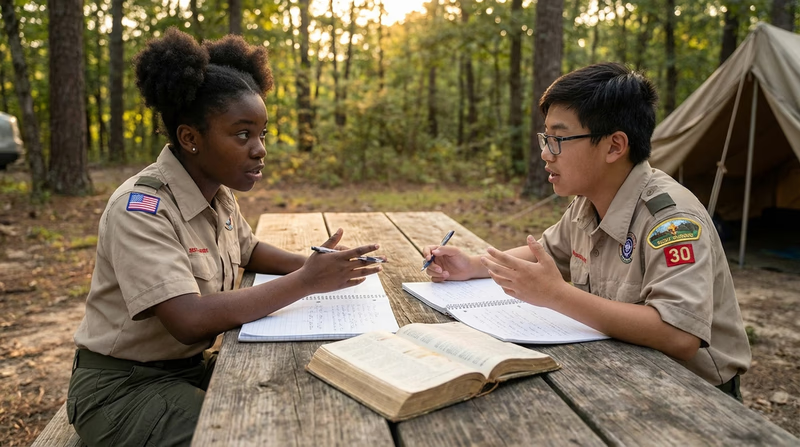
Connecting the Terms to the Scout Oath and Scout Law
Your counselor will want to hear how you connect these terms to Scouting. There is no single right answer, but here are some connections to think about:
Terms & the Scout Law
Think about which points of the Scout Law each term connects to
- Identities: A Scout is Friendly — to all kinds of people, not just those who are similar.
- Diversity: A Scout is Courteous — treating everyone with respect regardless of background.
- Equality: A Scout is Fair — giving everyone the same basic rights and dignity.
- Equity: A Scout is Helpful — recognizing when someone needs extra support.
- Inclusion: A Scout is Kind — making people feel they truly belong.
- Discrimination: A Scout is Brave — standing against unfair treatment.
- Ethical Leadership: A Scout is Trustworthy — doing the right thing even when it is hard.
- Upstander: A Scout is Brave — taking action when you see injustice.
These eight terms are the building blocks for everything that follows in this badge. You will see them again and again as you work through the requirements. Make sure you are comfortable with each one before moving on.