Req 4 — Responding to Scenarios
This is where your understanding of ethical leadership and being an upstander gets put to the test. The requirement gives you three real-world scenarios — situations that could actually happen in your life. You will choose two of the three to discuss with your counselor.
Before you dive into the scenarios, make sure you can recite the Scout Oath and Scout Law from memory. Your counselor will ask you to repeat them, because these words are the foundation for how you should respond.
How to Approach These Scenarios
There are no “trick answers” here. Your counselor is not looking for a single perfect response. They want to see that you can think through a situation, consider how the people involved might feel, and describe actions you could take as a leader.
For each scenario you choose, think through this framework:
- What happened? Identify the specific harmful behavior.
- Who is affected? Think about all the people involved — the person being hurt, the person doing the hurting, and the bystanders.
- What are your options? List several things you could do.
- What would you do, and why? Pick the action that best aligns with the Scout Oath and Scout Law.
- What might happen next? Think about the possible outcomes of your action.
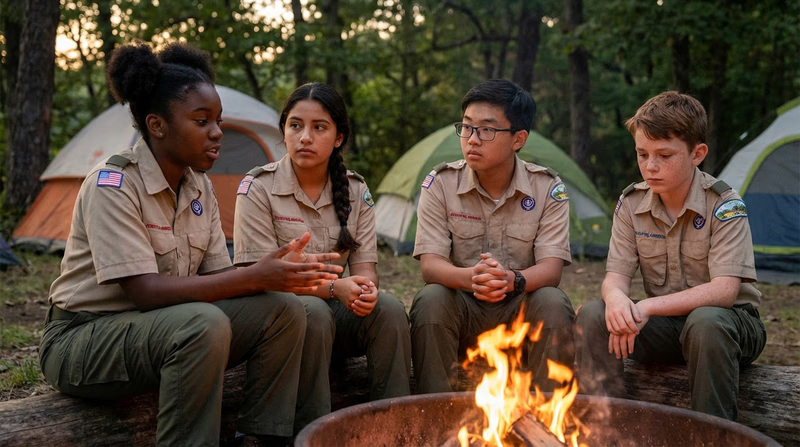
Scenario 1: Offensive Language at Camp
In this scenario, an accident (spilled food) triggers an angry, hurtful response — language that is offensive to people with disabilities. The bystanders laugh, which reinforces the behavior.
Think about what is really happening here: one person is embarrassed, another is angry, and the group is making things worse by laughing.
Things to consider:
- How does using disability-related language as an insult affect people with disabilities — even if none are present?
- What is the role of the bystanders who laughed? Are they part of the problem?
- What could you say in the moment? What could you do after the moment?
- Who at camp (adult leaders, camp staff) should be made aware?
Scenario 2: Cyberbullying and Impersonation
This scenario involves two layers of harm: insulting comments about someone’s identity and creating a fake social media account to impersonate them. This is cyberbullying, and in many places it is also illegal.
Things to consider:
- Your friend trusted you with this information. How do you honor that trust while also making sure they get help?
- What is the difference between handling this yourself and getting an adult involved?
- What steps can be taken to get the fake account removed?
- How can you support your friend emotionally while the situation is being resolved?
Scenario 3: Xenophobia and Exclusion
In this scenario, a new student is being targeted because of their national origin. The comments about their speech, clothes, and the phrase “go back home where you came from” are examples of xenophobia — fear or hostility toward people from other countries.
Things to consider:
- These are your friends saying these things. That makes it harder to speak up — but also more important.
- How could you make the new student feel welcome, both in the moment and going forward?
- What does the Scout Law say about how we treat people who are different from us?
- Is there a way to help your friends understand why their comments are harmful, without destroying the friendship?
Connecting to the Scout Oath and Scout Law
As you prepare your responses, look for specific connections to the Scout Oath and Scout Law. Here are some examples:
- Trustworthy: You can be trusted to do the right thing even when no one is watching.
- Helpful: You help others, especially those who are being targeted.
- Friendly: You are a friend to all people, not just those who are like you.
- Kind: You treat others with kindness and refuse to participate in cruelty.
- Brave: You have the courage to speak up when it would be easier to stay silent.
- Scout Oath — “To help other people at all times”: This is the core of every response to these scenarios.
You have now thought through real situations where leadership and inclusion matter. These are not hypothetical — they happen every day in schools, camps, and communities across the country.