Extended Learning
A. Introduction
Congratulations — you have worked through every requirement of the Citizenship in the Nation merit badge! You now understand the Constitution, the branches of government, your rights, and how to make your voice heard. But citizenship is not a badge you earn once and put away. It is a lifelong practice, and there is so much more to explore.
B. Deep Dive: How a Supreme Court Case Changes the Country
You have learned that the judicial branch interprets the Constitution. But what does that actually look like in practice? Understanding how a Supreme Court case works helps you see how nine justices can shape the lives of hundreds of millions of people.
A case reaches the Supreme Court when someone believes a law or government action violates the Constitution. The Court receives about 7,000 requests per year but agrees to hear only about 70–80 cases. These are usually cases where lower courts have disagreed or where a major constitutional question needs to be settled.
Once a case is accepted, both sides submit written arguments called “briefs.” Then the justices hear oral arguments — typically 30 minutes per side — where lawyers answer tough questions from the bench. After that, the justices discuss the case privately, take a vote, and the majority writes an opinion explaining their decision and reasoning. Justices who disagree write “dissenting opinions,” which sometimes become the basis for future changes in the law.
Some cases that have shaped modern America:
- Brown v. Board of Education (1954) — Declared racial segregation in public schools unconstitutional, overturning the “separate but equal” doctrine.
- Miranda v. Arizona (1966) — Required police to inform suspects of their rights before questioning (the “Miranda warning” you hear on TV shows).
- Tinker v. Des Moines (1969) — Ruled that students do not lose their First Amendment rights at the schoolhouse door. This case involved students wearing black armbands to protest the Vietnam War.
- New Jersey v. T.L.O. (1985) — Established the rules for when school officials can search a student’s belongings — balancing student privacy against school safety.
C. Deep Dive: The Amendment Process
The Constitution has been amended only 27 times in over 230 years. That is by design — the founders made the process deliberately difficult so that the Constitution could not be changed on a whim. Understanding the amendment process reveals just how significant each change to the Constitution really is.
There are two ways to propose an amendment:
- Congress proposes it. Two-thirds of both the House and the Senate must vote in favor of the proposed amendment. This is how all 27 existing amendments were proposed.
- A national convention. Two-thirds of state legislatures can call a constitutional convention to propose amendments. This method has never been used — though it has come close several times.
Once proposed, an amendment must be ratified (approved) by three-fourths of the state legislatures (38 out of 50 states). This high bar means that any successful amendment must have broad, nationwide support.
Some of the most important amendments beyond the Bill of Rights include:
- 13th Amendment (1865) — Abolished slavery throughout the United States.
- 15th Amendment (1870) — Prohibited denying the right to vote based on race.
- 19th Amendment (1920) — Guaranteed women the right to vote.
- 22nd Amendment (1951) — Limited the President to two terms in office.
- 26th Amendment (1971) — Lowered the voting age from 21 to 18.
The amendment process shows that the Constitution is a living document — designed to grow and improve as the nation’s understanding of justice and equality evolves. Each amendment represents a moment when the country decided to hold itself to a higher standard.
D. Deep Dive: How Elections Work
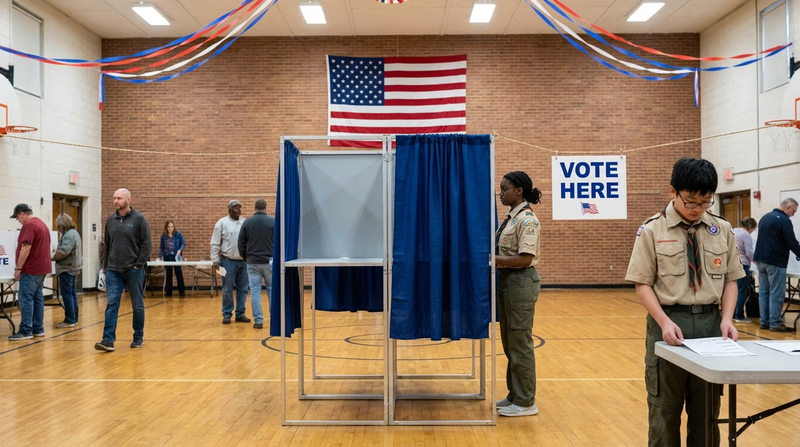
Voting is the most direct way citizens participate in their government, and understanding how elections work prepares you for the day you turn 18 and can cast your first ballot.
Primary elections are held to narrow down the candidates from each political party. Depending on your state, primaries may be “open” (any registered voter can participate) or “closed” (only registered party members can vote). Some states use caucuses instead of primaries — community meetings where voters publicly show their support for a candidate.
General elections are held on the first Tuesday after the first Monday in November. Congressional elections happen every two years (all House seats and one-third of Senate seats). Presidential elections happen every four years.
The President is not elected directly by popular vote. Instead, the Electoral College system gives each state a number of electors equal to its total congressional representation (House members + 2 senators). In most states, the candidate who wins the popular vote in that state receives all of its electoral votes. A candidate needs 270 out of 538 electoral votes to win the presidency.
You may not be old enough to vote yet, but you can still participate. Many states allow 16- and 17-year-olds to pre-register to vote. You can volunteer for campaigns, help with voter registration drives, and attend candidate forums and debates. These activities build the habits of participation that will last a lifetime.
E. Real-World Experiences
Ready to go beyond the badge? These experiences bring national citizenship to life.
Visit Washington, D.C.
Attend a Naturalization Ceremony
Visit Your State Capitol During a Legislative Session
Join a Mock Trial or Model Congress
Participate in a Citizenship Day Event
F. Organizations
These organizations offer resources, programs, and opportunities for young citizens who want to stay engaged.
An interactive museum in Philadelphia dedicated to the U.S. Constitution, with extensive online resources and educational programs for students.
Founded by Justice Sandra Day O’Connor, iCivics provides free games, lesson plans, and resources that teach students how government works through interactive experiences.
Provides educational resources about the Constitution and the Bill of Rights, including primary sources, videos, and lesson plans for students and educators.
Runs civic education programs that bring students to Washington, D.C. to experience government firsthand, including Capitol Hill visits and discussions with policymakers.
Free educational resources built around C-SPAN’s coverage of Congress, the White House, and the courts — including video clips, lesson plans, and discussion guides.