Req 1 — The Constitution
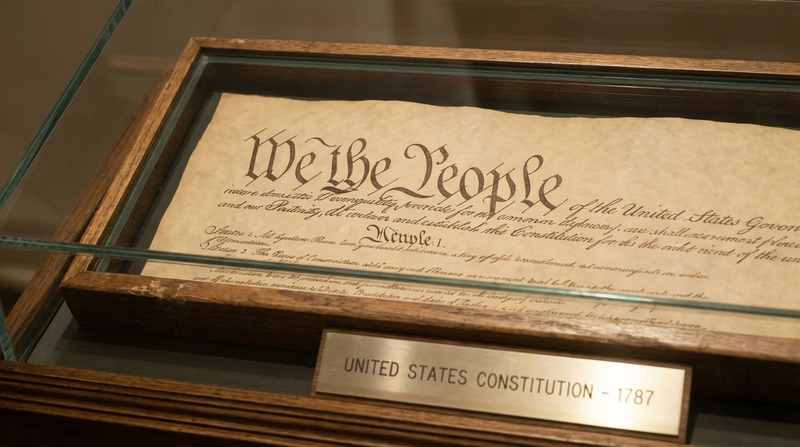
The Constitution of the United States is the supreme law of the land. Written in 1787 and ratified in 1788, it is the document that created the federal government, defined its powers, and set the rules for how the country operates. Every law passed by Congress, every decision made by the President, and every ruling handed down by the courts must follow the Constitution. If a law conflicts with it, that law can be struck down.
Think of the Constitution as the rulebook for the entire country. Just like a game needs rules so everyone plays fairly, a nation needs a constitution so the government treats people fairly and does not grab too much power.
What Does the Constitution Do?
The Constitution does four essential things:
- Creates the government. It establishes three branches — legislative, executive, and judicial — and spells out what each branch can and cannot do.
- Limits the government. It puts boundaries on government power so that no single person or group can become a tyrant.
- Protects individual rights. Through the Bill of Rights and later amendments, it guarantees freedoms like speech, religion, and due process.
- Provides a way to change. The amendment process allows the Constitution to grow and adapt as the nation evolves.
Key Principles
The Constitution reflects several core principles that the founders believed were essential to good government:
Popular Sovereignty — The power of the government comes from the people. The very first words of the Constitution, “We the People,” make this clear. The government does not rule over the people; the people choose the government.
Limited Government — The government can only do what the Constitution says it can do. Powers not specifically given to the federal government are reserved for the states or the people.
Separation of Powers — Government power is divided among three branches so that no single branch can dominate. Each branch has its own job: Congress makes laws, the President enforces laws, and the courts interpret laws.
Checks and Balances — Each branch has ways to limit the others. The President can veto a law passed by Congress. Congress can override that veto. The Supreme Court can declare a law unconstitutional. This system prevents any one branch from becoming too powerful.
Federalism — Power is shared between the national government and the state governments. Some things — like national defense and foreign policy — are handled by the federal government. Others — like education and local law enforcement — are primarily managed by the states.
Why Is It Important to Have a Constitution?
Without a constitution, there would be no agreed-upon rules for how the government should work. Leaders could make decisions without accountability. Citizens would have no guaranteed rights. Disputes between states, or between citizens and the government, would have no clear process for resolution.
The Constitution matters because it holds everyone — including the most powerful people in the country — to the same set of rules. It is the reason a President cannot simply declare themselves ruler for life. It is the reason you can criticize the government without going to jail. It is the reason every person accused of a crime gets a fair trial.
Explore More
National Constitution Center — Interactive Constitution Read the full text of the Constitution with expert analysis and commentary on every section and amendment. National Archives — The Constitution See the original document, learn its history, and explore the stories behind its creation.